

Measure in mm: Convert US and EU Sizes With ISO Guidance for Online Shoppers

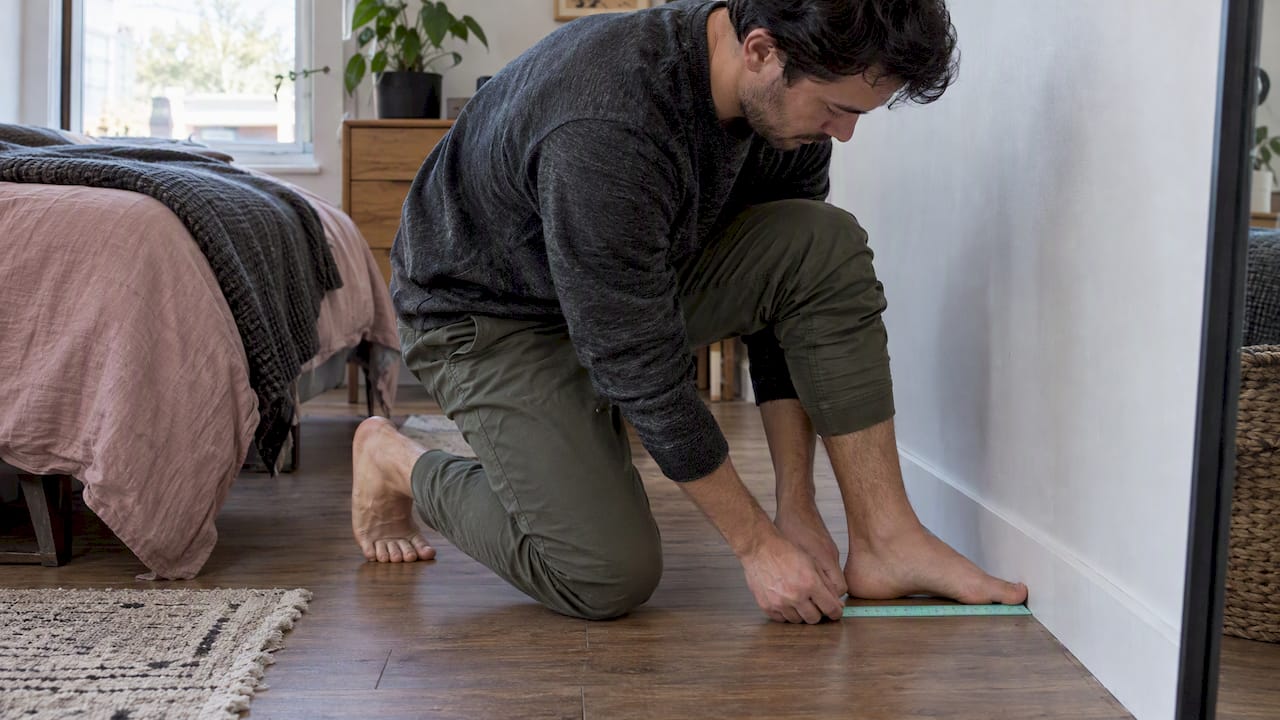
Use your body or foot measurements, in inches or millimeters, together with the conversion tables below as your starting point: numeric US and EU sizes are only approximate. For shoes, foot length (the basis of Mondopoint sizing) is the most reliable measure, while clothing numbers shift from one brand to the next. The tables that follow turn those measurements into usable US and EU equivalents.
TL;DR:
- For women, EU labels run roughly 32 points above US numbers, while men’s jacket sizes track chest circumference in centimeters; treat both as estimates.
- Measure both feet in millimeters, choose the larger measurement, and shop late in the day; leave 10 to 12 millimeters beyond the longest toe.
- Size labels lack legal definitions, and voluntary ASTM and ISO references do not bind manufacturers, so a labeled size can fit differently across brands.
- When measurements fall between sizes, choose larger for structured fabric and smaller for stretch fabric, then verify the garment’s own chart and return policy.
Table of Contents
- Clothing conversion charts for women, men, and children
- Shoe size conversion and why Mondopoint beats guesswork
- How to measure yourself before you order
- Why sizes differ across brands and countries
- Smart habits for shopping across US and EU sizes
- How we help you avoid a sizing mistake
- Where the conversion-chart habit falls short
- FAQ
- Sources
Clothing conversion charts for women, men, and children
Clothing sizes are a rough mapping between a body measurement and a label, so the chart is only as good as the measurement behind it. For women, EU sizes run roughly 32 points above the US number; for men, EU jacket and suit sizes track chest circumference in centimeters rather than the US chest-inch label.
| US Women’s Size | EU Size | Bust (inches) |
|---|---|---|
| 4 | 34 | approximately 33 |
| 6 | 36 | approximately 34 |
| 8 | 38 | approximately 35.5 |
| 10 | 40 | approximately 37 |
| 12 | 42 | approximately 38.5 |
| 14 | 44 | approximately 40 |
| US Men’s Size | EU Size | Chest (inches) |
|---|---|---|
| 36 (S) | 46 | approximately 36 |
| 38 (M) | 48 | approximately 38 |
| 40 (M/L) | 50 | approximately 40 |
| 42 (L) | 52 | approximately 42 |
| 44 (XL) | 54 | approximately 44 |
| 46 (XXL) | 56 | approximately 46 |
Each garment category leans on a different measurement, and knowing which one matters saves a return:
- Dresses, tops, and jackets key off bust or chest circumference, measured around the fullest point.
- Pants and skirts key off waist and hip circumference, measured at the natural waistline and the widest hip point.
- Children’s sizing often runs by height and age rather than circumference, so check both when a chart offers them.
Letter sizes (S/M/L) are even looser than numeric ones because there is no shared definition of what “medium” means across brands. A US medium top and a European medium can differ by two inches of chest room, a gap that vanity sizing has widened further as US brands have crept labels upward over the decades. Our sizing guide for fashion and motorcycle fit walks through how to read these labels against your own measurements.
How to measure yourself before you order
Getting a tape measure and five minutes of patience right up front beats returning the wrong size twice.
- Stand straight in light clothing and use a flexible fabric tape, not a metal one.
- Measure chest or bust around the fullest point, keeping the tape level and snug but not tight.
- Measure waist at your natural waistline, usually just above the belly button.
- Measure hips around the widest point, feet together.
- For inseam, measure from the crotch seam of well-fitting pants to the hem.
- For shoulders, measure point to point across the back where the shoulder meets the arm.
- For feet, stand on a sheet of paper, trace both feet, and measure each in millimeters from heel to the longest toe; use the larger measurement.
- Write every number down and match it to the garment’s own measurement chart, not just the size label.
Our guide on choosing the right jacket size covers the four dimensions that matter most for outerwear, and the walkthrough on how to measure for a jacket shows exactly where to place the tape.
Pro Tip: Keep your measurements saved in your phone so you can check them against any size chart before checkout, no second-guessing required.
Why sizes differ across brands and countries
Numeric sizes feel official, but very little about them is legally standardized. The FTC’s apparel labeling rules require accurate fiber content, country of origin, and manufacturer identification, but they say nothing about what a size 8 or a size 40 has to measure. That gap is why two US brands can both use “medium” for different chest measurements.
- ASTM D6240 and related tables offer voluntary body-measurement references for adult, junior, and plus-size categories, but no law forces a manufacturer to follow them.
- ISO footwear standards fill a similar role for shoes, offering conversion guidance without binding every shoemaker to one scale.
- Because adoption is optional on both sides of the Atlantic, the same labeled size can fit two different bodies depending on which chart, if any, the brand followed.
Many current US size charts still trace back to anthropometric surveys NIST has flagged as outdated, body data gathered decades ago that no longer reflects the current population, which is part of why labeled sizes and real-world fit keep drifting apart.
Smart habits for shopping across US and EU sizes
A few checks before you add anything to the cart catch most sizing mistakes before they become a return.
- Open the product’s own measurement chart, not just the size label, before choosing a size.
- Check the model’s listed height and size for a sense of scale, when the page provides it.
- Look for fabric content and stretch, since a size with 2% elastane fits differently than a rigid one.
- Confirm the return or exchange policy before you buy, especially for items shipped from overseas.
- When your measurement falls between two sizes, size up for structured fabrics and size down for stretch fabrics.
| Situation | What to trust | Why |
|---|---|---|
| Numeric size vs. body measurement conflict | Your body measurement | Labels vary by brand and country |
| Shoe size vs. foot length in millimeters | Foot length | Mondopoint is based on actual foot size |
| Letter size (S/M/L) across brands | The brand’s own chart | No shared definition of “medium” exists |
Our piece on reading size charts for leather fashion breaks down how to compare garment dimensions instead of trusting the label alone, which matters most with structured pieces like jackets and coats.
How we help you avoid a sizing mistake
We build every product page around a detailed size chart rather than a single label, so you can match your own measurements instead of guessing at what “large” means this time. Our size chart and sizing guide covers jackets, pants, suits, aprons, and chaps with the same measurement-first approach used throughout this article.
- We offer a Customize Jacket Order built to the measurements you provide rather than a fixed numeric size.
- Bespoke options extend to motorcycle suits, varsity jackets, and leather vests, each made to your own chest, waist, and sleeve measurements.
- Measurement walkthroughs on our site mirror the steps in this guide, so the numbers you take at home go straight into your order.
Where the conversion-chart habit falls short
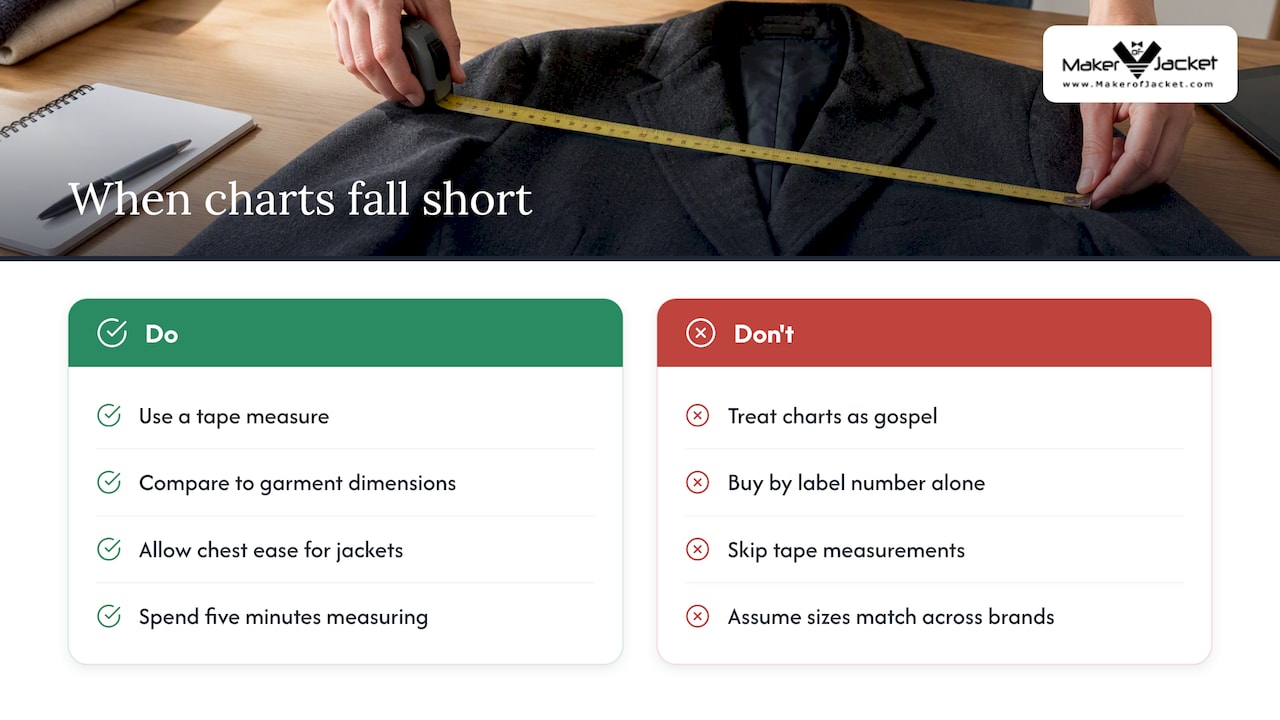
The honest take is that conversion charts get too much credit. They are a reasonable starting point, but treating a US-to-EU chart as gospel is how most international sizing mistakes happen, because the chart assumes every size 40 in Europe was built to the same spec, and it was not. The more reliable habit, backed by how ISO and ASTM actually describe their own tables, is to treat every numeric size as a rough estimate and the garment’s own measurements as the real answer.
Where this matters most is with structured garments like jackets and coats, where a half-inch of chest ease changes how something looks, not just whether it buttons. Shoppers who skip the tape measure and buy on label number alone are gambling on a coin flip between two brands’ interpretations of “medium.” The fix is not another app or algorithm. It is five minutes with a tape measure and a willingness to compare that number to the garment’s actual dimensions rather than its name.
— Maker
FAQ
What are the US pant sizes?
US men’s pants are typically sized by waist and inseam in inches, such as 32×32, while US women’s pants use either numeric sizes or waist measurements in inches. Always check the brand’s own waist measurement chart, since a US size 8 can vary by an inch or more between retailers.
Are European shoe sizes the same as US?
No, European and US shoe sizes use different numbering scales, so a US size 9 men’s shoe is roughly an EU size 42 based on foot length. The ISO 19407 standard provides conversion tables between these systems, but treats them as guidelines rather than exact equivalents.
What size is GG in Brazil?
Brazilian clothing sizing is a distinct national system, and sizing charts for Brazil are not part of the conversions covered by the US and EU standards discussed in this guide. For an accurate match, use the specific body measurements listed on the Brazilian retailer’s own size chart rather than relying on a US or EU label.
What is medium in European size?
A European medium generally corresponds to a US size 8 to 10 for women or a 38 to 40 chest for men, but letter sizes carry no fixed definition across brands. Checking the garment’s own bust, waist, or chest measurement is more reliable than matching the letter alone.
Sources
- ISO 9407:2019 – Footwear sizing — Mondopoint system of sizing and marking
- Apparel labeling — Federal Trade Commission
- Body dimensions for apparel — NIST
- Bunions – OrthoInfo – American Academy of Orthopaedic Surgeons


