

Embossing vs Embroidery on Leather Jackets: How to Choose

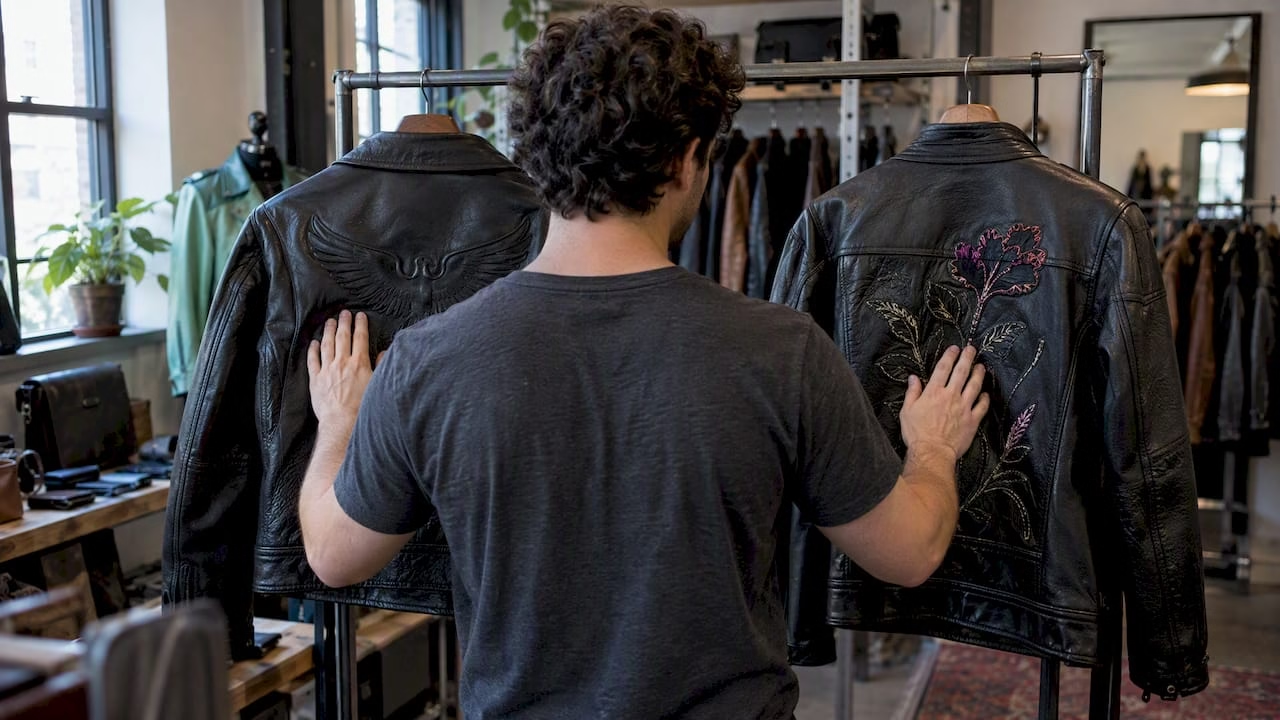
Embossing presses your design into the leather itself. Embroidery stitches thread through it. That one difference decides almost everything else: how the finished jacket looks, how it ages, whether you can undo it, and what can go wrong. For most leather jackets, embossing suits a quiet, tone-on-tone mark, while embroidery (usually on a patch) suits color, detail and bold lettering.
This guide is written for people ordering a custom jacket, biker, bomber or varsity, who want to pick the right finish before they pay. We also cover the chenille-versus-embroidery question, because it comes up the moment you think about a letterman-style jacket.
TL;DR
- Embossing raises or recesses the design in the leather. It is tone-on-tone, subtle and permanent, with no thread and no color.
- Embroidery adds thread color and texture. On leather, every needle hole is permanent, so many shops prefer stitching onto a separate patch.
- Chenille is the thick, looped-yarn style of varsity letters. It suits big, bold shapes. Flat embroidery suits fine detail and small text.
- Embossing needs a one-time metal die. Embroidery is priced by stitch count. Neither is cheap to redo, so approve a proof first.
- Care differs: skip leather oils on embroidered areas, and keep embossed areas away from heat and moisture.
Table of Contents
- What each technique actually does to leather
- Embossing vs embroidery at a glance
- Why leather changes the embroidery question
- How embossing behaves on a jacket
- Chenille vs embroidery patches
- Which should you pick? Match the technique to the jacket
- Our perspective
- Care: how each finish should be treated
- Order your custom jacket with the right finish
- Questions to ask before you approve any design
- FAQ
- Sources
What each technique actually does to leather
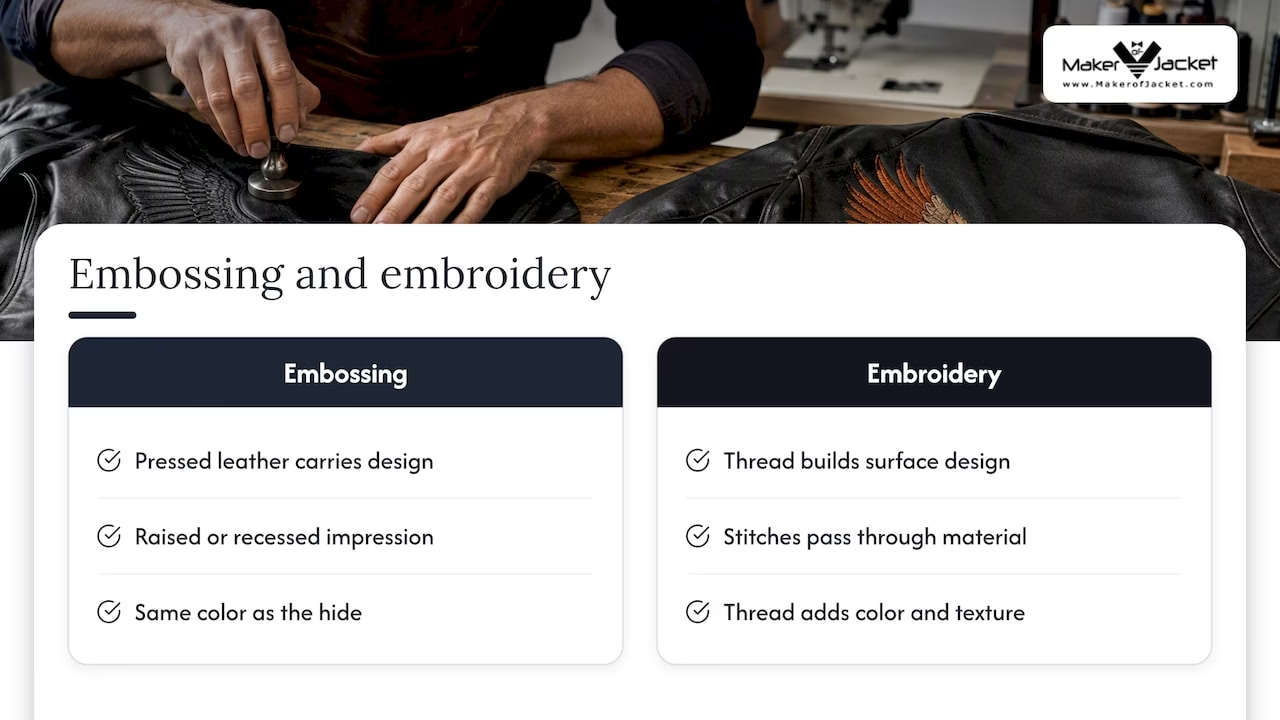
People mix up the vocabulary, so start there. Embossing presses a design so it sits raised above the surface. Debossing, sometimes called blind embossing, presses it down into the leather for a recessed look. Laser engraving is different again: it removes material by burning it. Leatherology’s personalization FAQ describes debossing as pressed into the leather itself, so it does not wear off.
Embroidery works the opposite way. A machine (or a hand needle) passes thread through the material and builds the design on the surface from stitches. DigitEMB’s comparison puts the split simply: embossing lets the material carry the design, embroidery gives you thread texture and color.
A third thing sometimes gets sold as “embossed embroidery.” That is a stitched design built over foam so it stands up from the fabric. It is a textile technique, closer to puffy lettering on a cap than to anything done to the leather itself, and it is not what a leather embosser does.
Embossing vs embroidery at a glance
| Embossing / debossing | Embroidery (direct on leather) | Embroidered or chenille patch | |
|---|---|---|---|
| Look | Tone-on-tone relief, same color as the leather | Colored thread, visible texture | Colored thread, raised or flat |
| Best for | Logos, monograms, crests, simple lines | Detailed art, multiple colors, small text | Team letters, club names, bold marks |
| Detail level | Moderate, limited by how the leather compresses | High | High (embroidery) or low-to-moderate (chenille) |
| Reversible? | No, though it can soften over time | No, needle holes remain | Yes, a patch can be removed |
| Risk to the jacket | Low if done correctly | Highest, leather does not recover from holes | Low to moderate, depends on how it is attached |
| Upfront cost | A die is typically needed | Digitizing and stitch count | Per patch |
| Feel | Smooth, subtle, “built in” | Textured, dimensional | Dimensional, sometimes plush |
Why leather changes the embroidery question
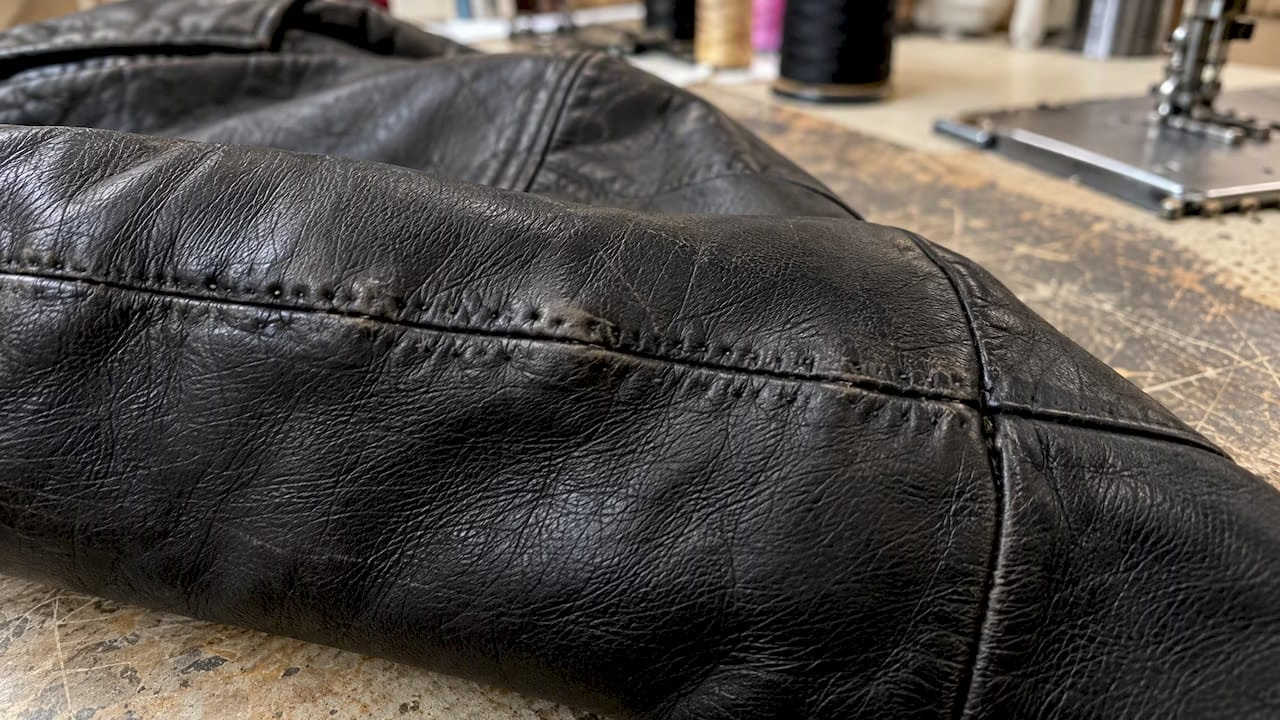
On a cotton hoodie, embroidery is routine. On leather it is a different job. Cloth closes up around a needle hole. Leather does not. A shop that explains this plainly, such as The Yard Collective, notes that leather and suede have no recovery: every hole is permanent, and bad tension or over-stitching can tear or distort the hide. That is why some embroiderers test an item in person first, and why some refuse to stitch on high-value or designer pieces.
It also shows up in pricing. The same shop notes that difficult materials like leather can carry a 50% surcharge over standard embroidery pricing, and that embroidery starts at $35 on customer-provided items. Treat those figures as one shop’s policy, not an industry rate, but they show the direction: leather costs more to stitch and carries more risk.
The practical consequences:
- Dense designs are the danger. A tightly packed fill perforates the leather like a postage stamp and can weaken it. Open, lighter designs are kinder.
- There is no undo. Remove embroidery and the holes stay. A patch can come off. Direct stitching cannot.
- Thickness matters. Thin lambskin puckers more easily than heavier cowhide, and the lining and any stabilizer behind it affect the result.
This is also why gempunch’s guide to embroidery on leather suggests a leather patch if direct embroidery feels too risky: the design is stitched on a separate piece, which is then sewn, riveted or glued onto the garment.
How embossing behaves on a jacket
Embossing is the more traditional leather method. A metal stamping die carries your artwork, etched in reverse, and is pressed into the leather, usually with heat, as McKinley Leather’s personalization page explains. That same source says a die is typically a one-time cost of around $75 at that shop, reusable for later orders without another die charge. Again, one shop’s figure, but the structure is typical: you pay once for the tool, then repeat it.
What that means for your jacket:
- It looks like it belongs. The mark is the same color as the hide, so it reads as craftsmanship rather than decoration. It shows best on smooth, full-grain leather in dark or mid tones, where shadows fall in the recess.
- It struggles on texture. Pebbled, distressed or heavily grained leather hides fine lines. Keep the artwork bold and simple.
- It ages with the jacket. Leatherology says the impression softens and deepens as the leather develops character, which many wearers like.
- It is not a color tool. If your logo is red and white, embossing will not give you red and white. Foil stamping can add color, but that is a separate process.
- Heat and moisture are the enemies. Extreme heat and dampness can flatten an impression over time, according to the care guidance in the National Park Service’s leather appendix.
What about laser engraving?
Engraving gets lumped in with embossing, but it burns material away. Suppliers warn that on chrome-tanned or coated leathers it can release toxic gases and scorch the surface, a point made in NUPUGOO’s embossing-versus-engraving explainer. We wrote our own piece on why you should demand a test before laser engraving. If a seller will not test on a scrap of your leather first, walk away.
Chenille vs embroidery patches
If you are searching this because you want a varsity or letterman look, the real choice is often not embossing at all. It is chenille against flat embroidery.
Chenille patches are made with thick, looped yarn that gives a plush, velvety surface. That is the classic varsity letter. It works for big letters and bold shapes, and it adds real bulk.
Flat embroidery uses fine thread in satin or fill stitches. It handles small text, thin lines, gradients of color and intricate logos far better than chenille can.
A quick way to decide:
- Is the design mostly one large letter or number? Chenille.
- Does it have small text, thin lines or many colors? Embroidery.
- Do you want both? Many designs combine them: a chenille letter with an embroidered outline or name. It is the standard varsity approach.
- Is it going on a leather body or sleeves? Put it on a patch rather than stitching densely through the hide. A patch can be replaced if your team, club or plans change.
We sell patches on their own, too: a Customize Patch Order is $5 on our custom order page.
Which should you pick? Match the technique to the jacket
| Jacket | Our usual suggestion | Why |
|---|---|---|
| Classic biker jacket | Embossed crest or small mark on the back or chest; embroidered patch for club names | Subtle mark keeps the clean line, a patch carries color |
| Varsity jacket | Chenille letter plus embroidered detail on a patch | Traditional look, bold and readable |
| Bomber jacket | Embroidered patch on sleeve or chest | Bomber culture is patch-driven |
| Suede jacket | Patch rather than direct stitching or deep embossing | Suede shows damage easily |
| Motorcycle suit or gear | Patches or panels, planned with the build | Fit and protection come first |
| Trench coat | Small tone-on-tone embossing or a discreet monogram | Understated style |
Then run these checks:
- What do you want the mark to say? Quiet signature means embossing. Loud identity means embroidery.
- How many colors? More than one or two points away from embossing.
- Will you change it? If yes, use a patch.
- What is the leather? Smooth and thick tolerates both. Thin, pebbled or suede leans toward patches.
- How long will you keep it? A mark that is part of the hide can feel more at home on a jacket you plan to keep for decades.
The question of which one feels “higher-end” comes up constantly in forum threads. There is no universal answer, but there is a pattern: tone-on-tone embossing reads as understated and luxury-adjacent, while embroidery reads as expressive and personal. Neither is better. Pick the message you want.
Our perspective
We make custom leather jackets, and the most common regret we hear about is not the wrong color. It is a mark that cannot be taken back. Because leather has no memory for needle holes, we treat direct stitching as the choice to make last, not first. A patch gives you the embroidery look with an exit.
When someone asks us for something subtle on a biker or trench jacket, we point to embossing. When they want a team, club or crew identity, we point to patches in embroidery or chenille. When the leather is thin or suede, we suggest keeping the artwork simple and the application gentle.
Our site is built around this process: you choose a style, tell us your size and preferences, and we handcraft the piece with premium-grade materials. If you are still deciding, read our guides on how leather embossing works and leather jacket embroidery for custom styles before you commit.
— Maker
Care: how each finish should be treated
Leather care is where many good custom jobs get quietly ruined.
Embroidered leather. Avoid leather dressings and oils on or around the stitching. According to the National Park Service’s Conserve O Gram on leather dressings, dressings are made of animal fats, oils and waxes, and they can cause problems on leather over time. The research we reviewed adds that oils can collect around thread, attract dust and lead to fatty acid spew, a waxy white buildup. Once leather is oiled, the oil is nearly impossible to remove fully, which can complicate repairs later.
Embossed leather. Keep it clean and dry, and keep it away from radiators, car dashboards and prolonged damp. Heat and moisture can soften and flatten the impression.
Patches. Check the attachment from time to time. If a patch is sewn on, look at the thread. If it is glued or riveted, check the edges.
For a wider view on how the leather itself affects durability, see our guide to which leather jacket materials last longest.
Order your custom jacket with the right finish
If you are ready to turn this into a real jacket, our custom order page lists the made-to-order range. Current published prices include:
- Custom Biker Jacket: 249 USD
- Customize Varsity Jacket Order: 249 USD
- Custom Bomber Jacket: 249 USD
- Custom Suede Leather Jacket: 299 USD
- Customize Motorcycle Jacket Order: 299 USD
- Customize Patch Order: 5 USD
Tell us which finish you want, and we will guide you on what suits the leather you choose. Worldwide free shipping applies, and our support team is available 24/5. If you ride, our custom motorcycle jackets range is the place to start.
Questions to ask before you approve any design
Whoever does the work, ask these first:
- Can I see a proof or a test on scrap leather? Essential for embossing and engraving.
- Is this a direct stitch or a patch? Direct stitching is permanent.
- What is the stitch density? Lower density is safer on leather.
- What is the leather type and thickness? It affects every technique.
- What is the cost structure? Embossing may involve a die. Embroidery is typically priced by stitch count, as shops such as Silva Way’s embroidery price list show, with charges that rise for specialty threads.
- Can I change it later? Only a patch can be removed.
For the broader process, our step-by-step jacket customization guide walks through the order from first idea to delivery.
FAQ
Is embossing better than embroidery on leather?
Neither is better in general. Embossing is safer for the leather and gives a subtle, built-in look, while embroidery gives color and detail. For most leather jackets, embossing works for a quiet mark and an embroidered patch works for anything colorful.
What are the disadvantages of embossing?
It is tone-on-tone, so you cannot get color from it, and fine detail can get lost on textured leather. It usually needs a metal die made for your artwork, and heat and moisture can flatten the impression over time. It also cannot be removed once done.
Is it better to engrave or emboss leather?
For most jackets, embossing is the safer choice. Laser engraving burns material away and can scorch or release fumes on chrome-tanned or coated leathers. If anyone offers engraving, ask for a test on a scrap first.
Can you embroider directly on a leather jacket?
Yes, but it is the riskiest option, since each needle hole is permanent and dense stitching can tear or distort the hide. A patch sewn, riveted or glued on is safer and can be replaced later. A professional should assess the specific leather before stitching.
What is the difference between chenille and embroidery patches?
Chenille uses thick looped yarn for a plush, bold, varsity-letter look. Embroidery uses fine thread, so it carries small text and detailed logos better. Many jackets use both on one patch.
Sources
- Leatherology: Personalization FAQ
- DigitEMB: Embossed vs Embroidered
- The Yard Collective: Embroidery on customer-provided items
- Gempunch: Embroidery on Leather
- McKinley Leather: Custom personalization
- NUPUGOO: Leather Engraving vs Embossing
- National Park Service: Curatorial Care of Leather and Skin Products
- National Park Service: Conserve O Gram on leather dressings
- Silva Way: 2025 embroidery price list


