

How accessories elevate jackets for personal expression


TL;DR:
- Accessories transform jackets into personalized and expressive fashion statements.
- Following principles like the Rule of Three ensures balanced and cohesive styling.
- Restraint and story-driven choices create lasting, memorable jacket looks.
Two people can wear the exact same leather jacket and look like they belong in completely different worlds. That’s not magic. That’s accessories at work. A jacket is your canvas, and the pieces you add around it — scarves, patches, pins, belts, boots — are what make the painting yours. Accessories enhance jackets by adding functionality, personality, texture, and balance to outfits in ways that no single garment ever could. Whether you’re a fashion enthusiast chasing the perfect layered look or a rider who wants your jacket to tell your story, this guide gives you the practical tools to do exactly that.
Table of Contents
- Why accessories matter: Transforming jackets from functional to expressive
- Core principles of jacket accessorizing: Rules for balance, texture, and personality
- Styling for fashion-conscious individuals: Outfit scenarios, trends, and expert dos & don’ts
- Motorcycle jackets and accessories: Expression, culture, and functional mastery
- Expert nuances: Avoiding over-accessorizing and tailoring for seasons, proportions, and occasions
- What most people miss: Why restraint and story-driven accessories lead to lasting style
- Take your jacket style further: Customization and accessory inspiration
- Frequently asked questions
Key Takeaways
| Point | Details |
|---|---|
| Accessories shape expression | Choosing the right accessories turns any jacket into a statement of your style and personality. |
| Balance and restraint matter | Limiting accessories prevents visual clutter and gives your jacket’s details room to shine. |
| Respect culture and context | Always follow placement and meaning rules for motorcycle patches, and adapt your accessory choices to occasion and season. |
| Personal stories stand out | Use custom patches or meaningful jewelry to symbolize achievements or interests and connect your jacket to your identity. |
| Seasonal flexibility | Scarves, gloves, hats, and bags help jackets stay relevant and stylish year-round. |
Why accessories matter: Transforming jackets from functional to expressive
A jacket without accessories is like a sentence without punctuation. Technically present, but missing something essential. When you strip back any iconic look — James Dean’s rebel aesthetic, a seasoned biker’s road-worn vest, or a fashion editor’s polished trench — you’ll notice it’s rarely the jacket alone doing the heavy lifting. It’s the layers beneath it, the hardware glinting at the wrist, the patch sewn above the chest pocket.
Accessories add personality, functionality, texture, and balance to basic jacket outfits. This isn’t just style advice. It’s a design principle. The right accessory shifts visual weight, draws the eye, and signals who you are before you open your mouth.
Here’s what accessories genuinely do for a jacket:
- Personality: A stark black biker jacket becomes yours the moment you add a hand-stitched patch or a silver skull ring.
- Functionality: Scarves add warmth without bulk. Crossbody bags keep gear accessible. Gloves protect while completing the aesthetic.
- Texture: Mixing a matte suede jacket with a silk scarf or a rough canvas bag against smooth leather creates visual contrast that makes an outfit feel intentional.
- Balance: A heavily embellished jacket needs minimal accessories. A clean bomber invites more expressive additions.
Think of personalizing jackets with accessories as editing rather than adding. Great style is curated. You’re not piling things on — you’re choosing what belongs.
“Style is not about being noticed. It’s about being remembered.” This idea drives every smart accessory choice: the goal is coherence, not spectacle.
Accessories also speak to the cultural role jackets in fashion have always played. From military surplus to punk rebellion to high-end runways, jackets serve as identity markers. Accessories amplify that identity, giving you creative control over exactly what message you send.
With the stage set for the role accessories play, let’s break down the core principles that guide successful jacket accessorizing.
Core principles of jacket accessorizing: Rules for balance, texture, and personality
Knowing why accessories matter, next are the frameworks that help anyone accessorize jackets confidently. Style experts recommend the Rule of Three, balanced proportions, color coordination, and focal point enhancement as the foundation of smart accessorizing.
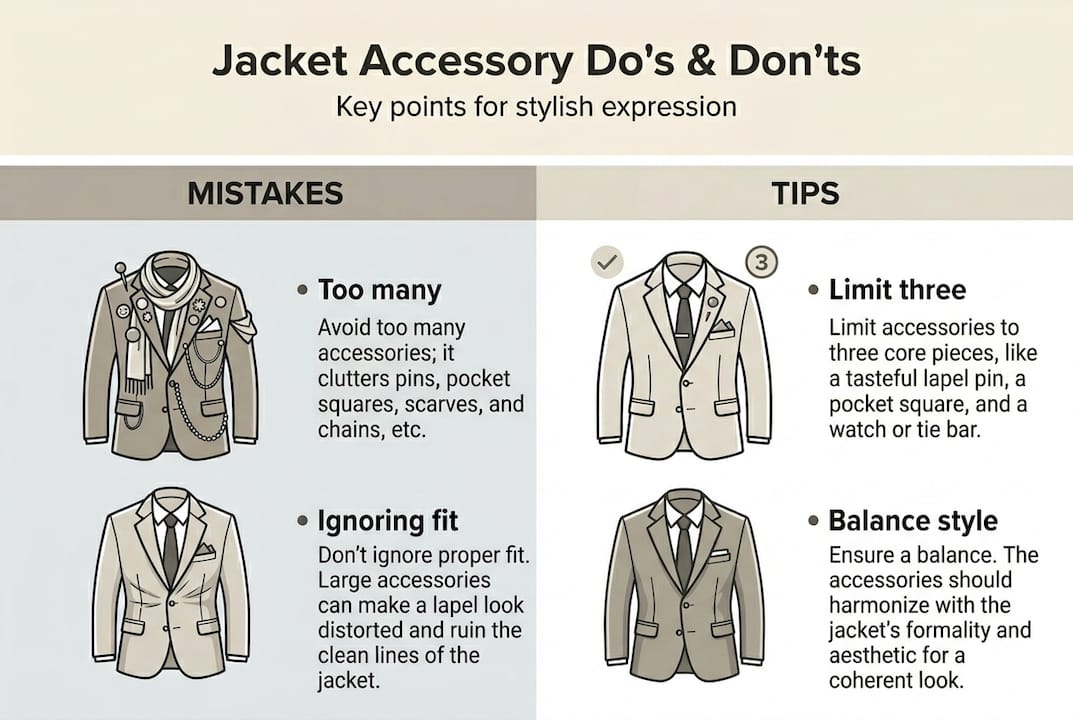
The Rule of Three is simple: limit hard accessories (watches, rings, bracelets, belt buckles) to three at a time. More than that and you start competing with yourself.
Here’s a quick comparison of common accessorizing approaches:
| Approach | Result | Best for |
|---|---|---|
| Rule of Three | Balanced, intentional | Any jacket style |
| Maximalist stacking | Bold but risky | Statement casual looks |
| Minimalist (one piece) | Clean, refined | Formal or tailored jackets |
| Mismatched metals | Chaotic feel | Usually to avoid |
How to apply these principles step by step:
- Start with your jacket’s complexity. Heavily detailed jackets (embroidery, patches, unusual cuts) need simpler accessories. Clean jackets welcome bolder choices.
- Coordinate your metals. If your jacket has silver zippers, lean toward silver-toned jewelry and hardware. Gold on gold. Don’t mix unless it’s intentional.
- Harmonize fabrics. Leather pairs well with metal, canvas, and silk. Suede works with wool and cotton. Mixing too many textures muddies the look.
- Identify your focal point. Choose one area — collar, wrist, waist — and let your accessories reinforce it without crowding other zones.
Pro Tip: Before leaving the house, put on everything you planned and then remove one item. Nine times out of ten, the look gets stronger.
Exploring the golden rules for accessorizing can help you refine these instincts further. And once you understand the framework, following proven jacket styling tips makes the whole process faster and more intuitive. You’ll find that the rules aren’t limiting — they’re liberating, because they take guesswork off the table.
Different types of fashion jackets also call for different accessory approaches. A bomber invites casual stacking. A trench rewards classic restraint. Knowing your jacket type is half the battle.

Styling for fashion-conscious individuals: Outfit scenarios, trends, and expert dos & don’ts
Now that the fundamental rules are clear, let’s explore how fashion enthusiasts apply these principles day-to-day. Fashion guides advise layering scarves for texture, matching leather accessories, and using jewelry to create distinct vibes — whether rock, casual, or polished.
Here’s how accessories map to common jacket scenarios:
| Jacket type | Vibe | Key accessories |
|---|---|---|
| Leather biker | Rock/edgy | Silver rings, chain belt, ankle boots |
| Bomber | Casual/sporty | Snapback, clean sneakers, minimal watch |
| Trench coat | Polished/formal | Silk scarf, leather gloves, structured bag |
| Varsity | Retro/playful | Chunky socks, crossbody bag, pins |
What actually works in practice:
- Layering a lightweight scarf under a leather jacket adds depth, especially in transitional seasons when you need style without bulk.
- A simple analog watch in matching metal to your jacket’s zippers ties the look together without effort.
- Chelsea boots or combat boots under any jacket instantly communicate attitude and anchor the outfit visually.
- Bold jewelry — stacked rings, a statement necklace — works best on plain jackets where the garment isn’t competing.
Pro Tip: If you’re building a rock-inspired look, don’t match every element perfectly. Slight imperfection — a slightly worn belt, mismatched stud sizes — adds authenticity that polished matching never achieves.
For formal occasions, the rule flips. Subtle is powerful. A slim leather belt, a quiet pocket square tucked into a blazer-style jacket, one clean watch. That’s it. Let the outfit breathe.
For bold jacket styling tips in casual settings, think of accessories as punctuation — they should emphasize, not overwhelm. And considering seasonal jackets and accessories ensures you’re always dressed for both the weather and the moment.
Motorcycle jackets and accessories: Expression, culture, and functional mastery
Transitioning from high fashion to the motorcycle world, let’s see how accessory rules both empower and protect. In biker culture, accessories aren’t decoration. They’re documentation.
Motorcycle patches carry earned meaning, and placement is codified with deep respect. This isn’t casual styling. It’s a language. Wearing the wrong patch in the wrong place can create real social consequences within club culture.
Here’s how placement typically breaks down:
- Back panel: Reserved for the full club set (top rocker, center patch, bottom rocker). This is the most sacred real estate on any vest or jacket.
- Front left chest: Name tags and club rank badges.
- Sleeves: Event patches, national flags, support club identifiers.
- Collar area: Memorial patches or small personal pins.
For solo riders or those outside formal club structures, the rules are more flexible. Custom patches, novelty pins, and personal badges let you build an identity without the strict hierarchy. Learning proper patch placement rules keeps your look authentic and culturally respectful.
Beyond patches, functional accessories do serious work on a motorcycle jacket:
- Gloves: Protect the hands while reinforcing the aesthetic — from sleek racing gloves to rugged gauntlets.
- Belts: Thick leather belts with heavy buckles communicate toughness and provide practical function.
- Bags: Saddlebag-style crossbody bags or tank bags signal an active rider lifestyle.
- Boots: Tall leather boots with reinforced toes balance protection with style.
Exploring options for personalizing jackets with patches gives you a sense of how deep customization can go, and understanding why people personalize their jackets reveals how much identity is packed into every stitch.
Expert nuances: Avoiding over-accessorizing and tailoring for seasons, proportions, and occasions
Armed with practical examples, it’s time to master nuanced accessorizing that goes beyond basic rules. Stylists suggest balancing accessories per frame, season, and context — and they specifically warn against excess layers for petite frames, where stacking can overwhelm rather than enhance.
Restraint by body shape:
- Petite frames: Avoid heavy, stacked necklaces. Long, thin chains elongate the neck and create the illusion of height.
- Broader builds: Bold accessories work. A wide leather belt defines the waist and creates proportion.
- Athletic builds: Almost any accessory approach works. Focus on intention rather than proportion.
Seasonal accessory swaps:
- Winter: Chunky knit scarves, leather gloves, structured hats, and thick-soled boots.
- Spring/Fall: Lightweight scarves, minimal jewelry, casual crossbody bags.
- Summer: Simple chains, canvas bags, no heavy layering. Let the jacket breathe.
Occasion always overrides personal preference. A formal dinner in a sleek jacket demands restraint regardless of your usual bold style. A festival weekend in the same jacket opens the door to pins, layered chains, and expressive hats.
Pro Tip: Build a small accessory rotation — a winter set, a summer set, and a formal set — so you’re never overthinking it in the moment. Preparation is the real style secret.
Before investing in accessories, running through a jacket buying checklist ensures your base garment is solid enough to support whatever you add. Also revisiting expert accessorizing rules periodically keeps your instincts sharp as trends shift.
What most people miss: Why restraint and story-driven accessories lead to lasting style
Having charted the dos and don’ts, here’s a fresh perspective that cuts through mainstream advice. Most people over-accessorize because they confuse abundance with expression. More pieces feel like more personality. But the truth is the opposite.
The most striking jacket looks we’ve seen aren’t the ones loaded with hardware and patches from every angle. They’re the ones where one or two carefully chosen pieces do all the talking. A single earned patch on a clean leather vest communicates more than twenty novelty pins ever could.
Personal style with accessories is built on story, not inventory. The ring your grandfather wore. The patch from a rally you actually rode to. The scarf that ties back to a specific memory. These things carry weight that trends simply don’t.
Restraint isn’t minimalism for minimalism’s sake. It’s confidence. It says you know exactly who you are and you don’t need every surface covered to prove it. That kind of clarity is what people actually remember.
Take your jacket style further: Customization and accessory inspiration
Ready to make your style truly unique? Here’s where to go next.
At Maker of Jacket, we believe the jacket you wear should be as individual as you are. Whether you’re starting fresh or looking to enhance what you already own, our platform makes it easy to find exactly what fits your vision.
Explore our full range of options to customize your jacket from the ground up — your choice of cut, material, hardware, and detailing. Browse our curated selection of jacket accessories to find pieces that complement your existing wardrobe. Or start from scratch with a fully bespoke custom jacket designed around your measurements, style, and personality. Every order ships free worldwide.
Frequently asked questions
How do I choose the right accessory for my jacket?
Start with your jacket’s complexity and apply the Rule of Three. Coordinate color and materials for cohesion and let your jacket’s existing hardware guide your metal choices.
Are there specific rules for adding patches to motorcycle jackets?
Yes, placement is codified in biker culture. Patch placement rules define that club patches go on the back, name and rank on the front, and flags on the sleeves — unauthorized club patches should always be avoided.
What are common accessorizing mistakes with jackets?
Over-accessorizing and ignoring body proportions or the occasion are the most frequent errors. Aim for a max of 3 hard accessories and adjust based on your frame and setting.
Which accessories work for all seasons with jackets?
Scarves, gloves, hats, and versatile bags are the most adaptable. Seasonal adaptation means swapping materials rather than replacing your whole approach — heavier fabrics in winter, lighter textures in summer.
How can accessories communicate personal stories with jackets?
Custom patches and meaningful jewelry let achievements, affiliations, and memories speak without words. Accessories carry meaning that is especially powerful in biker culture, where every patch on a jacket represents something genuinely earned.
Recommended
- Jacket Accessories: How They Shape Personal Style – Maker of Jacket
- Jacket Personalization Explained: Crafting Your Unique Style – Maker of Jacket
- Types of Fashion Jackets: Enhancing Personal Style – Maker of Jacket
- Top jacket styles and customization for personal style
- The Hidden Story Behind Hip Hop Fashion: From Streets to High Fashion (NOV 2025) – Stevie The Manager aka Stangr The Man


