

$5 Patch or $249 Jacket: What Varsity Letters Mean for Buyers

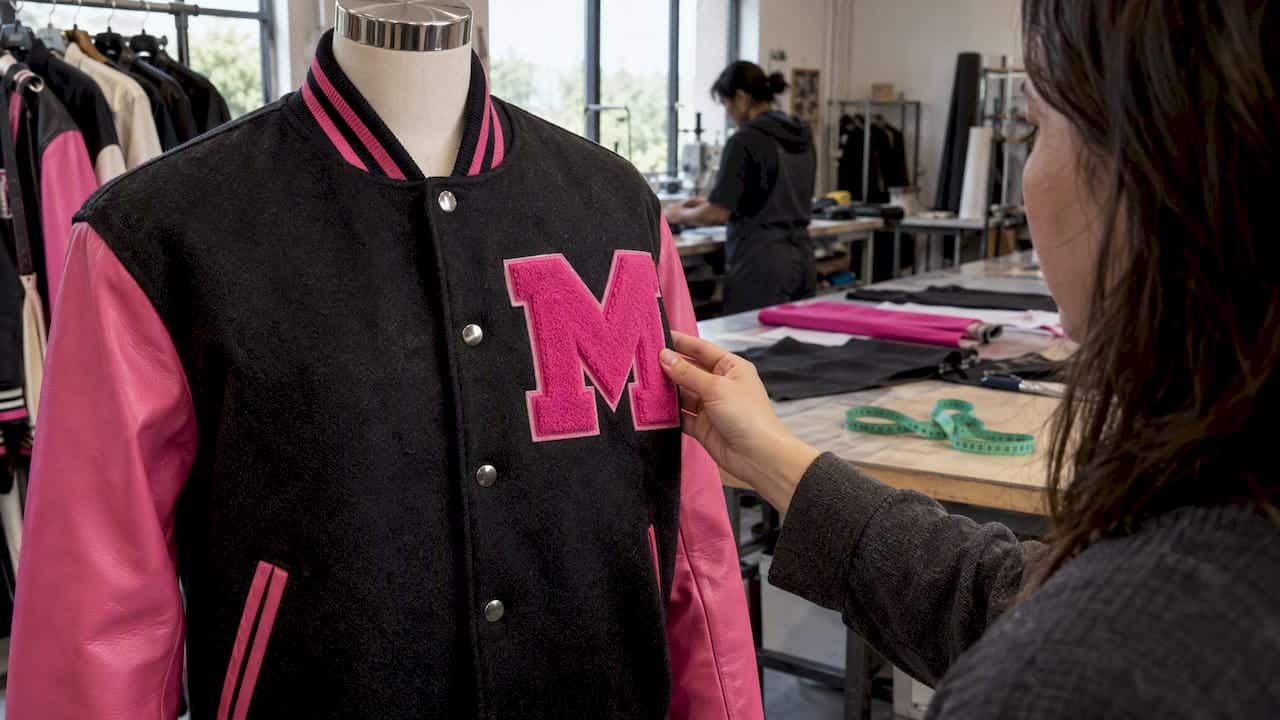
Varsity letters are chenille or felt cloth patches, usually the school’s or individual’s initial, attached to the left chest of a varsity jacket as its focal emblem. They can show a mascot, a name, or a custom monogram instead of a single letter. Shoppers choosing letters for a jacket pick from a range of materials, sizes, fonts, and attachment methods, and each choice changes the final look and how long it lasts.
TL;DR:
- Chenille is the most common material for varsity letters, offering durability and a textured, raised appearance, while felt is a lighter, cheaper alternative.
- Letters typically range from 4 to 8 inches in height, with size chosen based on jacket scale and desired prominence, and placement remains mostly on the left chest.
- Sewn attachment methods provide the best long-term durability for wool and leather jackets, while iron-on options suit casual, infrequently washed garments.
- Choosing contrasting colors makes varsity letters stand out, whereas tone-on-tone designs offer a more subtle, modern look.
- Custom orders benefit from pre-approval mockups and detailed questions about thread color, backing, and reinforcement to ensure a durable and proper fit.
Table of Contents
- What are varsity letters made of and where do they go?
- Which styles and customization options fit your jacket?
- How do you choose varsity letters when placing an order?
- What attachment method should you pick for your letters?
- How do you care for chenille and felt letters?
- Where did varsity letters come from?
- What does it actually take to earn a varsity letter?
- Why do varsity letters carry so much weight in school culture?
- Do varsity letters look different across sports and activities?
- What a jacket customizer actually does with your letter order
- Starting a custom varsity letter order with Maker of Jacket
- Sources
- FAQ
What are varsity letters made of and where do they go?
A varsity letter is almost always built from chenille, a soft tufted fabric, or from flat felt, a cheaper and lighter alternative. Chenille yarn is made by trapping short lengths of yarn between two core yarns and twisting them together, which creates the fuzzy pile that gives the letter its raised texture and holds up well under regular wear, according to James Dunlop Textiles. That tufted surface is called a moss stitch, and it’s typically framed by a chain stitch outline that defines the letter’s edge and keeps the pile from fraying, per Wikipedia’s entry on varsity letters.
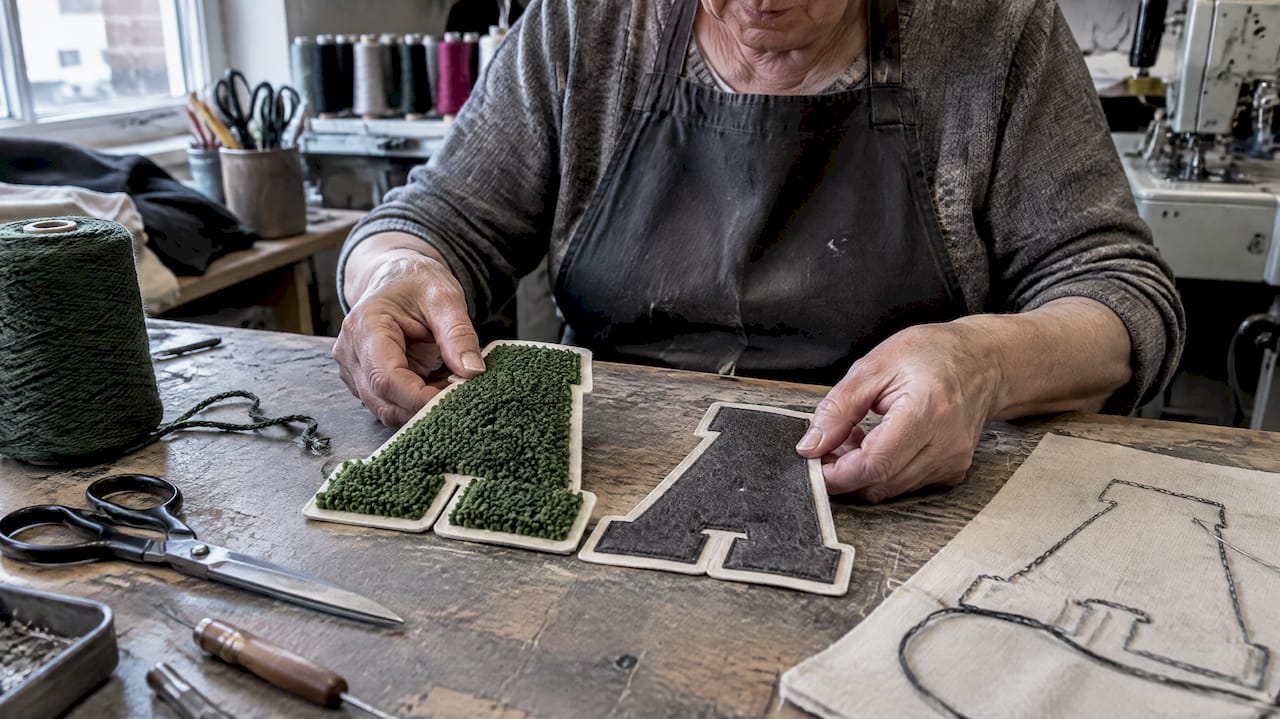
Standard letter heights commonly fall within a range suitable for junior-scale jackets up to larger sizes used for traditional varsity prominence, according to Wikipedia. The left chest remains the dominant placement, a convention that carried over as letter sweaters gave way to leather-sleeved jackets in the early 20th century, as shown in archival material from the University of Montana and mirrored in design advice from How to design a custom team uniform | Coach’s Guide | Capra Sports.
Quick reference for sizing and placement:
- 4 to 5 inches: common for junior or smaller-scale jackets, sometimes placed above the pocket instead of center chest.
- 6 to 8 inches: the traditional size for a jacket’s main emblem, centered on the left chest.
- Left chest: the visual standard across most varsity jackets, though archive collections show junior letters occasionally placed above the pocket, per Nebraska Archives Online.
Which styles and customization options fit your jacket?
Font choice changes the letter’s personality as much as its material does. Block letters read as the classic athletic look and stay legible at a distance, Old English lettering leans vintage and formal, and script works for a more personal, name-style patch. Thicker outlines and larger sizes help legibility on jackets viewed from across a stadium or hallway, while thinner strokes suit smaller, closer-up details.
3D chenille, where the tufted pile sits noticeably raised off the backing, costs more than flat felt but delivers a distinctive tactile depth that has stayed popular for high-visibility personalization.
- 3D chenille: more texture and dimension, higher cost, strong durability when properly backed.
- Flat felt: lighter, less expensive, better for subtle or secondary details.
- Mascot patches and award bars: add specific achievements or team identity beside the main letter.
- Embroidered name tapes and small icon add-ons: personalize without competing with the primary emblem.
Chenille’s rise in American apparel took off by the late 1930s, when machine production expanded availability and influenced cost and style options, which is part of why the look became a fixture of varsity jackets rather than a novelty.
Color choice matters as much as style. A letter in a sharply contrasting color against the jacket body reads bold and traditional, while a tone-on-tone letter, close in shade to the jacket itself, gives a subtler, more fashion-forward result.
How do you choose varsity letters when placing an order?
A good order starts with a short checklist rather than guesswork.
- Match material to jacket fabric: chenille pairs naturally with wool jacket bodies, felt works well on lighter fabrics, and leather sleeves call for careful stitch planning to avoid widening needle holes over time.
- Size for your jacket’s scale: a letter that looks right on a full-size adult jacket may overwhelm a cropped or junior cut, so size the letter to the garment, not just to tradition.
- Pick a font and outline weight for legibility: bold block letters hold up at a distance, while script or thinner outlines suit smaller or more personal patches.
- Decide on attachment method early: sewn, snap-backed, iron-on, or adhesive each carry different tradeoffs between permanence and removability.
- Set a realistic budget and timeline, and ask for a mockup or stitch sample before committing to a full order.
Bring a short list of questions to whoever is making the jacket: what thread color will outline the letter, what backing material sits behind the chenille, and whether seams get reinforced at high-wear points like the chest edge and sleeve seam.
Pro Tip: Ask for a photo of the actual stitch sample, not just a digital mockup, before you approve a chenille letter order.
What attachment method should you pick for your letters?
Sewn-on letters are the most durable option and the standard choice for wool jacket bodies and leather sleeves, since stitching holds up to years of wear without peeling or lifting. Iron-on backing works for lighter, more casual garments, but it’s a poor match for leather or jackets that get washed often, since heat and repeated laundering weaken the adhesive bond.
- Sewn-on: best durability, ideal for wool bodies and leather sleeves.
- Iron-on: acceptable for casual, rarely laundered pieces, not recommended for leather.
- Adhesive or peel-and-stick: suited only to temporary or short-term use, like a single event.
- Snap or button-backed letters: allow easy removal, rotation between jackets, and simple storage.
For leather-sleeved jackets, the strongest approach is hand-sewing a reinforced chain-stitch outline with waxed polyester thread, matching the thread color to the letter edge, and reinforcing the chest area where the fabric flexes most during wear.
How do you care for chenille and felt letters?
Chenille holds up well, but it needs the right handling. Spot clean small marks with a damp cloth and mild soap, and send the whole jacket to a professional cleaner experienced with wool or leather garments when a deeper clean is needed.
- Avoid the dryer: machine heat flattens the chenille pile and can warp the backing felt, so reshape letters by hand and air-dry the jacket flat.
- Fix small issues early: a loosening chain-stitch outline or a fraying backing felt is a quick repair if caught before the letter shifts or tears away.
- Reinforce seams around the letter’s edge if you notice early fraying at the corners, where stress concentrates.
- Store removable letters properly: keep snap-on or detached letters in a labeled envelope, away from moisture and direct heat.
Pro Tip: If you ever remove a chenille letter as a keepsake, cut the thread close to the backing fabric rather than through the chenille pile, so the letter keeps its shape for display.
Where did varsity letters come from?
The varsity letter traces back to early collegiate and high school athletics, where a letter sweater, not a jacket, was the original reward for team participation. University archival collections document this shift clearly: letter sweaters gave way to leather-sleeved jackets with chenille letters by the 1930s, a transition that also changed how the letter itself was displayed, according to the University of Montana archive.
That shift mattered for more than fashion. A sweater’s knit fabric could only hold a sewn-on letter in a limited way, but the sturdier jacket body, paired with the newly industrialized chenille fabric becoming widely available by the late 1930s, gave the letter a more durable, more visually prominent home according to UGA Today’s coverage of chenille’s history. The jacket format also introduced the leather sleeve as a design element, separate from the wool body where the letter sat.
Archive collections holding physical letter jackets and patches, including stadium blankets and early sewn detailing, show how much variety existed even in those early decades, from backing material to thread color, according to Nebraska Archives Online. What stayed consistent across most of that variety was the letter’s role: a visible, wearable record of having earned a place on a team.
What does it actually take to earn a varsity letter?
Earning a varsity letter has never been handed out for showing up. Most school athletic programs set a participation threshold, often tied to a minimum number of games, meets, or practice hours across a season, along with a performance standard in some sports that rewards specific achievements over simple attendance. Academic teams, band, and other non-athletic programs that award letters typically set their own versions of these same two ingredients: sustained commitment and a recognized level of contribution.
The specific bar varies by school and by activity, which is part of why a single, universal definition of “earning a letter” doesn’t exist. A swim team might set its standard around meet participation and qualifying times, while a debate team might set it around tournament appearances and judged results. What stays constant is the idea that the letter has to be earned, not simply issued, which is what gives it weight once it’s sewn onto a jacket.
That earned quality is also why the jacket itself became a visible marker worth customizing. A letter sized at 6 to 8 inches and placed dead center on the left chest, the traditional format noted earlier, reads as a deliberate, prominent display precisely because what it represents required meeting a real standard first.
Why do varsity letters carry so much weight in school culture?
A varsity letter functions as a visible, portable record of achievement, worn in hallways and at reunions decades after the season that earned it. That’s a different kind of symbol than a trophy sitting in a case: it travels with the person, which is part of why the jacket format, not just the letter itself, became such a fixture of American school culture.
The letter’s value also comes from scarcity. Not every student who plays a sport earns one, and that selectivity is what separates a varsity letter from simple team membership. Add-ons like mascot patches and award bars build on that same logic, layering specific accomplishments onto the base letter so the jacket becomes a fuller record over time rather than a single static symbol.
For many wearers, the jacket becomes the one piece of clothing that compresses years of effort into something small enough to wear casually. That’s also why customization choices, font, color, size, matter more on a varsity jacket than on almost any other garment: the letter is the point, and everything else on the jacket exists to support it.
Do varsity letters look different across sports and activities?
Yes, and the differences go beyond color. Contact sports like football and wrestling often favor larger, bolder block letters with reinforced stitching, since the jacket and its emblem take more physical wear during the season it represents. Sports with more individual recognition, like track or swimming, sometimes pair the main letter with smaller award bars noting specific meets, records, or times, building a more detailed record on a single jacket.
Non-athletic activities, band, academic teams, student government, tend to use the same chenille letter format but often pair it with different supporting patches, like an instrument icon or an activity-specific emblem instead of a sport ball. The core letter stays consistent across all of these categories because the tradition itself is shared, but the supporting details shift to reflect what the activity actually rewards.
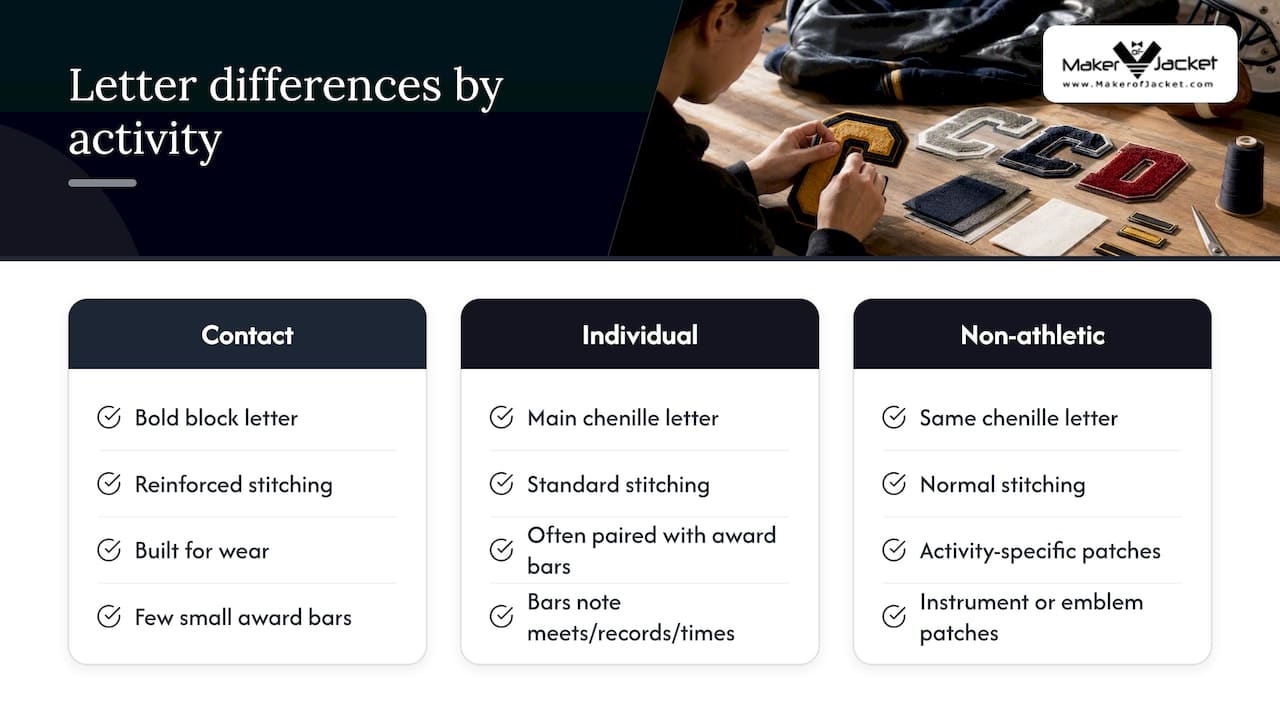
Color conventions also shift by school rather than by sport, since most programs set one or two official colors that apply across every team. The real variation between sports shows up less in the letter’s color and more in what surrounds it, since a wrestler’s jacket and a trumpet player’s jacket might carry the exact same chenille “M,” just with entirely different patches telling the rest of the story.
What a jacket customizer actually does with your letter order
A reputable customizer treats the letter as part of the whole jacket, not an afterthought. Maker of Jacket works from mockups before cutting any chenille, confirming material, size, and font against the jacket body the customer has chosen. Placement gets checked against jacket scale, since a letter sized for a full adult cut looks wrong on a cropped or junior fit, and attachment method gets matched to the fabric, sewn stitching for wool and leather, lighter methods for casual pieces.
Customers typically see a proof or sample photo before the order is finalized, with shipping details confirmed once the design is approved. That approval step is where most sizing or color mistakes get caught, long before the jacket ships.
— Maker
Starting a custom varsity letter order with Maker of Jacket
Picking the right letter is only half the project. The other half is getting it made and attached correctly, which is where a Customize Varsity Jacket Order from a custom jacket service takes over: you choose the jacket body, specify letter material, size, font, and color, and approve a mockup before anything gets cut. The process stays simple from browsing to approval.
- Browse varsity jacket styles or start a fully custom request.
- Specify letter material, size, font, and attachment method in your order notes.
- Review a mockup and approve before production begins.
The Customize Patch Order option covers standalone letters or patches for a jacket you already own, priced at $5 one-off, while a full Customize Varsity Jacket Order runs $249 one-off and includes the jacket itself. Place your order through the customization page and request a mockup before it goes into production.
Sources
- Varsity letter — Wikipedia
- Book explores rise of chenille fabric — UGA Today
- Chenille product explanation — James Dunlop Textiles
FAQ
What are varsity letters actually made of?
Varsity letters are most commonly made from chenille, a tufted fabric built with a moss stitch pile and a chain stitch outline, or from flatter felt, according to Wikipedia. Chenille gives more texture and durability, while felt offers a lighter, cheaper alternative.
What size should a varsity letter be?
Standard varsity letters run from about 4 to 8 inches in height, with smaller sizes common on junior-scale jackets and larger sizes used for traditional prominence, per Wikipedia. The right size depends on your jacket’s overall scale and how bold you want the emblem to look.
Can I attach a varsity letter myself at home?
Iron-on and adhesive letters can be applied at home, but they’re best for lighter, casual garments rather than leather or heavily laundered jackets. For a wool body or leather sleeves, sewn attachment with reinforced stitching holds up far better over years of wear.
How much does a custom varsity jacket with letters cost?
A Customize Varsity Jacket Order from Maker of Jacket is $249 one-off, and a standalone Customize Patch Order for letters alone is $5 one-off. Both prices cover a made-to-order process that includes a mockup for approval before production.
How do I clean a jacket with chenille letters without ruining them?
Spot clean small marks with a damp cloth and mild soap, and avoid machine drying, since heat can flatten the chenille pile and warp the backing. For a deeper clean, use a professional service experienced with wool or leather garments rather than a standard washing machine.


