

Chenille Patches Guide: Types, Uses and Care

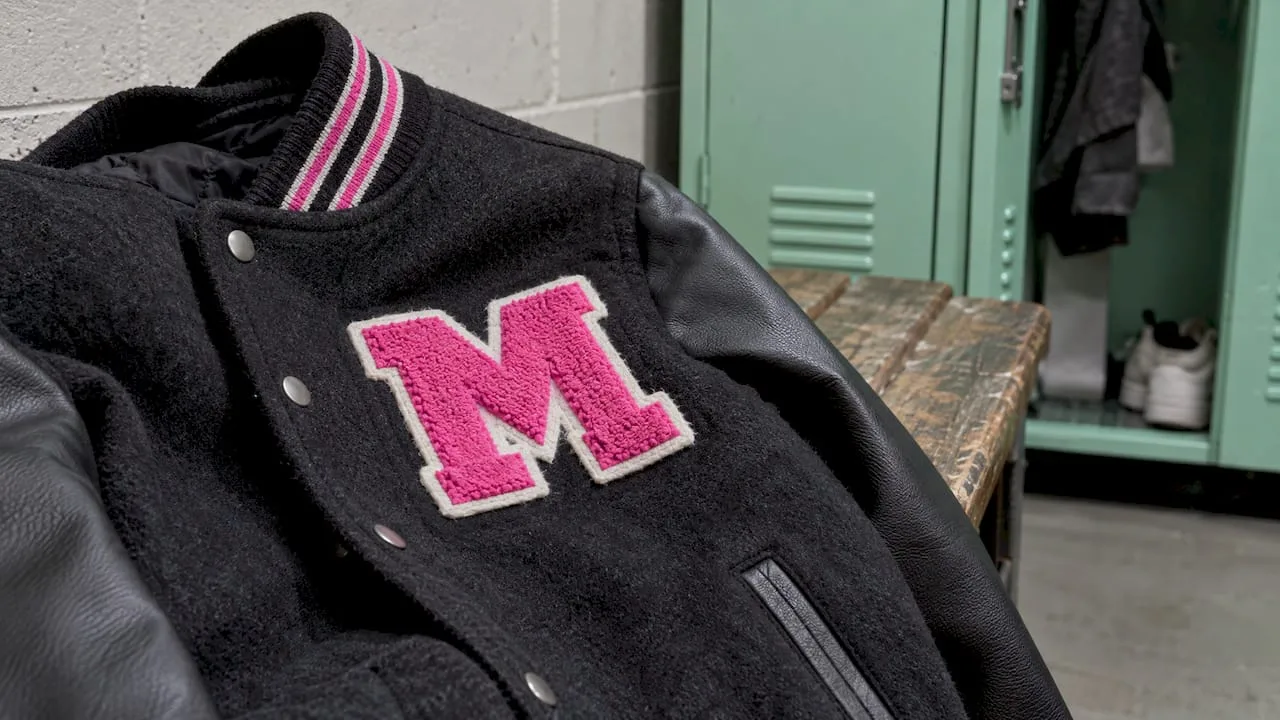
Chenille patches are raised, fuzzy emblems made from looped yarn on a felt base. They are the classic choice for varsity letters, mascots and bold lettering, and they look best on heavy garments like wool-and-leather letterman jackets. This guide covers how they are made, how they compare with embroidered patches, what varsity chenille letters mean, how to attach them and how to keep them looking full.
TL;DR
- Chenille patches have a plush, raised surface made of yarn loops. Embroidered patches are flat and made of thin thread.
- Choose chenille for big, bold shapes such as letters, numbers and mascots. Choose embroidery for fine text and small, detailed logos.
- A varsity chenille letter traditionally goes on the left chest of a letterman jacket.
- For a patch you want to keep for years, stitch it on. Use iron-on only when the fabric can take heat.
- Gentle washing and air drying help the pile keep its shape.
Table of Contents
- What chenille patches are
- How chenille patches are made
- Chenille vs. embroidered patches
- Varsity chenille letters
- How to attach a chenille patch
- Caring for chenille patches
- Our perspective
- Ordering patches and custom jackets
- A quick planning checklist
- FAQ
- Sources
What chenille patches are
The word comes from the French for caterpillar, and the look explains why. The Cambridge English Dictionary defines chenille as a thick, soft thread used for decorating cloth, or the fabric made from it. A chenille patch takes that idea and turns it into a stitched emblem: a felt backing with a dense, soft surface of yarn on top.
Two things set a chenille patch apart at a glance:
- Texture. The surface is raised and plush. You can feel the letters with your fingertips.
- Depth. Felt is usually layered under the yarn, so colors step up and down. A white letter with a gold outline on a navy background reads almost like a small sculpture.
That is why chenille became the signature of school and team apparel. A flat logo can look sharp, but a chenille “M” on a jacket chest looks like an award.
How chenille patches are made
You do not need the machine details to buy a patch, but knowing the process explains why chenille costs more than flat embroidery and why some designs work better than others.
The yarn and the loops
Traditional chenille yarn starts as a loosely woven fabric. According to PieceWork magazine, loosely spun weft yarns are held in a leno weave, and the fabric is cut between pairs of warp threads so the freed wefts form the fuzzy pile.
Patches are usually made a different way. Machine makers describe a technique called moss or chenille embroidery. As ZSK explains, a hooked needle and a one-thread system pull yarn through the base material and form repeated loops on the surface, building up a dense, three-dimensional, moss-like texture.
The base and the finish
The loops need something to hold them. That is the felt (or twill) base, which carries the structure of the patch. The maker then trims the surface, adds a border around the edge, and finishes the back, either plain for sewing or with a heat-activated adhesive for iron-on use.
The design steps before that matter just as much:
- The artwork is converted into a stitch file.
- A proof is checked against the intended colors and shapes.
- The yarn is tufted onto the base, trimmed and finished.
- The finished patch is inspected, backed and shipped.
Because the yarn is thick, the machine cannot make tiny curves or hairline details. That limit shapes everything about what chenille does well.
Chenille vs. embroidered patches
Both are stitched, and both can last for years. They simply do different jobs.
| Chenille patch | Embroidered patch | |
|---|---|---|
| Look | Raised, soft, fuzzy | Flat, crisp, smooth |
| Material | Looped yarn on a felt base | Thin thread on a twill base |
| Best designs | Large letters, numbers, mascots, bold shapes | Detailed logos, small text, fine lines |
| Feel | Plush, tactile | Smooth, slightly textured |
| Best on | Heavy jackets: varsity, letterman, wool, leather | Almost any garment, caps, bags, shirts |
| Typical cost | Higher, because the process is more specialized | Lower, especially in bulk |
When chenille wins
Choose chenille when the shape is simple and big. A single letter, a two-digit number, a bulldog head, a lightning bolt. These designs have thick strokes, so the yarn fills them well and the raised surface becomes the feature.
Chenille also suits garments with weight. A wool body with leather sleeves can carry a thick patch without puckering. On a thin T-shirt, a heavy chenille patch can drag the fabric down.
When embroidery wins
Choose embroidery when the design has a thin outline, a small word or a lot of detail. A slogan in small type, a crest with a dozen elements or a signature will turn into mush in yarn. Thread is fine enough to hold those details, and it lies flat, so the patch is also less exposed to rubbing.
Using both on one jacket
The two are not rivals. A common varsity layout puts a large chenille letter on the chest and small embroidered patches for sport, year or name elsewhere on the jacket. The contrast is part of the look. If you are planning a jacket, decide first which element should be the hero. That one gets chenille. The supporting details get thread.
Varsity chenille letters
The varsity letter is where most people first meet chenille.
What the letter means
The tradition grew out of American college athletics and spread to high schools over the twentieth century. A school awards a letter, usually its initial in school colors, to a student who meets the standard in a sport or other activity. The letter is then worn on a jacket as proof of that achievement.
The details differ by school. Some schools award one letter and add smaller insignias for each sport. Others use pins or bars attached to the letter to mark extra seasons or honors. If you are buying for a school jacket, check your athletic department’s rules before you order, because placement and size can be specified.
Where it goes
The standard spot is the left chest, over the heart. The letter is large and bold, because it is meant to be read from across a hallway. Sport patches, year bars and name patches are usually smaller and sit around it or on the sleeves.
If you want a plain explanation of how letters and jackets are priced and what each element signals, see our guide to what varsity letters mean for buyers.
Choosing colors and style
- Two or three colors work best. A letter in the school color with a contrasting outline reads clearly from far away.
- Match the jacket, then contrast. A navy body with a white or gold letter is the traditional pairing. A brown or black jacket can take cream or gold.
- Keep the letter’s shape simple. Block letters give the yarn room to fill. Script or very condensed styles lose definition.
If you want to see how patch placement looks on finished jackets, browse the black patch detail varsity letterman jacket or the brown wool patched logo varsity jacket. Both show how a patch changes the look of a jacket.
How to attach a chenille patch
There are two routes: sew it or iron it. Which is right depends on the patch backing, the fabric and how long you want it to last.
Sewing: the long-term choice
For a big letter on a jacket you plan to wear for years, stitching is the dependable method. Use a strong thread in a color that disappears into the patch border, and sew around the edge with small, even stitches that go through the border and the garment. Work from the outside, and keep the patch flat as you go so it does not twist.
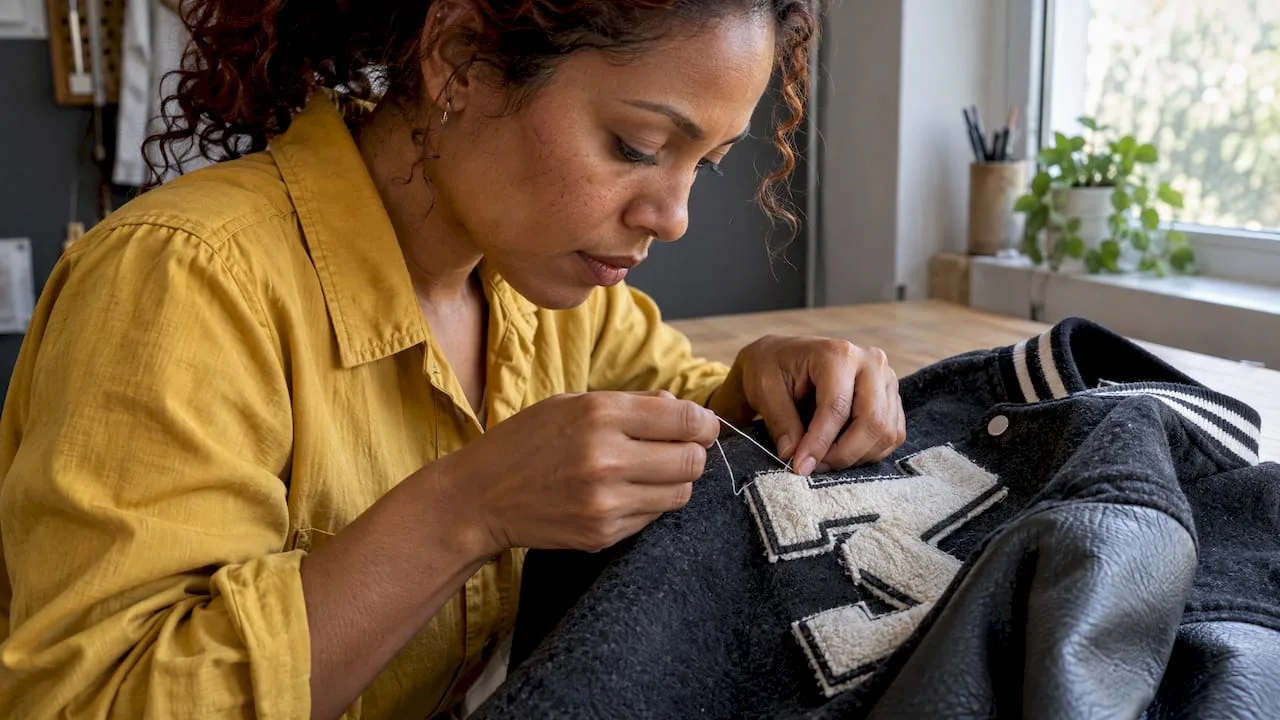
If the jacket has a lining, stitch through the outer layer only, or open the lining seam and stitch from inside so thread does not show.
Ironing: quicker, but fabric-dependent
Iron-on patches carry a heat-activated adhesive on the back. They work best on stable fabrics such as cotton, polyester and blends.
- Pin or tape the patch in place and check the position in a mirror.
- Set the iron to the heat recommended for your fabric and turn steam off.
- Put a thick press cloth over the patch so the iron does not crush the pile.
- Press from the back of the garment when you can, applying firm pressure rather than sliding.
- Let it cool fully before moving the garment.
Fabrics that need extra care
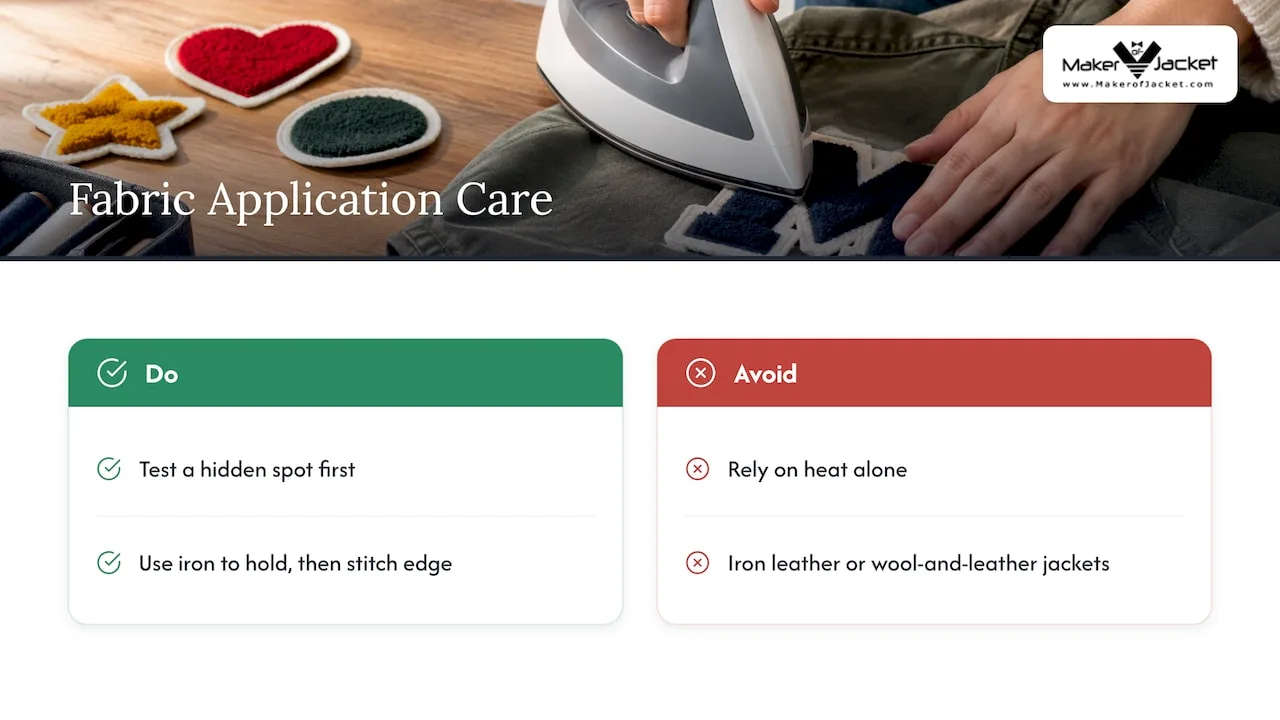
Heat is the main risk. Leather can mark or shrink under an iron, and wool and some nylons can scorch or change texture. On those fabrics, do not rely on heat alone. A practical middle path for heavy pieces is to use the iron only to hold the patch in place, then stitch around the edge. For a leather jacket or a wool-and-leather varsity jacket, skip the iron and sew.
If you are unsure about a fabric, test on a hidden spot such as an inside hem before touching the front of the jacket.
Caring for chenille patches
Chenille’s softness is also its weak spot. The pile is made of loops, so heat, friction and aggressive washing can flatten or loosen it. A few habits keep it fuller for longer.
- Wash less often. Spot clean with a damp cloth when you can.
- Turn the garment inside out and wash on a gentle cycle in cool or warm water.
- Air dry. Skip the hot dryer, which can soften adhesive and flatten the pile.
- Brush gently. A soft brush, moving in one direction, lifts a flattened pile.
- Store flat or on a wide hanger so the patch is not creased.
Fiber care in general follows the same logic. This washing guide, drying and storing costumes covers the gentle-handling habits that also help soft, textured trims keep their shape.
A jacket with a leather body needs its own care, so keep chenille patches away from any leather cleaner or conditioner. Apply those to the leather only, and let them dry before the jacket goes back in the closet.
Our perspective
We make jackets for people who care about the details, and patches are where those details show first. A chenille letter changes how a jacket reads: it moves from a nice jacket to your jacket.
Our view is simple. Start with the jacket, then let the patch do one thing. If the jacket is a varsity or letterman style, give the chenille letter the left chest and let everything else stay quiet. If the jacket is a biker or a bomber, a single patch can carry the whole design.
We build custom pieces around your size and style preferences, handcrafted by skilled craftsmen using premium-grade materials, because a patch only looks right when the jacket under it fits and the materials can carry it. That is why we treat patches and jackets as one project, not two.
Our advice to anyone planning a custom order: decide the hero element first, pick two or three colors, and keep the lettering bold. The result is a jacket you will still want to wear years from now.
Maker
Ordering patches and custom jackets
If you already have a jacket and want a patch for it, our Customize Patch Order starts at $5. You can also look at our team-style patches, such as the Carolina Panthers team logo patch or the Los Angeles Charger team logo patch.
If you want the patch built into a new jacket from the start, our custom jacket orders cover the styles that suit chenille best:
| Custom piece | Price |
|---|---|
| Customize Jacket Order | $199 |
| Customize Varsity Jacket Order | $249 |
| Custom Bomber Jacket | $249 |
| Custom Biker Jacket | $249 |
| Custom Leather Vest | $229 |
| Customize Patch Order | $5 |
We offer free shipping worldwide, and our support team is available 24/5 if you have questions about your design.
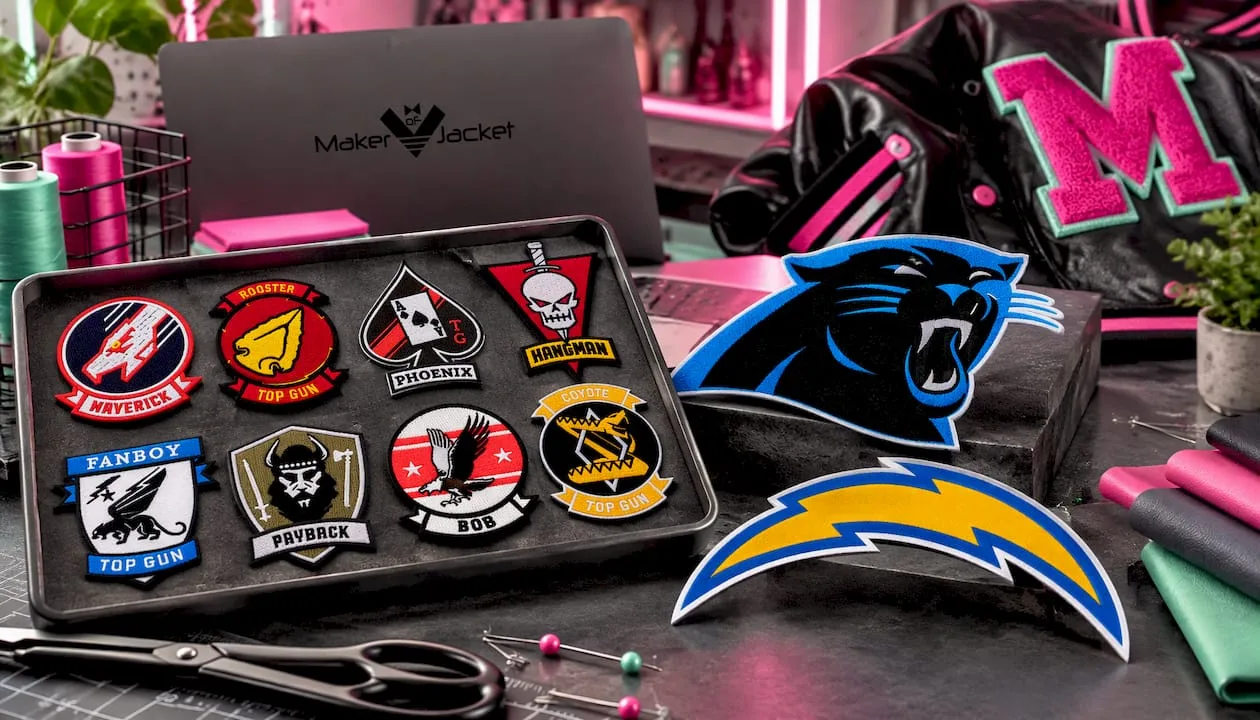
If you want a varsity look, start with a style like the Polo Ralph Lauren-inspired patch P wing crest varsity jacket for ideas, or browse the brown varsity jackets and blue and white varsity jackets to see how color pairings work with a bold letter.
A quick planning checklist
Before you order any chenille patch, run through these points:
- Purpose. Is it an award, a team mark, a fashion piece or a gift?
- Garment. Is the fabric heavy enough, and can it take stitching or heat?
- Design. Are the strokes thick and the shape simple? If not, consider embroidery for the finer parts.
- Colors. Two or three, with strong contrast against the jacket body.
- Placement. Left chest for a letter, sleeves or back for supporting patches.
- Attachment. Sew for anything you will wear for years, iron only on compatible fabrics.
FAQ
What are chenille patches?
They are raised, fuzzy emblems made of looped yarn on a felt base. The soft, plush surface is what separates them from flat embroidered patches. They are most often used for varsity letters, mascots and bold lettering.
What is the difference between chenille and embroidered patches?
Chenille uses thick yarn loops for a raised, soft look, so it suits large, bold shapes. Embroidery uses thin thread and lies flat, so it suits fine text and detailed logos. Many jackets combine both.
Can you iron a chenille patch onto a leather jacket?
It is better not to. Leather can mark or shrink under direct heat, so stitching is the safer way to attach a patch to a leather jacket. Wool and some nylons also need care, so sew or test a hidden spot first.
Where does a varsity chenille letter go on a jacket?
The traditional spot is the left chest. Smaller patches for sports, years or names usually go around it or on the sleeves. Check your school’s guidelines if the jacket is for an official award.


