

Why cowhide leather? Durability, style, and smart buying

TL;DR:
- Not all cowhide leather is equal; premium grades offer better durability, appearance, and aging quality.
- Understanding leather grades and comparing types helps buyers make informed, value-driven choices for their needs.
Most people shopping for a leather jacket assume that “leather is leather.” That assumption costs them money, comfort, and sometimes safety. The truth is, not every hide performs the same, and the gap between a premium cowhide jacket and a poorly graded alternative can be enormous. Cowhide sits at the center of the leather world for good reason. It powers motorcycle gear, fashion staples, work boots, and custom apparel worldwide. This guide breaks down exactly what makes cowhide worth your attention, how it stacks up against competing leathers, and how to shop without being tricked by misleading labels.
Table of Contents
- What makes cowhide leather stand out?
- Cowhide vs other leathers: Strengths and tradeoffs
- Grades of cowhide: Why the quality label matters
- Cowhide in action: Everyday uses and care tips
- The truth behind ‘best leather’: Expert insights for smart buyers
- Ready to experience premium cowhide leather?
- Frequently asked questions
Key Takeaways
| Point | Details |
|---|---|
| Durability advantage | Cowhide’s natural thickness and toughness make it a leading choice for rugged and long-lasting gear. |
| Value for money | Cowhide’s global abundance keeps prices reasonable compared to exotic leathers, while delivering high value. |
| Know your grades | Understanding leather grades helps you avoid low-quality purchases and select materials that last. |
| Not always best | Cowhide excels in many uses but isn’t superior for every need—match your choice to your goals. |
| Care extends life | Proper cleaning and conditioning make cowhide products last and look great for years. |
What makes cowhide leather stand out?
To understand why cowhide is so respected, we need to break down its defining features.
Cowhide is the most widely produced leather on earth. That’s not a coincidence. It comes from cattle hides that are a natural byproduct of the beef industry, which means supply is consistent, pricing stays competitive, and manufacturers can work with it at scale. According to global leather production data, cowhide’s widespread availability supports its use across virtually every category of consumer goods, from footwear and belts to full motorcycle suits.
What really sets cowhide apart, though, is its physical makeup. The fiber structure is dense and tightly packed, which translates directly to toughness in the real world. Cowhide resists abrasion and friction better than softer, finer-grain alternatives, which is exactly why it dominates protective motorcycle apparel. When you’re on a bike and road contact is a genuine risk, the material covering your arms and torso matters.
Here’s a quick breakdown of where cowhide shows up in everyday products:
- Motorcycle jackets and suits — dense protection against road rash
- Biker boots and harness boots — structural integrity for long rides
- Saddlebags and panniers — weather and wear resistance for outdoor storage
- Belts and wallets — shape retention and long wear life
- Home décor and upholstery — visual texture and durability
“Cowhide is the go-to for serious riders and gear makers not because it’s cheap, but because it does the job without compromise. Thickness, density, and availability make it an unmatched workhorse in the leather world.”
Understanding cowhide qualities and uses gives buyers a strong foundation before they ever look at a price tag. And if you’re a rider wondering how the material holds up through summer heat and winter chill, the research on all-season cowhide durability is genuinely reassuring.
Cowhide vs other leathers: Strengths and tradeoffs
Understanding cowhide’s strengths is essential, but how does it hold up against its main leather rivals?
Every leather has a profile. Horsehide is legendary among vintage jacket enthusiasts for its tight grain and extreme abrasion resistance. Buffalo leather is thicker and has a rugged, pebbly texture that ages dramatically. Lambskin is butter-soft and great for fashion pieces but offers almost no protection in a crash. Cowhide lives in the sweet spot for most buyers.
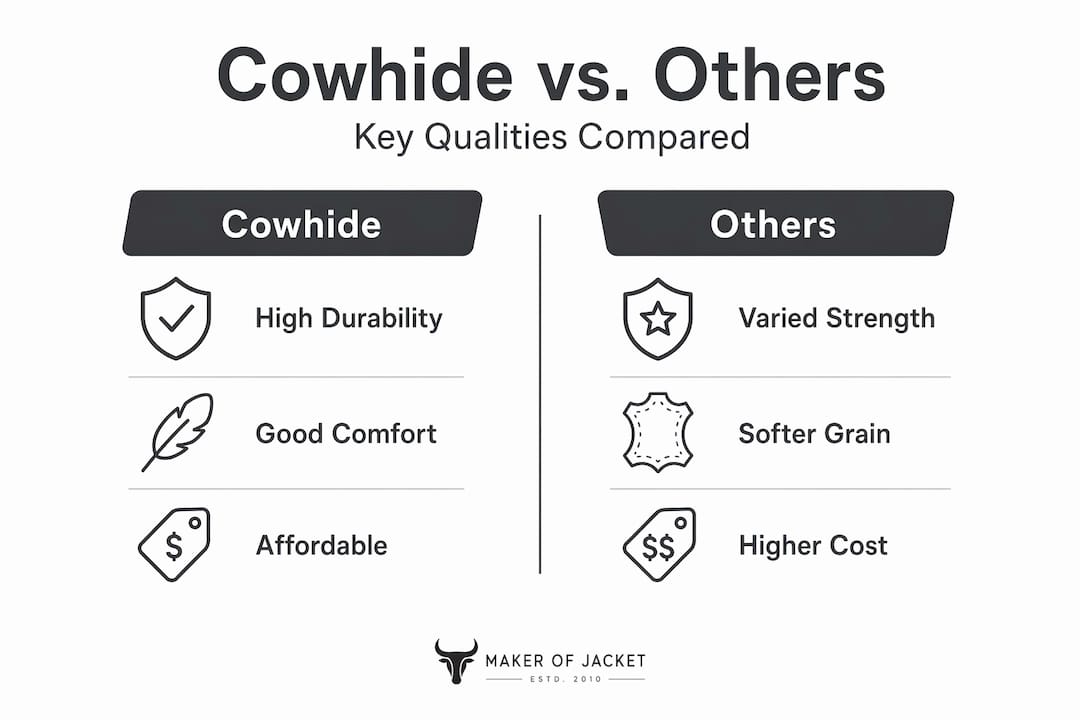
That said, cowhide is not automatically best in every protection scenario. Expert comparisons consistently show that other leathers can outperform cowhide in specific properties. Horsehide, for instance, may have a longer slide time during a fall at equivalent thickness. Buffalo may outlast cowhide in extreme outdoor environments. The real skill is matching material to purpose.
Here’s a direct comparison to help you decide:
| Leather type | Durability | Softness | Abrasion resistance | Price point | Best use case |
|---|---|---|---|---|---|
| Cowhide | High | Moderate | High | Moderate | Riding gear, fashion jackets |
| Horsehide | Very high | Firm | Very high | High | Vintage jackets, max protection |
| Buffalo | Very high | Rough | High | Moderate-high | Outdoor gear, rugged fashion |
| Lambskin | Low | Very soft | Low | Moderate | Fashion, light casual wear |
| Pigskin | Moderate | Moderate | Moderate | Low | Linings, accessories |
For riders, cowhide paired with proper CE-rated armor offers excellent all-around performance. For fashion buyers who want softness without sacrificing too much durability, cowhide at a lighter weight still outperforms lambskin in longevity. For those wanting to explore how cowhide compares specifically to buffalo, the cowhide vs buffalo leather breakdown covers that in detail.

If you want biker-approved cowhide gear recommendations from the riding community, the insight from experienced riders adds a practical layer that lab specs alone can’t provide.
Pro Tip: Before buying any leather jacket for riding, ask the brand to specify the leather type AND the weight in ounces per square foot. A cowhide jacket below 1.0 mm thickness offers dramatically less protection than a 1.2 to 1.4 mm version.
The benefits of cowhide leather go well beyond protection. Break-in time, long-term comfort, and value retention all favor cowhide when you’re comparing it to more exotic alternatives.
Grades of cowhide: Why the quality label matters
Not all cowhide is created equal. Let’s look at what separates premium jackets from low-cost letdowns.
This is where most shoppers get tripped up. They see “100% genuine leather” printed on a hang tag, feel like they’re getting a deal, and walk out with a product that will crack and peel within two years. The problem is the word “genuine.” In the leather industry, that term doesn’t mean authentic or high-quality. It’s actually one of the lower grades on the scale.
Cowhide performance depends heavily on grade. The grade tells you which layer of the hide was used and how much processing it went through. Here’s the breakdown:
| Grade | Description | Durability | Texture | Common use |
|---|---|---|---|---|
| Full-grain | Outermost layer, no sanding | Exceptional | Natural marks visible | Premium jackets, boots |
| Top-grain | Outermost layer, lightly sanded | Very good | Uniform, smooth | Fashion jackets, bags |
| Corrected-grain | Sanded and embossed | Good | Artificial texture | Mid-range apparel |
| Genuine/Split | Inner layers of the hide | Poor to fair | Flat, artificial | Budget items |
| Bonded leather | Leather scraps + polyurethane | Very poor | Smooth but fake | Low-end furniture, trim |
Key points to remember when shopping:
- Full-grain cowhide is the top tier. The grain layer remains fully intact, which means the natural fiber structure is unbroken. This translates to superior strength, breathability, and aging. Full-grain pieces develop a patina over time that actually improves their look.
- Top-grain is thinner and more processed than full-grain, but still performs well. It’s more uniform in appearance, which makes it popular in fashion-focused designs where a clean look matters more than raw ruggedness.
- Genuine leather is misleading by design. It’s typically split cowhide, meaning the inner layers after the top-grain has been separated. It’s real leather, technically, but it lacks the strength and aging qualities of the grades above it.
- Bonded leather is not even a true leather product. It’s leather dust and scraps pressed together with adhesive and a polyurethane coating. It looks like leather initially but peels fast.
The leather grading guide walks you through exactly how to read product descriptions and ask the right questions before you buy. Knowing the difference between these grades is not just about snobbishness. It’s about getting value from your purchase.
Cowhide in action: Everyday uses and care tips
Understanding materials is only half the journey. Let’s see how cowhide is used daily and how you can get the most out of your gear.
Cowhide shows up everywhere once you know what to look for. It’s the leather in your favorite jacket, your motorcycle chaps, your work boots, your belt, and quite possibly the couch you’re sitting on while reading this. Its rugged performance across applications comes from that dense fiber structure we’ve already discussed. But even the best cowhide degrades without proper care.
Here are the core care steps every cowhide owner should follow:
- Clean regularly with a leather-specific cleaner. Avoid dish soap or household cleaners. These strip natural oils from the hide and accelerate cracking. A dedicated leather cleaner lifts dirt without damaging the surface.
- Condition every 3 to 6 months. Leather conditioner replaces the oils that dry out over time through heat and sun exposure. A dry jacket becomes brittle. Conditioning keeps it supple and prevents surface cracking.
- Store in a cool, dry, ventilated space. Plastic bags trap moisture and encourage mold. Use a breathable garment bag and keep your jacket away from direct sunlight, which fades color and weakens fiber.
- Treat water spots promptly. Let wet leather dry naturally at room temperature, away from heaters or hair dryers. Forced heat warps and shrinks leather permanently.
- Apply a water-repellent spray for protection. Especially important for riders and anyone in a wet climate. This step is not a one-time fix but should be reapplied seasonally.
- Polish or use a leather balm on worn areas. Scuffs and light scratches can often be rubbed out or minimized with balm before they become permanent damage.
Pro Tip: After your first conditioning treatment, check how the leather absorbs it. If the conditioner soaks in quickly and the leather looks hungry for it, your jacket was overdue. Going forward, condition after every heavy ride season or every few months in dry climates.
Good habits around leather jacket maintenance can realistically double or triple the usable life of your gear. For a quick reference guide covering all the essentials, the jacket care basics overview keeps it simple and actionable.
Cowhide is an investment that rewards attention. A properly cared for full-grain jacket can last 20 to 30 years and look better at year ten than it did when you first bought it.
The truth behind ‘best leather’: Expert insights for smart buyers
While cowhide often dominates the conversation, discerning buyers should pause before accepting any “best leather” claims.
Here’s our honest take after years of working with riders, fashion buyers, and custom apparel enthusiasts. The phrase “best leather” is almost always a red flag. Best for what? Best for a cruiser rider who logs 10,000 miles a year is not the same as best for someone who wants a sleek fashion jacket for city wear. Conflating those two needs leads to bad purchases every single time.
The label issue is the most underreported problem in leather retail. Brands use “genuine leather” not because it’s a fair description but because it’s technically accurate and sounds premium to an uninformed buyer. This is not a gray area. It’s a deliberate use of vague language to obscure grade. Always read about leather grading before you commit to any purchase over $150.
The second trap is assuming that cowhide always wins on protection. Other leathers can outperform cowhide in very specific scenarios. If your primary goal is absolute maximum abrasion protection in a crash scenario and budget is not a concern, horsehide at full thickness has a strong argument. Cowhide wins on balance, not on every single metric.
Ask your brand these questions before buying: What grade of cowhide is this? What is the thickness in millimeters? Is it full-grain, top-grain, or corrected-grain? If a brand can’t answer these clearly, that tells you something important about the product and the company.
Smart buyers don’t just chase the best-looking jacket. They match the material to the mission and verify the grade before handing over their money.
Ready to experience premium cowhide leather?
If you’re ready to choose quality over confusion, here’s how to take the next step.
At Maker of Jacket, every piece starts with material selection that’s actually transparent. You won’t find vague “genuine leather” promises here. Explore custom cowhide jackets built to your exact specifications, including grade, weight, color, and fit. Whether you’re a rider wanting serious road protection or a fashion buyer after a clean silhouette, the customization options let you build exactly what you need.
Still learning about what makes a leather product worth its price? The leather grading guide will sharpen your eye for quality before you browse. And when your jacket arrives, knowing how to care for leather products ensures it stays sharp for years. Premium cowhide is a long-term investment. We make sure you have everything you need to protect it.
Frequently asked questions
Is cowhide leather waterproof or water-resistant?
Cowhide leather is naturally water-resistant to a modest degree, but it is not waterproof without treatment. Applying a quality water-repellent spray and conditioning regularly significantly improves its ability to handle rain and moisture.
Does cowhide leather get softer over time?
Yes, cowhide leather typically becomes noticeably softer and more comfortable the more you wear it. As noted in comparisons of leather types, cowhide’s break-in process delivers a balance of comfort, availability, and long-term value that few other leathers match.
Is cowhide better for motorcycle jackets than lamb or buffalo?
Cowhide is a strong choice for motorcycle jackets because of its thick density and superior abrasion resistance compared to softer leathers like lamb. However, cowhide is not automatically best in every protection category, and buffalo or horsehide may excel in specific performance situations.
How do I spot low-quality cowhide leather products?
Check the product label carefully. “Genuine leather” often signals split cowhide, which is a lower-grade inner layer with inferior strength and aging properties. Always look specifically for full-grain or top-grain labeling to ensure you’re getting a product built to last.
Recommended
- Cowhide Leather in All Seasons for Riders – Comfort, Durability & Style
- Cowhide leather explained: qualities, uses, and how to choose
- Ultimate Guide on Cowhide Leather: Origins, Characteristics, Benefits, Care, and Applications – Maker of Jacket
- Cowhide vs Buffalo Leather: Which Performs Better for Motorcycle Gear? – Maker of Jacket


