

The Role of Padding in Motorcycle Gear Explained

TL;DR:
- Proper padding in motorcycle gear absorbs impact energy and reduces injury severity during crashes. CE Level 2 armor offers twice the impact absorption of Level 1, but placement and fit are crucial for effective protection. Regularly inspect, maintain, and upgrade padding to ensure long-term safety and comfort while riding.
Most riders buy a motorcycle jacket thinking the armor inside is just a finishing touch. It is not. The role of padding in motorcycle gear is the difference between walking away from a crash and spending weeks in recovery. Padding absorbs energy, distributes force across bone and soft tissue, and keeps road rash from turning into something far worse. This article breaks down exactly how padding protects you, what the materials actually do, what certifications mean for real-world safety, and how to choose and maintain gear that works when it matters.
Table of Contents
- Key takeaways
- How padding protects riders from crash forces
- Padding material in motorcycle gear: what the options actually do
- Understanding CE ratings and what they mean for your protection
- Balancing comfort and protection in modern padded gear
- Maintaining and upgrading your motorcycle gear padding
- My take on the padding problem most riders overlook
- Get CE-certified padding built for your ride
- FAQ
Key takeaways
| Point | Details |
|---|---|
| Padding absorbs crash energy | Properly rated armor reduces force transmission to your body during impact, protecting joints and organs. |
| Padding materials differ significantly | Foam, viscoelastic, and hard composite inserts perform differently under impact and in heat. |
| CE certification levels matter | Level 2 armor transmits half the force of Level 1, making the rating a meaningful safety distinction. |
| Placement beats rating alone | Mispositioned high-rated padding protects less than correctly placed lower-rated armor. |
| Padding degrades over time | Heat, sweat, and UV exposure break down armor materials even without a crash. |
How padding protects riders from crash forces
When a crash happens, the physics are brutal and fast. Your body hits pavement or another vehicle, and the force of that collision has to go somewhere. Without padding, it goes directly into your joints, bones, and organs. With proper armor, the padding absorbs and redistributes that energy across a larger surface area and over a longer period of time. That fraction of a second of absorption makes an enormous difference in injury outcome.
Consider what happens to your knees during a slide. Pants without knee protection fail within 2 seconds of contact with asphalt, exposing bone. With proper knee padding, that survival window extends to 6 to 8 seconds. That additional protection time is the gap between road rash and a fracture requiring surgery.
Helmet padding works on the same principle, just applied to the most critical organ you have. Helmets reduce brain injury risk by 67% and cut the risk of death by 37%. The padding inside the helmet shell disperses the kinetic energy of impact across the foam liner, slowing the deceleration of your skull. Without that interior padding working correctly, the shell alone would transfer shock directly to your head.
Elbow and shoulder padding work through a combination of rigid outer shells and softer inner layers. The hard shell deflects sharp objects and prevents direct abrasion on the joint, while the inner foam or viscoelastic layer absorbs the compression force. Together, they protect the joint from both the surface contact and the deeper mechanical trauma.
Pro Tip: If you can feel the rigid outer shell of your elbow or shoulder armor pressing uncomfortably into your arm at rest, the padding is either the wrong size or incorrectly positioned. Discomfort at rest almost always means misalignment during a crash.
Padding material in motorcycle gear: what the options actually do
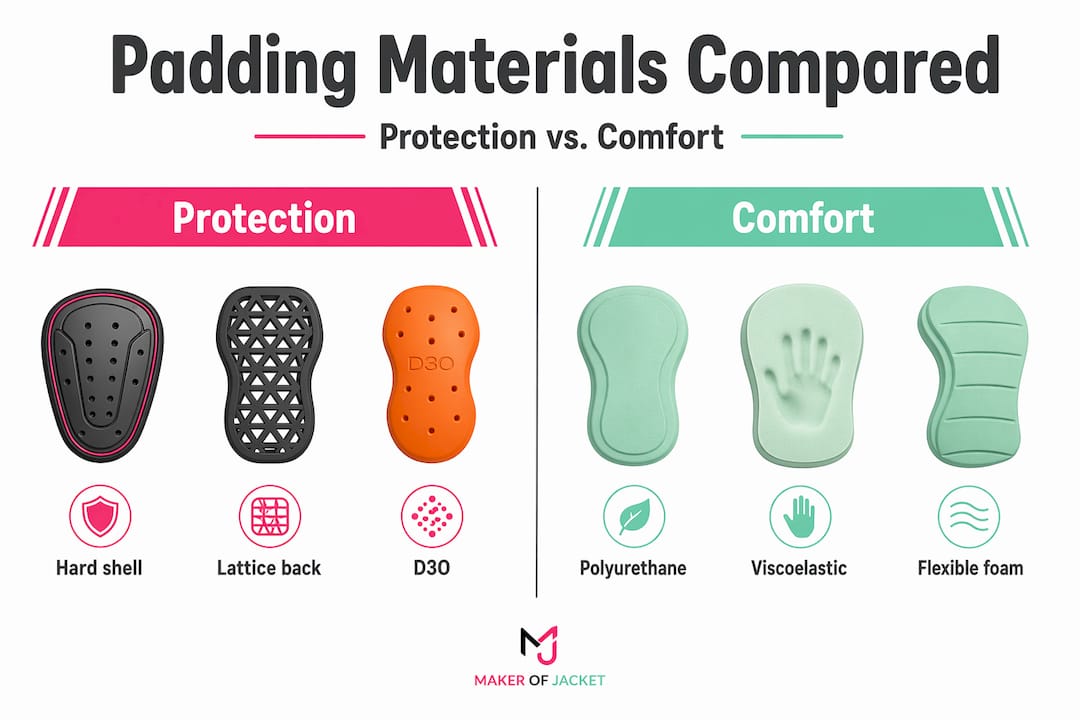
Not all motorcycle gear padding is built from the same material, and those differences are not cosmetic. The padding material in motorcycle gear determines how well it absorbs impact, how it feels during long rides, and how well it holds up over years of use.
| Material | Protection | Flexibility | Heat performance |
|---|---|---|---|
| Standard polyurethane foam | Good baseline absorption | Stiff at low temperatures | Degrades faster in heat |
| Viscoelastic foam (D3O) | High absorption, hardens on impact | Excellent daily flexibility | Moderate heat resistance |
| Hard shell composite | Maximum abrasion deflection | Limited; best for joints | Stable across temperatures |
| Lattice structure plastic | Strong impact protection | High flexibility | Superior airflow and stability |
Standard polyurethane foam is the most common and affordable insert found in motorcycle gear. It does the job at a basic level but stiffens in cold weather and breaks down faster under repeated heat and sweat exposure. Most entry-level jackets use this material.
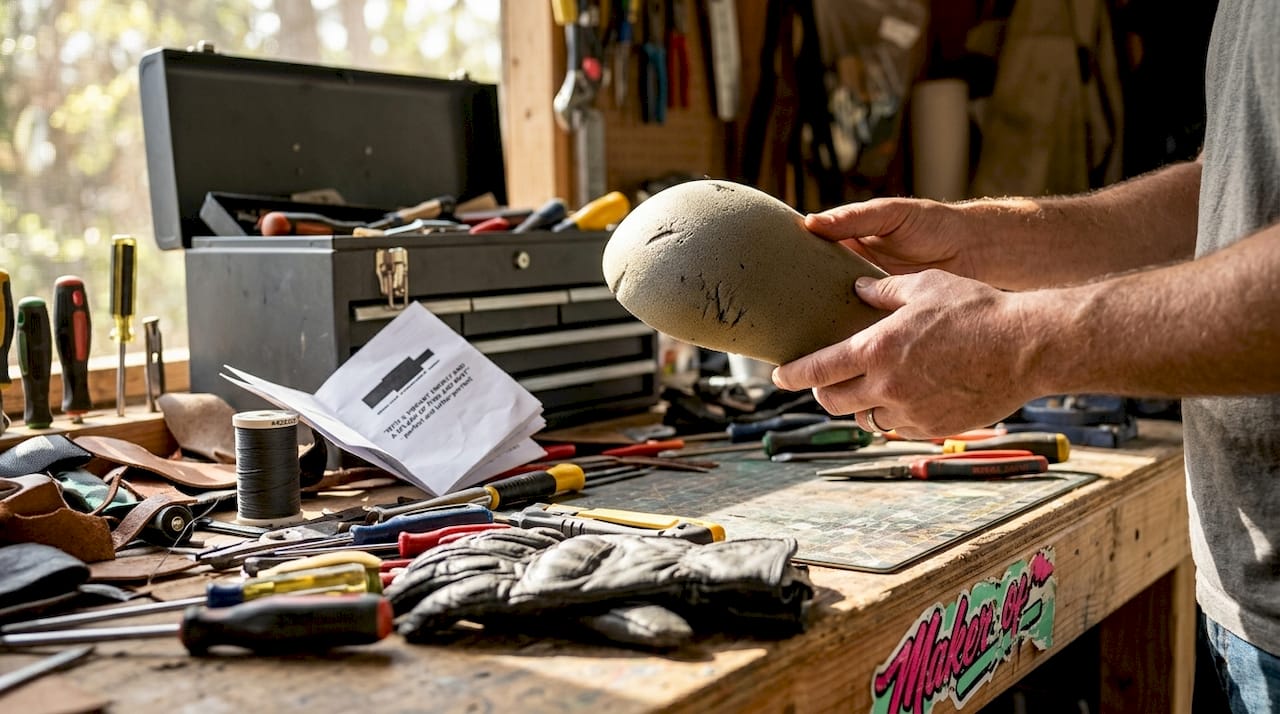
Viscoelastic materials like D3O represent a significant upgrade. Under normal conditions, they stay soft and pliable, making them comfortable to wear for hours. On impact, the molecular structure locks up and the material hardens instantly to absorb force. This is the material used in high-performance motorcycle suits, and it is what most riders upgrading from entry-level gear gravitate toward.
Hard shell composites, typically used in knee sliders and high-end back protectors, prioritize deflection over absorption. They stop sharp edges and pavement from cutting into the joint, and the shell distributes pressure laterally rather than allowing concentrated impact points. The trade-off is reduced flexibility, which is why they are most effective on fixed joint positions rather than areas requiring constant movement.
Lattice-structure back protectors are among the newest developments in padding material. These maintain impact protection in high temperatures and allow airflow through the structure itself, addressing the long-standing problem of back protectors becoming unbearable in summer heat.
Pro Tip: When buying replacement armor inserts, flex the pad with your hands before purchasing. If it returns to shape instantly and feels uniformly firm, it is likely standard foam. Viscoelastic materials will feel softer and return to shape more slowly.
Understanding CE ratings and what they mean for your protection
The European CE certification system is the global standard most motorcycle padding is tested against, and understanding it will sharpen how you evaluate gear. For limb armor (shoulders, elbows, knees, hips), the relevant standard is EN 1621-1. For back protectors, it is EN 1621-2. These are separate tests with separate thresholds, and a jacket’s overall safety is only as strong as its weakest armor zone.
Here is what the two levels actually measure:
- Level 1 armor transmits a maximum of 18 kN of force through the protector during impact testing. This is the minimum standard for motorcycle protective gear and is adequate for lower-speed riding and urban commuting.
- Level 2 armor transmits a maximum of 9 kN. That means Level 2 armor absorbs roughly twice the impact energy of Level 1, making it the preferred choice for highway speeds and higher-risk riding situations.
- CE Level 1 is a reasonable starting point; Level 2 is strongly recommended for anyone regularly riding at speed or on mixed terrain.
- Back protectors tested under EN 1621-2 follow the same Level 1 and Level 2 structure but are tested with larger impact areas to replicate spine contact during a fall.
One fact most riders do not know: certification level matters less than fit and placement. Poorly positioned Level 2 armor provides less real protection than well-placed Level 1 armor, because impact forces simply transfer around a pad that is sitting even slightly off center from the joint it is protecting. Check that your shoulder pads cap the shoulder point, elbow pads center directly over the elbow, and knee pads cover the kneecap fully. If your gear lacks adjustable armor pockets, that is a legitimate safety concern.
Read more about what separates true motorcycle gear from fashion jackets in Makerofjacket’s breakdown of the biker vs motorcycle jacket distinction.
Balancing comfort and protection in modern padded gear
Here is the uncomfortable truth about protective padding: if riders find it too hot, too stiff, or too bulky, they take it out or skip the gear entirely. That behavioral reality makes comfort a genuine safety feature. Comfortable, flexible, well-fitted padding increases the likelihood that you actually wear your gear on every ride, not just the ones where you are expecting risk.
The gear industry has taken this seriously, and the innovations are worth knowing:
- Perforated and mesh-backed armor pockets allow heat to escape from the padding zone without reducing protection, addressing the main complaint about summer gear.
- Adjustable armor pocket systems let you shift pads vertically or horizontally for a precise fit, which directly improves protective effectiveness.
- Slimmed-down viscoelastic inserts now match the profile of standard foam while offering superior impact performance, eliminating the bulk problem that plagued older designs.
- Lattice-structure back protectors provide airflow through the structure itself, so summer riding does not force a choice between comfort and spine protection.
One thing to be clear about: fashion-oriented padded apparel without CE-rated armor offers minimal protection in a crash. Many decorative biker jackets include stitched-in foam that looks like armor but has never been tested against any impact standard. The visual similarity to genuine motorcycle gear is misleading, and it is a gap many riders fall into without realizing the risk.
Pro Tip: Before buying any padded jacket, check the product listing or care label for explicit CE certification references. If the listing says “padded” without naming a standard like EN 1621-1 or EN 1621-2, assume the padding is decorative.
For a deeper look at safety features worth prioritizing, Makerofjacket’s motorcycle jacket safety guide covers exactly what certified gear should include.
Maintaining and upgrading your motorcycle gear padding
Padding does not last forever. Even without a crash, the materials inside your gear break down from repeated exposure to heat, sweat, UV light, and simple compression over time. Experts recommend replacing padding every 5 years at minimum, and immediately after any significant impact. Replace helmets on the same schedule, since the EPS liner compresses permanently during impact even when the outer shell looks intact.
Follow this sequence to keep your padding in working condition:
- Inspect annually. Remove all armor inserts and flex them by hand. Look for cracking, delamination, or permanent compression. Standard foam that no longer springs back has lost meaningful protective capacity.
- Clean according to material. Most foam pads can be wiped down with a damp cloth. Never machine wash armor inserts unless the manufacturer explicitly states it is safe. Heat from dryers destroys foam cell structure.
- Check placement every season. Body weight and riding posture change. Armor pockets that fit correctly two years ago may have shifted out of position. Recheck alignment against your joints.
- Upgrade inserts where possible. Many jackets accept aftermarket CE Level 2 inserts in the same armor pocket as the stock Level 1 padding. Replacement armor inserts are slightly thicker at Level 2, so measure your armor pocket before ordering.
- Replace immediately post-crash. Any armor that took a direct impact during a fall should be replaced regardless of visible damage. Internal foam structures that absorb a crash are permanently compromised.
My take on the padding problem most riders overlook
I have talked to a lot of riders over the years, and the most common pattern I see is someone spending real money on a jacket because it looks right, then never questioning what is actually inside it. The padding conversation gets skipped because the jacket looks protective. It has stitching, a CE tag somewhere on the collar, and it feels solid. That is not the same as knowing where the armor is, whether it is rated, and whether it actually covers your joints.
What I have learned from watching riders upgrade gear after close calls is this: the moment you put on a jacket with properly placed, properly rated armor, you feel the difference. The pads sit differently. The shoulder cap has a defined structure. The back protector actually spans your spine. That tactile feedback is telling you something important.
My honest take is that comfort-focused armor is not a compromise on safety. It is the only approach that actually works long term. Gear you find uncomfortable gets left at home. Gear that breathes, moves with you, and fits correctly gets worn every ride. That is where real protection lives.
I also think the fashion padding problem is underdiscussed. Many riders conflate fashion padding with technical protective armor, and that confusion creates dangerous expectations. If you are not sure what is inside your jacket, pull out the inserts and look for the CE certification stamp. No stamp means no tested protection. It is that straightforward.
— Maker
Get CE-certified padding built for your ride
Knowing what you need is half the battle. Finding gear that actually delivers it is the other half.
At Makerofjacket, every padded motorcycle jacket is designed with certified armor at the impact zones that matter: shoulders, elbows, and back. You can choose your padded motorcycle jacket from a curated lineup built for real riding conditions, or go further and configure a custom jacket tailored to your body, your riding style, and your protection priorities. Makerofjacket combines leather quality with CE-rated armor placement so you do not have to trade the look for the protection. Free worldwide shipping is included, with dedicated promotions for US riders.
FAQ
What is the main role of padding in motorcycle gear?
Padding absorbs and distributes impact energy during a crash, protecting joints, bones, and soft tissue from direct force. It also extends the time your skin survives contact with pavement during a slide, significantly reducing abrasion injuries.
What is the difference between CE Level 1 and Level 2 armor?
Level 1 armor transmits a maximum of 18 kN of force, while Level 2 limits transmission to 9 kN, absorbing roughly twice the impact energy. Level 2 is the recommended standard for highway speeds and higher-risk riding.
How often should I replace motorcycle gear padding?
Replace padding every 5 years as a baseline, or immediately after any crash impact. Helmet padding should follow the same schedule, since EPS foam liners compress permanently on impact even when the outer shell looks undamaged.
Can I upgrade the padding in my existing jacket?
Yes, most motorcycle jackets accept aftermarket CE Level 2 inserts in the existing armor pockets, provided the new pad fits correctly. Measure your pocket dimensions before ordering, since Level 2 inserts are typically slightly thicker than Level 1 stock pads.
Does fashion padding in a biker jacket offer real protection?
No. Decorative padding in fashion-oriented jackets is rarely CE-certified and provides minimal protection in a crash. Always look for explicit EN 1621-1 or EN 1621-2 certification markings before trusting any padding for actual riding safety.


