

Ethical leather: quality, longevity, and sustainability explained


TL;DR:
- Ethical leather involves traceability, responsible tanning, and durability, beyond just certification claims.
- Vegan leather often has a higher environmental impact due to plastic materials and shorter lifespan.
- Properly sourced ethical leather offers superior safety, longevity, and environmental benefits over synthetic alternatives.
Most people assume swapping leather for a vegan alternative is automatically better for the planet. That assumption is worth questioning. Vegan leather isn’t always the cleaner choice it’s marketed to be, and ethical real leather is far more nuanced than its critics suggest. This guide breaks down what “ethical leather” actually means, how to measure it against real standards, and why those distinctions matter for both your wardrobe and your ride. Whether you’re a fashion-forward buyer or a rider who takes safety seriously, you’ll walk away knowing exactly how to make a purchase you’re proud of.
Table of Contents
- What makes leather ‘ethical’? Key principles and benchmarks
- Ethical leather vs. vegan and faux alternatives: Sustainability and durability compared
- Why ethical leather matters for fashion and motorcycle gear: Performance, safety, and personalization
- How to identify and buy truly ethical leather
- Our take: Why the smartest buyers don’t compromise on ethics or performance
- Ready for a jacket that looks good, lasts, and matches your values?
- Frequently asked questions
Key Takeaways
| Point | Details |
|---|---|
| Benchmark ethical leather | Look for third-party certification, origin transparency, and LWG standards for true responsibility. |
| Vegan alternatives aren’t always greener | Some vegan leathers use plastics and may be less durable or sustainable over time. |
| Performance and ethics coexist | Ethical leather products rival or exceed others in safety, durability, and custom style. |
| Shop with evidence | Trust brands that provide traceability, clear certifications, and repair options for every purchase. |
What makes leather ‘ethical’? Key principles and benchmarks
With the confusion laid out, let’s clarify exactly what makes leather “ethical” and how real standards separate marketing from substance.
“Ethical leather” isn’t a single certification or a brand’s self-declared badge. It’s a cluster of measurable factors that cover where the hide comes from, how it’s processed, who handles it, and how long the finished product lasts. When all three layers line up, you get a material that’s genuinely responsible, not just strategically positioned.
The three pillars of ethical leather
A practical framework for buyers focuses on three distinct signals. According to Mulberry’s partnership with British Pasture Leather, the strongest ethical purchases share a stated origin and traceability story, a third-party environmental benchmark, and clear product longevity signals. If any one of those three is missing, you’re dealing with a partial claim.
Sourcing and traceability means knowing which farm the hide came from, what the animal’s living conditions were, and whether the leather is a byproduct of the food industry or sourced specifically for leather production. Traceability documentation at the farm level is increasingly available and increasingly expected.
Production standards center on chemistry. Conventional chrome tanning uses heavy metals that can be toxic if poorly managed. Vegetable tanning and aldehyde-based alternatives exist, but chemical intensity differences across tanning methods vary widely, and no single method is automatically clean. What matters is how wastewater is treated and whether chemical management is audited.
Repairability and longevity are often overlooked sustainability signals. A leather jacket repaired twice instead of replaced once avoids the full environmental cost of manufacturing a new product. That’s a lifecycle argument most vegan leather alternatives currently lose.
The Leather Working Group (LWG) provides the most credible third-party framework for evaluating tanneries on environmental performance, covering water use, energy efficiency, chemical management, and biodiversity. LWG Gold-rated tanneries represent the current industry benchmark for verified, responsible production.
Pro Tip: When shopping online, search the brand’s site for “LWG,” “tannery certification,” or “hide traceability.” If that language is completely absent, the sourcing story is probably vague on purpose.
| Attribute | Ethical leather | Conventional leather |
|---|---|---|
| Traceability | Farm-to-finished-product documentation | Often minimal or absent |
| Tannery certification | LWG or equivalent | Uncertified |
| Chemical management | Audited, compliant wastewater treatment | Variable, often unregulated |
| Longevity design | Built for repair and decades of use | Functional, but not optimized for longevity |
| End-of-life | Biodegradable if untreated or minimally treated | Slower if heavily coated |
Learning to spot genuine quality is also a practical skill. Knowing what spotting genuine leather looks and feels like helps you validate sourcing claims in person and online.
Ethical leather vs. vegan and faux alternatives: Sustainability and durability compared
Once we understand what ethical leather means, it’s important to compare it with the alternatives that often dominate eco-minded fashion conversations.

The vegan leather category is a broad umbrella. It includes polyurethane (PU) coated fabrics, PVC-based materials, and newer bio-based alternatives like mushroom mycelium or cactus fibers. The first two dominate the market, and they carry real sustainability limitations that rarely show up in marketing copy.
Where the vegan narrative gets complicated
Vegan leather’s sustainability claims are increasingly scrutinized by regulators and researchers. PU and PVC leathers are essentially plastics applied to a fabric backing. They don’t biodegrade, they shed microplastics during washing, and they typically last three to five years before cracking, peeling, or delaminating. At that point, the product goes to landfill. Repairing a peeling PU jacket is rarely practical.
Ethical real leather, by contrast, ages rather than deteriorates. Surface scuffs can be conditioned out. Seams can be re-stitched. With basic care, a well-made leather jacket can outlast two or three synthetic alternatives. That’s not a romanticized claim; it’s a lifecycle math argument.
“The durability and end-of-life trajectory of a material matter as much as its production footprint. A material that lasts 20 years and biodegrades is categorically different from one that lasts 5 years and persists in landfill.”
Understanding the nuances within the vegan category itself matters too. The faux vs vegan leather differences are more significant than most buyers realize, and knowing the difference between faux and real leather arms you with the vocabulary to ask the right questions before you buy.
| Feature | Ethical real leather | Vegan/faux leather | Conventional leather |
|---|---|---|---|
| Durability | 10 to 30 years with care | 3 to 7 years typical | 5 to 15 years |
| Repairability | High: conditioning, re-stitching | Low: peeling/delamination is terminal | Moderate |
| Environmental footprint | Lower with certified tannery | Lower production carbon, higher end-of-life impact | Higher due to unregulated processing |
| Biodegradability | Moderate to high | Very low (plastic-based) | Moderate |
| Microplastic risk | None | Present (PU/PVC shedding) | None |
| Cost per year of use | Low (amortized over lifespan) | Higher (frequent replacement) | Moderate |
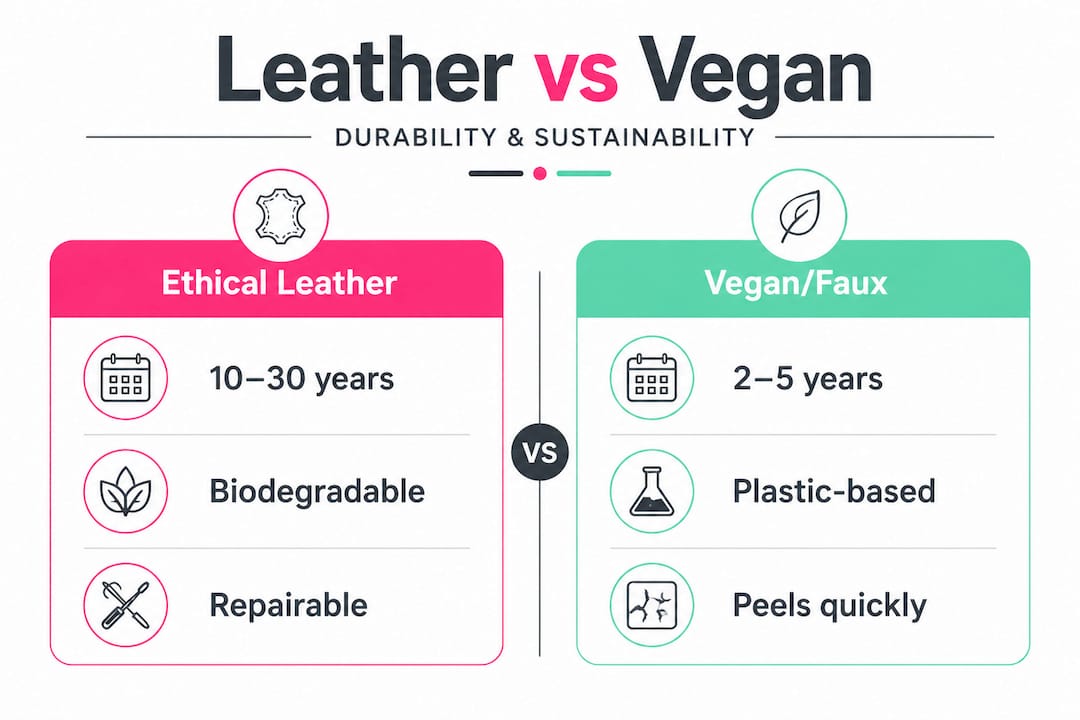
This table makes one thing clear: sustainability is not a single metric. If you optimize only for production-phase carbon, vegan leather wins in some scenarios. If you account for total lifecycle impact, repair potential, and end-of-life, ethical real leather often comes out ahead.
Why ethical leather matters for fashion and motorcycle gear: Performance, safety, and personalization
Knowing how ethical leather compares in theory is one thing. Here’s how it delivers real-world value for those who care about performance, safety, and style.
Safety is not an afterthought
For riders, the stakes of material choice are literal. Abrasion resistance is the first line of defense in a slide, and leather outperforms most textiles and all synthetic leathers in that critical test. Motorcycle jacket performance evaluations consistently assess abrasion resistance, construction quality, and armor integration together, because no single factor protects a rider on its own.
Industry benchmarks for riding jackets center on cowhide thickness. Drum-dyed cowhide in the 1.1 to 1.2 mm range, combined with CE-certified armor at shoulders, elbows, and optionally the back, sets the standard for genuine protection. Ethical sourcing at this level means the hide comes from a traceable farm, processed at a certified tannery, with construction methods that preserve tensile strength throughout the jacket.
Understanding how cowhide vs buffalo leather perform differently, and knowing the factors that go into choosing motorcycle jacket material, helps riders make safety decisions with real data rather than assumptions.
Top 4 reasons ethical leather improves both style and safety
- Consistent quality control. Tanneries with LWG certification operate under ongoing audits. That means the hide going into your jacket was processed with controlled chemistry, which directly affects the leather’s hand feel, tensile strength, and surface consistency. You can feel the difference.
- Traceability enables customization. When a brand knows exactly where its leather comes from, it can make meaningful promises about grain type, thickness, and finish options. That traceability is what makes a bespoke jacket genuinely bespoke, not just a rename of a stock item.
- Longevity reduces your total cost. A jacket that lasts 15 years at a higher upfront price costs less per year than a “budget” piece replaced every three years. The pros and cons of leather in fashion always land in leather’s favor when you do that math honestly.
- Ethical construction practices preserve structural integrity. Double-stitched seams, reinforced stress points, and quality hardware are byproducts of a production process that values the material. Brands that trace their leather tend to treat the finished product with equal care.
Pro Tip: For motorcycle gear specifically, request the CE rating for armor panels and confirm seam construction is double or triple-stitched at the shoulders and elbows. These are objective, verifiable safety indicators that ethical producers are typically proud to share.
How to identify and buy truly ethical leather
Now that you know why ethical leather matters, discover how you can confidently recognize and select genuinely sustainable options on your next shopping trip.
Greenwashing in the leather industry is real. Terms like “eco-tanned,” “sustainable hide,” or “responsible sourcing” are marketing phrases unless backed by documentation. When you see claims like “eco-friendly tanning,” treat them as conditional and look for certification and LCA-style evidence before accepting them at face value.
Step-by-step buying process
- Ask for the tannery name or certification. Any brand committed to ethical sourcing can name its tannery. If they can’t or won’t, that’s a signal.
- Look for LWG status. Gold, Silver, or Audited status from the Leather Working Group is the most reliable third-party signal in the market right now.
- Check for a traceability story. This doesn’t have to be a documentary. Even a clear statement like “hides sourced from pasture-raised cattle in X region, processed at [named tannery]” counts.
- Evaluate construction for longevity signals. Look at seam quality, lining attachment, zipper hardware, and any listed repair services. A brand confident in its leather’s lifespan will offer maintenance guidance.
- Confirm repairability. Can the jacket be re-lined? Can zippers be replaced? These questions reveal whether the brand designed for longevity or for turnover.
- Test for spotting fake leather characteristics. Real leather has irregular grain patterns, a distinctive smell, and breathes differently from PU coatings. These physical tests still work, even for online purchases when you request samples.
Questions to ask any brand
- Where does your leather come from, and can you name the tannery?
- Do you hold or source from LWG-certified facilities?
- What tanning method is used, and how is wastewater managed?
- Can I get this jacket repaired, and do you offer that service?
- What is the expected lifespan of this product with normal care?
Brands that answer these questions clearly have earned serious consideration. Those that deflect into vague sustainability language probably haven’t earned it yet.
Our take: Why the smartest buyers don’t compromise on ethics or performance
Here’s the uncomfortable truth that the industry rarely says plainly: a high price tag and an ethical label are not the same thing. We’ve seen expensive jackets from prestigious brands that couldn’t name their tannery, and we’ve seen mid-range pieces that came with full traceability documentation and LWG certification. Price signals aspiration. Transparency signals integrity.
The smartest buyers we’ve encountered approach leather the same way they approach any long-term investment. They don’t optimize for the lowest price or the most compelling marketing story. They look for verifiable evidence of quality at every layer: the hide, the tannery, the construction, and the brand’s commitment to keeping that product functional for years.
Sustainability isn’t really about swapping leather for mushrooms or cactus pulp. It’s about buying less because what you buy lasts longer. A jacket with a documented lifecycle assessment and strong construction history isn’t just ethically sounder; it’s economically smarter. It costs less per year of use, requires less frequent replacement, and holds its aesthetic better as it ages.
We believe that understanding why real leather matters shifts buyers out of trend-chasing and into the more satisfying practice of building a wardrobe or gear collection with genuine staying power. That shift is good for your wallet, good for your ride, and genuinely better for the planet over any ten-year horizon.
Ready for a jacket that looks good, lasts, and matches your values?
Understanding ethical leather in this kind of depth puts you in a fundamentally stronger position as a buyer. You know what to look for, what questions to ask, and what claims to be skeptical of. The next step is finding a brand that actually delivers on those standards.
At Maker of Jacket, every customize your leather jacket option is built around genuine material quality and your personal specifications. From biker cuts to motorcycle suits, you choose the hide, the fit, the detailing, and the finish. Browse the full range of handmade leather jackets to see what ethically minded craftsmanship looks like in practice. And once your jacket arrives, our leather care guide makes sure it stays in peak condition for the long haul. This is what buying smarter actually looks like.
Frequently asked questions
How can I verify that leather is ethically sourced?
Look for traceability documentation, reputable certifications like LWG Gold status, and transparent information about tanning chemistry and repair services. Brands with nothing to hide share these details openly.
Is vegan leather really more sustainable than ethical real leather?
Not always. Many vegan leathers rely on plastics that peel within a few years and aren’t recyclable or biodegradable, making ethical real leather a stronger choice when total lifecycle impact is the measure.
Does ethical leather sacrifice performance for sustainability?
No. When sourced from certified tanneries and constructed with proper techniques, ethical leather delivers top-tier abrasion resistance and structural integrity. Performance standards for riding gear confirm that ethical sourcing and protective performance are fully compatible goals.
What should I ask brands before buying a leather jacket?
Ask about country of origin, tannery name, tanning method, third-party certifications, and whether the jacket can be repaired. Brands committed to ethical sourcing standards will answer these questions with specifics, not generalities.
Recommended
- Why Invest in Quality Leather – Long-Term Value Unpacked – Maker of Jacket
- Understanding the Pros and Cons of Leather Fashion – Maker of Jacket
- Understanding the Difference Between Faux and Real Leather – Maker of Jacket
- Why Leather Jackets Last: Durability Explained for Riders – Maker of Jacket
- Why avoid animal leather: sustainable style guide – The Cork Store


