

What Is Waterproofing in Jackets: a Buyer’s Guide


TL;DR:
- Most waterproof jackets rely on a system of membranes, coatings, and sealed seams to keep you dry. Proper maintenance with washing and heat reactivation of the DWR coating is essential for sustained performance. Selecting the right jacket depends on activity level, weather exposure, and balancing waterproof ratings with breathability.
Most people assume any jacket labeled “waterproof” will keep them dry no matter what. That assumption gets people soaked. What is waterproofing in jackets is actually a layered system involving membranes, coatings, sealed seams, and sometimes specialized zippers working together. No single element does the job alone. Getting it wrong at the purchase stage means spending good money on a jacket that fails you in the first serious downpour. This guide breaks down exactly how waterproofing works, what features to look for, and how to keep your jacket performing long after you buy it.
Table of Contents
- Key takeaways
- How waterproofing in jackets actually works
- Waterproof vs. water-resistant vs. water-repellent
- Key waterproof jacket features worth knowing
- Caring for your waterproof jacket
- Choosing the right waterproof jacket
- My honest take on waterproof jackets
- Build your jacket with Makerofjacket
- FAQ
Key takeaways
| Point | Details |
|---|---|
| Waterproofing is a system | True waterproofing requires a membrane, DWR coating, and sealed seams working together. |
| Ratings tell the real story | Hydrostatic Head ratings from 1,000mm to 20,000mm+ tell you how much rain a jacket can handle. |
| DWR vs. membrane confusion | The membrane stays waterproof longer; DWR wears off first and needs reactivating or reapplying. |
| Layer construction matters | 2-layer, 2.5-layer, and 3-layer builds affect durability, weight, and breathability in practical ways. |
| Maintenance extends performance | Washing, heat reactivation of DWR, and proper storage preserve your jacket’s waterproof lifespan. |
How waterproofing in jackets actually works
The core of a waterproof jacket is its membrane. Waterproof membranes contain microscopic pores that are large enough to let water vapor (sweat) escape outward but small enough to block liquid water droplets from getting in. This is why high-quality waterproof jackets can still feel breathable even in a heavy storm. Materials like Gore-Tex use expanded polytetrafluoroethylene (ePTFE) for this membrane layer, while more affordable options use polyurethane (PU) coatings that laminate directly to the inner fabric.
But the membrane alone is not the whole picture. The outer fabric gets treated with a Durable Water Repellent (DWR) coating. This coating causes water to bead up and roll off the surface rather than soaking into the fabric fibers. The DWR causes beading on the surface while the membrane handles any water that gets through. Without a working DWR, the outer fabric saturates, a condition called “wetting out,” which makes the jacket feel cold and heavy even if the membrane underneath is still technically blocking water.
Then there are the seams. Every stitch hole in a jacket is a potential entry point for water. Fully taped seams use waterproof tape bonded over every seam line on the inside of the jacket. Critical seam taping covers only the highest-stress areas like shoulders. Full seam taping covers every seam in the jacket. The difference between the two shows up fast when you are standing in a real downpour.
Waterproofness is measured using the Hydrostatic Head (HH) rating, which tells you how many millimeters of water pressure the fabric resists before leaking. Here is how those numbers translate to real-world rain:
- 1,000mm: Light drizzle, brief showers
- 5,000mm: Moderate, steady rain
- 10,000mm: Heavy rain and sustained downpours
- 20,000mm+: Extreme storms and high-exposure conditions
Pro Tip: Check both the waterproof rating and the breathability rating before you buy. A jacket rated at 20,000mm waterproof but only 10,000g/m²/24h breathability may work for standing in rain but will leave you drenched in sweat on an intense hike.
Waterproof vs. water-resistant vs. water-repellent
These three labels are not interchangeable, even though they often get treated that way on the shop floor.
Water-repellent jackets rely entirely on a DWR surface coating. Think waxed canvas or a treated nylon shell. Water-resistant jackets rely solely on DWR without any membrane layer. They shed a splash or light drizzle just fine, but the protection is entirely surface-level. Once the fabric fibers absorb enough moisture, the water moves through.
Water-resistant jackets perform slightly better but still have a hard ceiling. Water-resistant protection fails after roughly 15 to 20 minutes of heavy rain exposure. The construction simply does not include the membrane and seam sealing needed for sustained protection.
Waterproof jackets combine all three elements: a waterproof membrane, a DWR-treated outer fabric, and sealed seams. This combination provides sustained, reliable protection across extended exposure.
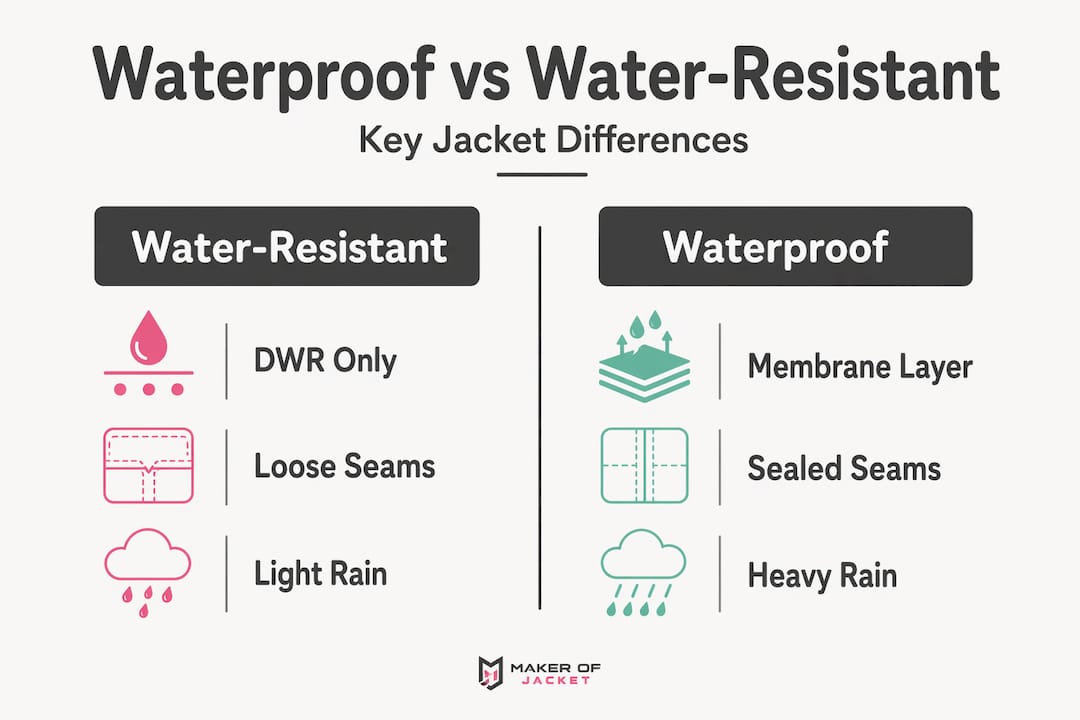
Here is a quick comparison to put it in perspective:
| Feature | Water-repellent | Water-resistant | Waterproof |
|---|---|---|---|
| DWR coating | Yes | Yes | Yes |
| Waterproof membrane | No | No | Yes |
| Sealed seams | No | Partial | Fully taped |
| Heavy rain performance | Poor | Moderate | Strong |
| Best use case | Light urban use | Short outdoor activity | Extended outdoor exposure |
Knowing where you actually use a jacket matters here. A commuter walking four blocks in a drizzle does not need the same jacket as a trail runner logging miles in a Pacific Northwest storm.
Key waterproof jacket features worth knowing
Understanding the individual features helps you read product specs without relying on marketing language.
- DWR coating: Applied to the outer fabric, this treatment makes water bead and roll off. It wears down over time with use, washing, and contamination. It is reactivatable with low heat, which is covered in the maintenance section below.
- Waterproof membrane: The core barrier between you and the rain. Membranes are either laminated directly to the outer fabric (bonded) or hung as a separate inner layer. Gore-Tex and polyurethane membranes are the most common. The key spec to check is the membrane’s own HH rating and breathability rating (measured in grams of moisture vapor per square meter per 24 hours).
- Fully taped seams: The gold standard for rainy-weather jackets. Every seam is sealed from the inside. Critically seam-taped jackets cut costs by only covering the most exposed seams at the shoulders and hood.
- Waterproof zippers: Waterproof zippers and zipper garages eliminate one of the most common leak points in any jacket. They are stiffer to operate than standard zippers but worth it if you spend real time in heavy rain.
- Layer construction: The way a jacket bonds its layers affects feel, durability, and packability significantly. The 2, 2.5, and 3-layer constructions each have distinct trade-offs. A 3-layer jacket bonds the outer fabric, membrane, and inner liner together into one piece. Durable, comfortable, but heavier. A 2.5-layer jacket drops the inner liner and prints a minimal pattern on the membrane surface instead. Light and packable, ideal for fast hiking or travel. A 2-layer jacket keeps the outer fabric and membrane separate from a hanging liner, making it more affordable and flexible but less packable.
Pro Tip: For activities like trail running or ski touring where you move fast and generate heat, prioritize breathability over maximum waterproof ratings. A jacket rated at 10,000mm with exceptional breathability will keep you more comfortable than a 20,000mm jacket that holds all your sweat in.
You can also review the essential features of windbreaker jackets to understand how wind resistance and water resistance often overlap in lighter shell designs.
Caring for your waterproof jacket
This is where most people lose performance without realizing it. A well-made waterproof jacket does not just stop working because of age. It stops working because of neglect.
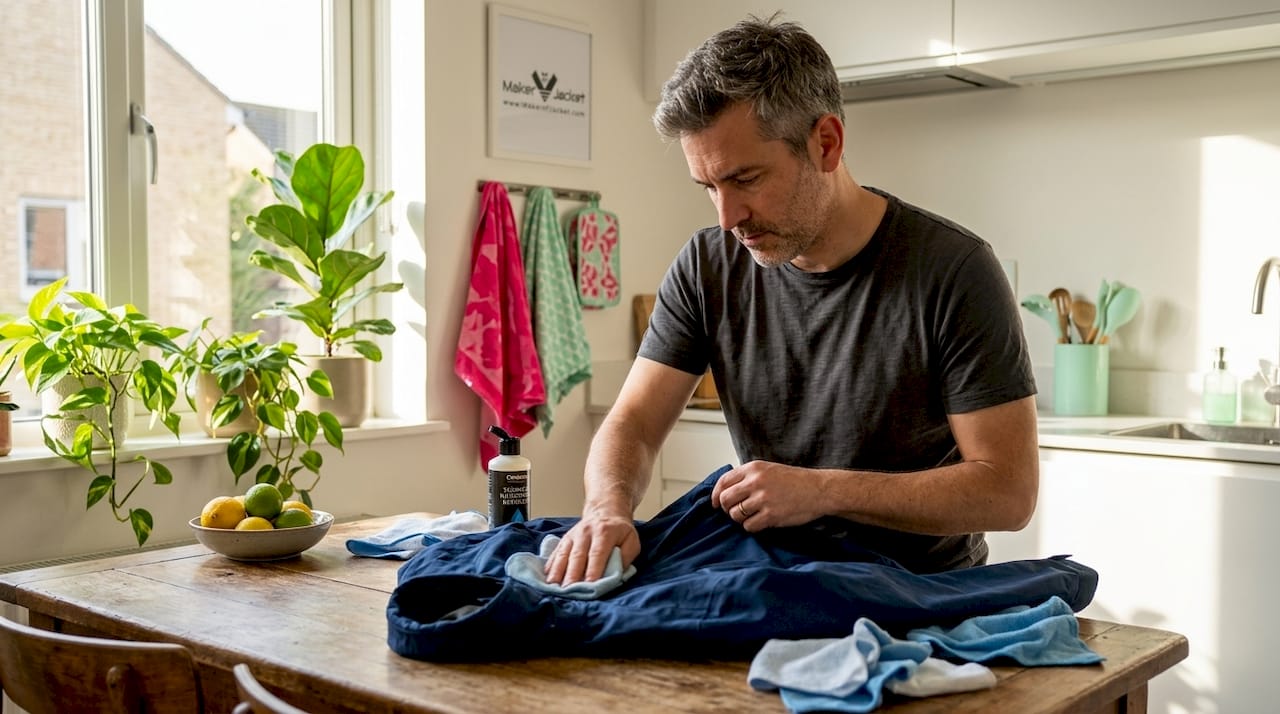
Contaminants like body oils, sunscreen, and insect repellent degrade the DWR coating and clog the membrane pores that allow breathability. The fix is regular washing with the right products. Here is how to do it correctly:
- Use a technical detergent: Standard detergents leave residue that clogs membrane pores. Products designed for waterproof outerwear are formulated to clean without damaging performance.
- Skip fabric softener: Softener coats the fibers and defeats the DWR treatment entirely.
- Wash on a gentle cycle: High spin speeds and hot water can degrade the membrane lamination over time.
- Reactivate the DWR with heat: Applying low heat after washing causes the water-repellent molecules in the DWR coating to stand back up, restoring the beading effect. Tumble dry on low or run a warm iron over the jacket surface with a cloth barrier for about two minutes.
- Store loosely: Compressing a waterproof jacket for long periods in a stuff sack can damage the membrane lamination.
One thing worth understanding clearly: the membrane stays waterproof through washing cycles. The DWR coating is what degrades. If your jacket is wetting out but you can see water still not soaking through completely, the membrane is still doing its job. The DWR just needs reactivating or eventually replacing with a spray-on DWR treatment.
For leather jackets specifically, the approach to waterproofing is different. The waterproofing process for leather uses oils and wax-based treatments rather than membranes, and the care routine reflects that.
Choosing the right waterproof jacket
With the technical foundation in place, the decision comes down to matching the jacket’s specs to your actual use.
- For high-output activities (trail running, ski touring, fast hiking): Prioritize breathability ratings over maximum waterproof ratings. A jacket with 10,000mm and a 20,000g breathability rating will outperform a 20,000mm/10,000g jacket when you are moving hard. High waterproof ratings reduce breathability and add weight, which becomes a real issue when your core temperature is elevated.
- For low-output or static use (hiking in heavy rain, fishing, sailing): Flip the priority. Maximum waterproof rating matters more than breathability when you are standing still in a storm.
- For travel or everyday use: A 2.5-layer jacket with a 10,000mm rating and reasonable breathability covers most urban and light outdoor scenarios without the weight of a full mountaineering shell.
- For budget-conscious buyers: A PU membrane jacket with critical seam taping and a 5,000mm rating delivers solid performance for moderate rain and costs significantly less than a premium Gore-Tex build.
A good jacket buying checklist walks through these decisions in a structured way if you want to map each feature to your specific activities before you purchase.
My honest take on waterproof jackets
I’ve tested a lot of jackets across a lot of conditions, and the single most persistent misconception I run into is that people blame the jacket when they should be looking at the DWR. A jacket that was keeping someone perfectly dry two years ago starts wetting out, they assume the jacket is defective or worn out, and they buy something new. Nine times out of ten, ten minutes in a dryer or a DWR spray would have fully restored the original performance.
The other thing most articles skip over is the breathability trade-off in real use. On paper, breathability ratings look straightforward. In practice, a jacket that performs brilliantly during a slow walk in rain will soak you in sweat during a 45-minute climb at pace. I’ve found that most people who spend a lot of time outdoors are better served by a moderately waterproof jacket with high breathability than by chasing the highest HH rating available.
The honest answer to “are waterproof jackets worth it” is yes, but only if you match the jacket’s system to how you actually use it and maintain it properly. A neglected premium jacket will lose to a well-maintained mid-range jacket every time.
— Maker
Build your jacket with Makerofjacket

At Makerofjacket, the approach to waterproof outerwear goes beyond off-the-shelf options. Whether you need a jacket built for serious weather exposure or a stylish piece that handles the daily elements, the platform lets you design a custom jacket with your chosen materials, layer construction, and waterproofing specifications. DWR treatments, membrane options, and sealed-seam construction are all part of what gets built into each order. You can also explore the customization process to see exactly how each jacket comes together from first spec to final product. Worldwide free shipping and a clear size guide take the guesswork out of ordering.
FAQ
What is the difference between waterproof and water-resistant?
Waterproof jackets use a membrane plus sealed seams and a DWR coating to block sustained rain. Water-resistant jackets rely only on DWR and fail after roughly 15 to 20 minutes of heavy rain.
How does jacket waterproofing work at the fabric level?
The membrane contains microscopic pores that block liquid water droplets while letting water vapor (sweat) escape outward, keeping you dry from both external rain and internal moisture.
What is a good Hydrostatic Head rating for a waterproof jacket?
A rating of 10,000mm handles heavy rain well for most outdoor activities. Ratings of 20,000mm or higher are designed for extreme storm conditions or extended high-exposure use.
Why does my waterproof jacket stop beading water?
The DWR coating wears down through use, washing, and contamination. The membrane beneath is usually still intact. Tumble drying on low heat or ironing with a cloth barrier typically reactivates the DWR and restores beading.
Are waterproof jackets worth the higher price?
Yes, for anyone spending real time outdoors in wet conditions. The combination of a membrane, taped seams, and waterproof zippers provides protection that water-resistant jackets cannot match once rain gets heavy or prolonged.


