

Airbag Jacket vs. Regular Motorcycle Jacket: What Changes

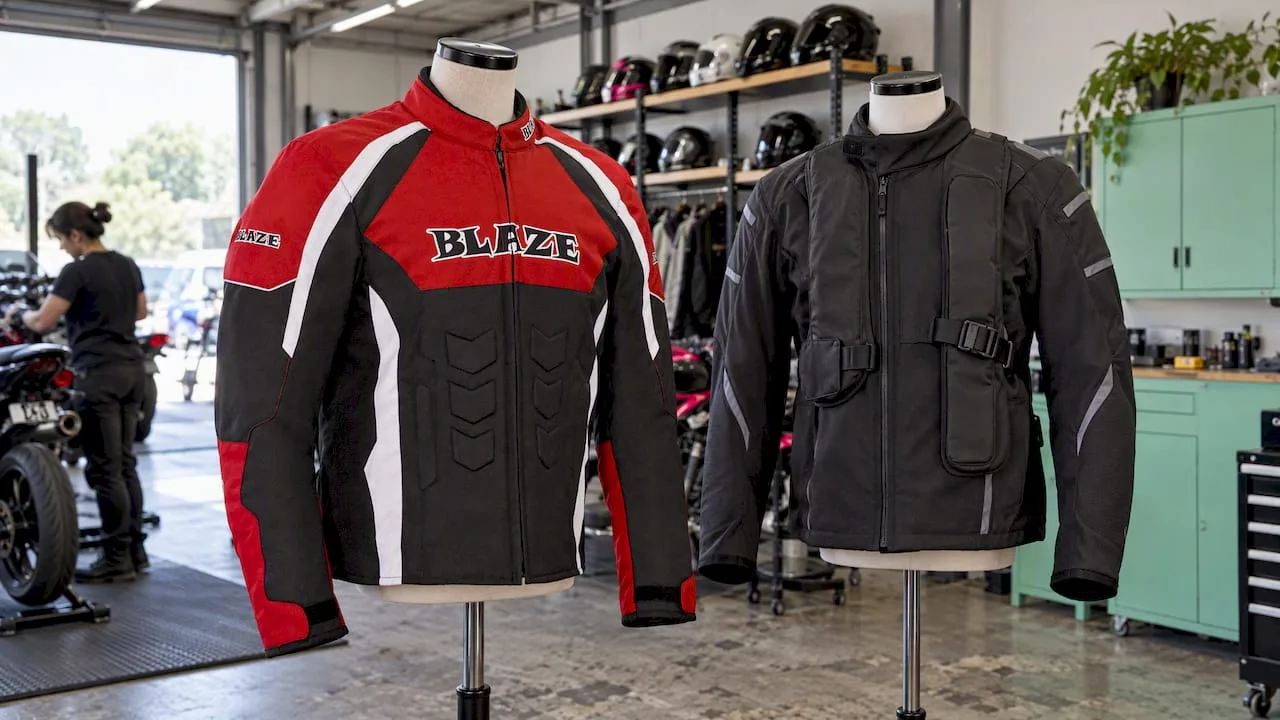
An airbag jacket adds something a regular motorcycle jacket cannot: it inflates around your torso in a crash. A regular jacket, whether leather or textile, protects you the whole time with abrasion-resistant material and fixed armor. Neither replaces the other in a simple way. The airbag is an extra layer that costs more and needs upkeep, and the regular jacket is the foundation you still need underneath or around it. This guide explains what each does, what they cost in the US, how fit changes, and how to choose.
TL;DR
- A regular armored jacket is passive protection: it resists abrasion and carries fixed padding at the shoulders, elbows and back. An airbag is active protection: it detects a crash and inflates.
- Airbags add cushioning for the chest, back and neck, but they do not guarantee you walk away, and they are not a substitute for a durable jacket, gloves, pants, boots and a compliant helmet.
- Expect to pay hundreds more for an electronic airbag system, plus a service fee after it deploys. A regular leather or textile jacket has no recharge or battery to manage.
- Airbags need extra room in the chest, about 4 cm (roughly 1.5 inches) under a jacket, so fit matters more than with a regular jacket.
- For most street riders, the best order is a well-fitted, certified jacket first, then an airbag layer if the budget and riding style justify it.
Table of Contents
- What a regular motorcycle jacket does
- What an airbag jacket adds
- Airbag jacket vs. regular jacket, side by side
- Motorcycle airbag vs. armor: which protects what
- What an airbag jacket costs in the US
- Fit: the part most riders get wrong
- Armored hoodie vs. leather jacket
- How to choose
- Our perspective
- Build the jacket your airbag will fit over
- FAQ
- Sources
What a regular motorcycle jacket does
A regular motorcycle jacket is built around three jobs: stop the road from tearing through the garment, hold armor in the right place, and keep you comfortable enough to wear it every ride.
NHTSA’s national motorcycle safety agenda says well-constructed jackets and protective clothing can prevent abrasions and bruises, and impact-resistant materials may help prevent fractures and serious torso or spinal-cord injuries. That is the baseline every rider gets from ordinary riding gear. The Road Collision Investigation Project came to a similar conclusion in the UK: motorcycle protective equipment gives more collision protection than ordinary non-motorcycling clothing.
The armor inside is passive. It is already in place when you fall, and it does not depend on a sensor, a tether or a battery. That is its strength and its limit. Foam or composite pads spread a blow over a wider area, but they cannot add volume around you. Research is also thinner than many riders assume: a systematic review found only two small cross-sectional studies on back protectors and concluded that evidence on their effect on spinal injuries is limited. The right takeaway is not that armor is pointless. It is that nobody should oversell any single piece of gear.
Leather, textile and mesh
Leather has long been the default for abrasion resistance, which is why it still dominates sport and cruiser riding. Textile jackets usually win on weather protection, with removable liners and waterproof membranes. Mesh jackets trade some of that for airflow in hot weather. If you are weighing those materials, our guides to features of quality motorcycle jackets and mesh motorcycle jackets go deeper.
What an airbag jacket adds
An airbag jacket, or an airbag vest worn over or under a jacket, contains a folded bladder and a gas source. When the system senses a crash, the bladder inflates quickly around the body.
There are two main triggers:
- Mechanical (tethered): a cord connects you to the bike. IIHS explains that when rider and motorcycle separate, the tether activates a CO2 cartridge and the vest inflates within milliseconds.
- Electronic: sensors and a control unit read your movement and the bike’s, then fire the inflator without any cord. A peer-reviewed article by Suzanne Reimer describes both approaches, a tether or electronic sensors with an onboard control system, inflating around the back, shoulders, kidneys and chest. MCN’s US buyer’s guide describes the same split in plain terms: mechanical tether or electronic sensors releasing compressed gas into the bladder.
Reimer frames the central difference clearly. Conventional armor is passive protection already present at impact. An airbag is active protection that detects the crash and deploys extra energy-absorbing volume. That extra volume is what you are paying for.
What an airbag does not promise
Bennetts’ 2026 airbag review cautions that an airbag can significantly reduce serious-injury risk but cannot guarantee that injury is prevented, and that severe or high-speed impacts can exceed what any riding gear can handle. The RAC Foundation’s safety notice adds a practical warning: some airbag products may not activate and inflate quickly enough in a crash. That discussion refers to UK standards, not US rules, but the point holds anywhere: check what the specific product has been tested for.
Also keep designs apart. IIHS notes that real-world effectiveness studies had not been conducted for a motorcycle-mounted frontal airbag. That is a different device from a wearable airbag jacket, and it is a reminder not to treat every airbag design as equally proven.
Airbag jacket vs. regular jacket, side by side
| Factor | Regular armored jacket | Airbag jacket or vest |
|---|---|---|
| How it protects | Abrasion-resistant shell plus fixed armor | Same shell and armor if worn over a jacket, plus an inflating bladder |
| Type of protection | Passive, always in place | Active, triggered by a crash |
| Power or upkeep | None | Battery charging and firmware updates (electronic) or a cartridge to replace (tethered) |
| After a crash | Inspect, replace damaged armor or the jacket | Professional servicing or a new cartridge, often with a fee |
| Fit | Snug and comfortable | Needs extra chest room for inflation |
| Typical US cost | Wide range, from budget to custom | Usually adds several hundred dollars on top |
| Weak point | No added cushioning volume | Depends on the trigger working and on the gear around it |
Motorcycle airbag vs. armor: which protects what
The two do different work, so framing it as airbag versus armor can mislead.
Armor and the jacket shell handle sliding and localized impact. The shell keeps you from losing skin on pavement, and the pads cover the points most likely to hit first: shoulders, elbows, back.
The airbag covers the large area armor leaves open. Think chest, ribs, abdomen, collarbone, and in some designs the neck. It adds cushioning where a flat pad cannot.
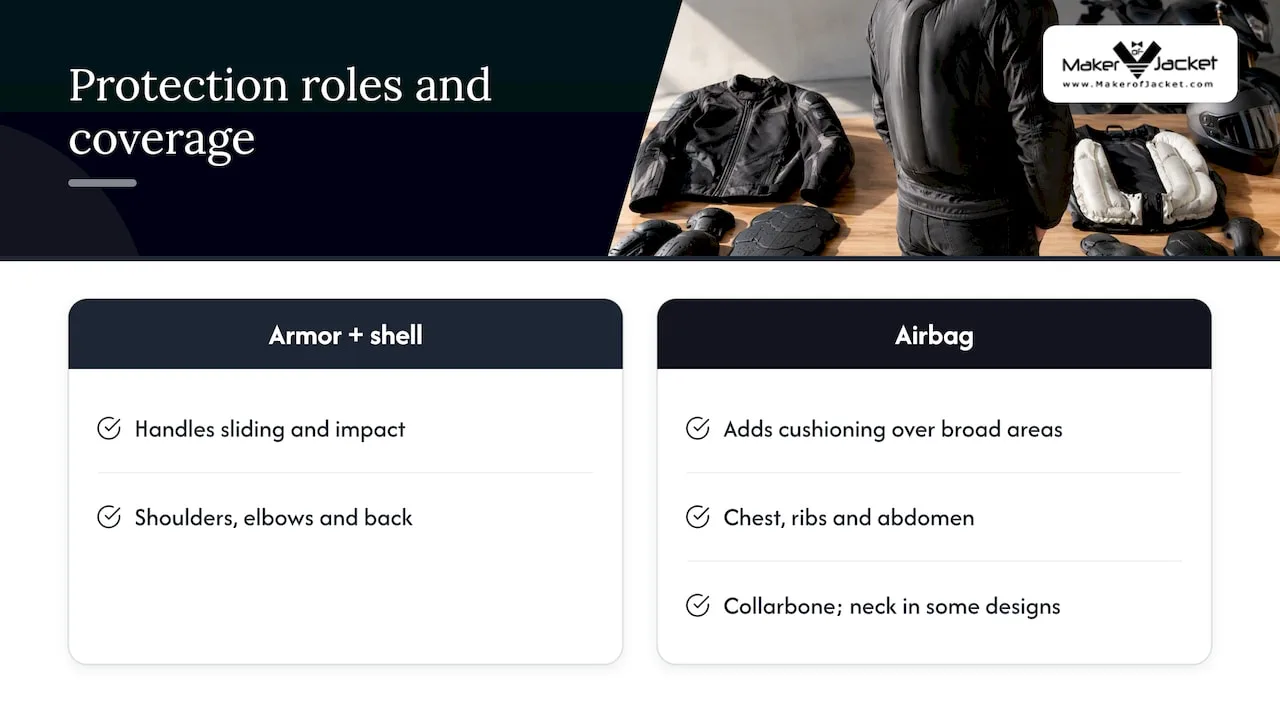
NHTSA’s guidance treats protective clothing as a package. In that light, an airbag belongs on top of a durable jacket, armor, gloves, pants, boots and a compliant helmet, not in place of them. If your budget allows only one upgrade, a properly certified jacket with good armor and a correct fit comes first for most riders.
What an airbag jacket costs in the US
Prices vary by brand and by whether the system is tethered or electronic, but real figures help.
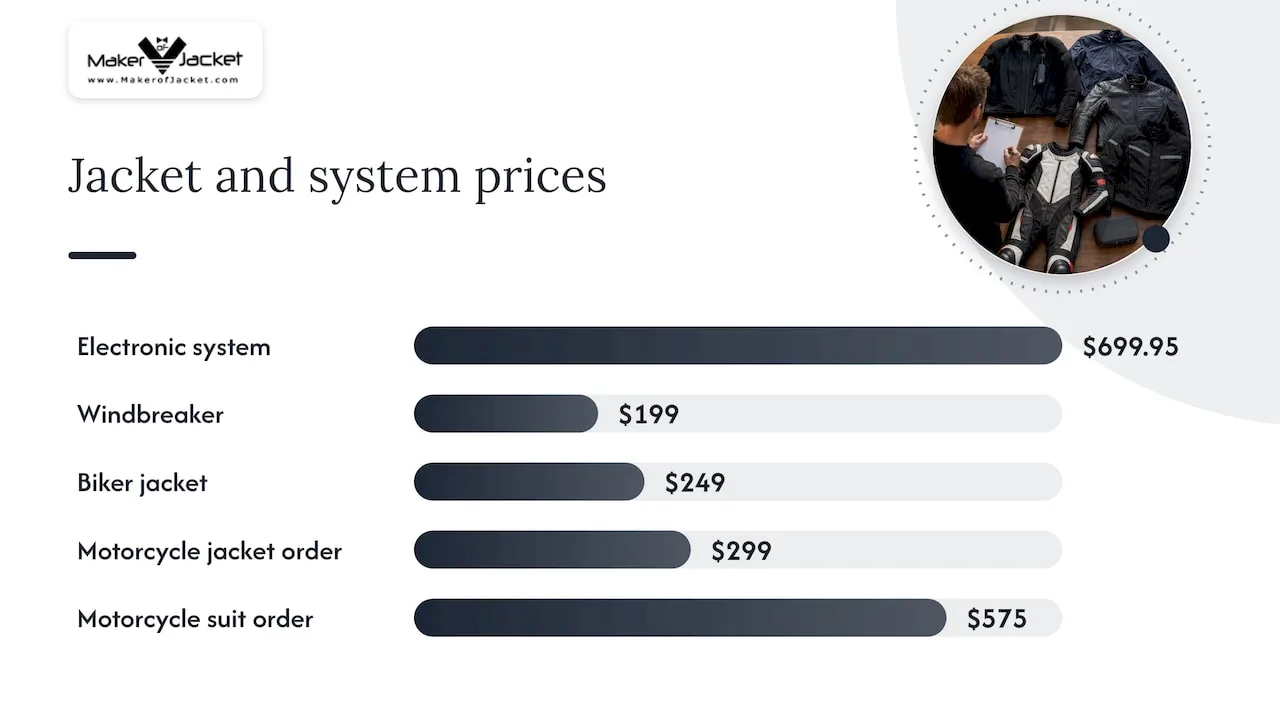
One widely reviewed electronic system, tested by Motorcycle.com, costs $699.95, and after deployment the maker charges $299 for inspection, repacking and recharging. Another review of that same system notes a battery lasting up to 30 hours per charge and an app that delivers firmware updates. So the true cost of ownership is the purchase price, plus a service fee if it ever fires, plus the habit of keeping it charged and updated.
Compare that with our own custom jackets, which have no battery and no post-crash recharge fee:
| Custom item | Price |
|---|---|
| Custom Windbreaker Jacket | $199 |
| Custom Biker Jacket | $249 |
| Customize Motorcycle Jacket Order | $299 |
| Custom Suede Leather Jacket | $299 |
| Custom Studded Jacket | $349 |
| Customize Motorcycle Suit Order | $575 |
The motorcycle jacket order at $299 costs less than half of that electronic airbag system’s purchase price. That does not make the two equivalent, since they protect in different ways. It does show where the money goes if you are building a kit from scratch.
Fit: the part most riders get wrong
An airbag needs room. Motorcycle.com’s test explains that riders need about 4 cm of chest space under a leather or textile jacket so the bladder can inflate. If you wear a vest under a jacket that already fits snugly, you may be buying a system that restricts itself or a jacket you cannot close.
The Motorcycle Safety Foundation’s guidance on protective gear says clothing should fit comfortably without binding, with materials chosen for your riding habits, local weather and budget. Before you buy an airbag, try it on over the exact jacket you plan to wear, in your riding position, with the layers you wear in cold weather.
Two ways to solve it
- Vest over the jacket. This avoids tight fit, but the vest sits in the airflow and the weather.
- Vest under a larger jacket. Cleaner look and more weather protection, but you must size the jacket up or have it made with room. A made-to-measure jacket suits this well, because the chest and torso can be specified instead of guessed. See our custom motorcycle jackets for how that works.
Armored hoodie vs. leather jacket
Many riders ask this when the choice is really about everyday use rather than airbags. An armored hoodie looks like streetwear with pads sewn in and usually rides cooler and feels more casual. A leather jacket is heavier and stiffer, but leather has a long record as a tough abrasion barrier, and the shape of the jacket holds armor in place.
Which one fits depends on how you ride:
- Short urban trips, warm weather, low speeds: a hoodie you will actually put on every time beats a jacket left on the hook. Look for a certification label and removable armor, and do not assume padding alone equals protection.
- Highway speeds, long rides, cold weather or sport riding: leather or heavy textile gives you a sturdier shell and a better chance of staying intact in a slide.
- Mixed use: a leather jacket for fast days and a lighter option for hot errands is a common answer.
Whichever you pick, the gear you wear every ride protects you more than the gear you skip because it is hot or inconvenient. An airbag layer can sit over either one, provided the fit works.
How to choose
Use these questions in order.
- How and where do you ride? Commuting in traffic, weekend canyons and touring have different crash profiles and different comfort limits.
- Do you have a certified jacket that fits? If not, solve that first. It is the layer you cannot skip.
- Is your budget for one item or two? A good jacket plus a later airbag is a sound path. A cheap jacket plus an expensive airbag is not.
- Will you maintain it? Electronic systems need charging and updates. If you will forget, a tethered system or no airbag may suit you better.
- Does the fit leave room? Remember the 4 cm rule for inflation.
- Will you wear it every time? Comfort, ventilation and style all feed into this answer.
Our perspective
We make jackets, so we see the same pattern from the customer side. Riders come to us worried about protection and style, and many have never had a jacket cut for their own torso. A jacket that pinches in the shoulders or rides up in the back is a jacket people leave at home, and that is a bigger risk than any gap in features.
So our advice is plain. Start with the jacket: good leather or textile, armor in the right places, a cut that fits your size and your riding posture. We build custom pieces by hand from premium-grade materials, to your size and style preferences, which matters most if you plan to add an airbag layer later and need extra room in the chest. If you add an airbag, think of it as a second system, with its own cost, upkeep and fit rules. And never treat any single product as a promise that you will be unhurt.
Our safety guides, motorcycle jacket safety features and safety tips for better protection, cover what to check on any jacket before you ride.
— Maker
Build the jacket your airbag will fit over
If you want a jacket made around your measurements, including the chest room an airbag layer needs, start with our custom order range. The Customize Motorcycle Jacket Order is $299, the Custom Biker Jacket is $249, and the Customize Motorcycle Suit Order is $575. We offer worldwide free shipping and 24/5 support if you have sizing questions before you order.
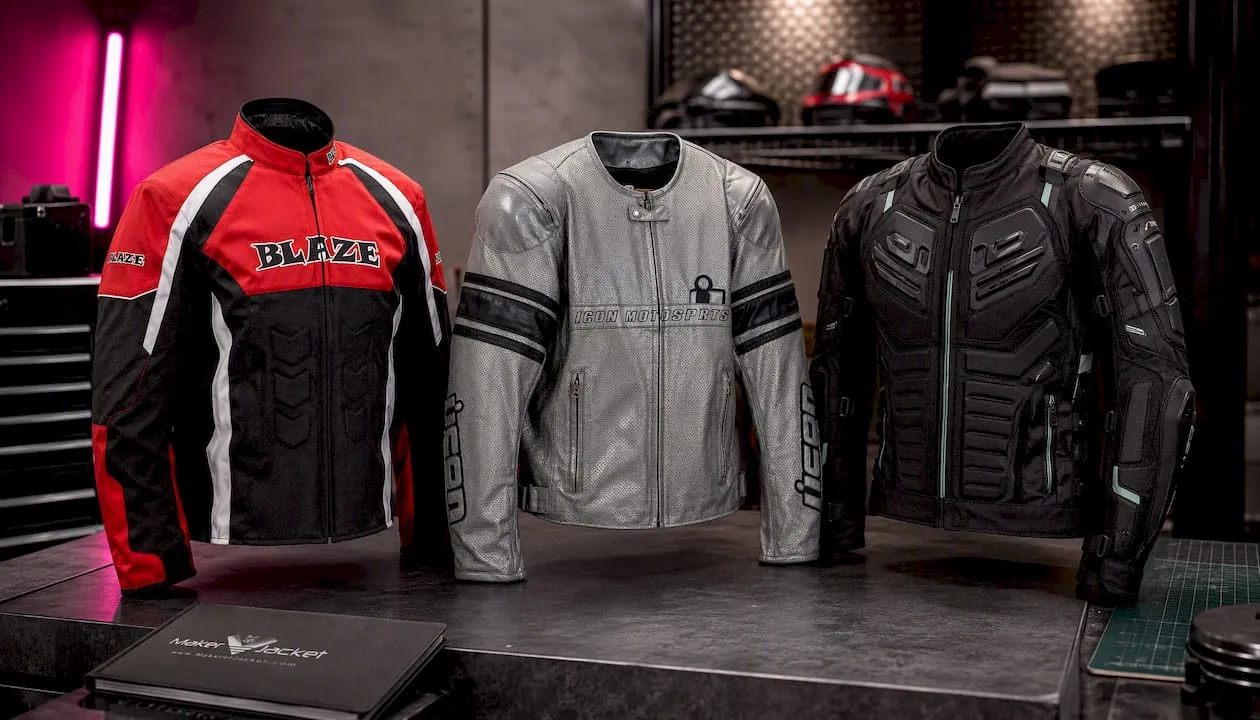
If you would rather start from a ready-made piece, browse our leather motorcycle jackets, such as the black and red leather armor jacket.
FAQ
Is an airbag jacket worth it compared with a regular jacket?
It can be, if you ride at higher speeds or on busy roads and can afford both a good jacket and the airbag. It adds cushioning for the chest, back and neck, but reviewers caution it cannot guarantee you avoid injury. A well-fitted certified jacket should come first.
Can I wear an airbag over or under my regular jacket?
Yes, many vests are designed for both. Under a jacket, you need roughly 4 cm of extra chest room so the bladder can inflate, which often means sizing the jacket up. Try the combination on before buying.
What happens after an airbag deploys?
It usually needs servicing or a new cartridge before you can ride with it again. For one popular electronic system, the maker charges $299 for inspection, repacking and recharging. Check the service terms for any system before you buy.
Is an armored hoodie as safe as a leather jacket?
Not necessarily. Leather generally offers sturdier abrasion resistance, while a hoodie is easier to wear daily in warm weather. Look for certification on any armored hoodie and choose by your typical speed and conditions.
Does an airbag replace armor?
No. NHTSA’s guidance treats protective clothing as a package, so the airbag is an added layer on top of a durable jacket, armor, gloves, pants, boots and a compliant helmet.


