

$150–$4,000: Motorcycle Suit Cost in the US and a $575 Custom Option

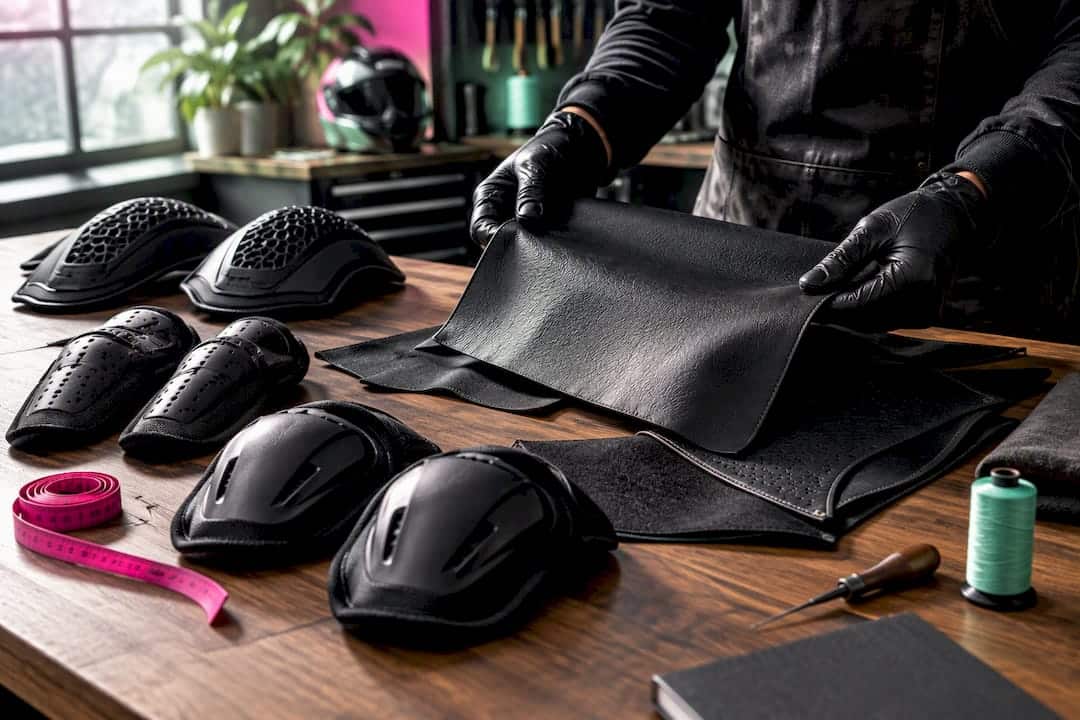
A motorcycle suit typically runs from $150 for a basic textile touring piece to $4,000 or more for a custom leather race suit, with MotoGP-level gear pushing past $10,000 once you add sanctioned upgrades. Fit, materials, and armor quality drive most of that spread, far more than brand names do. If you’re commuting, look at the lower bands below; if you’re racing or building a bespoke setup, skip ahead to the custom and race pricing sections.
TL;DR:
- Lower-cost textile suits around $150 to $400 prioritize weather resistance and basic CE armor but offer limited abrasion protection.
- Entry-level leather suits priced between $400 and $900 feature cowhide construction with crash-tested CE armor, suitable for casual riding.
- Mid-range leather suits from $900 to $1,800 improve on durability, with reinforced stitching and better armor, ideal for longer rides or occasional racing.
- Custom and race suits cost $1,800 or more due to precise fitting, advanced materials, external sliders, and personalized design features, enhancing protection during high-speed crashes.
- Always verify if armor inserts are included when comparing suit prices, as separate chest and back protectors can add $50 to $150 and significantly impact overall safety performance.
Table of Contents
- Price breakdown by suit type
- What actually drives the price of a motorcycle suit
- How custom and race suit pricing gets built
- How to save money without cutting corners on protection
- Maker of Jacket: how our custom suit pricing lines up
- Financing and payment plans for higher-end suits
- Costs beyond the sticker price
- What a suit actually costs you over time
- Warranty coverage and what service costs after you buy
- Choosing by rider profile
- Ready to start your custom motorcycle suit order
- Sources
- FAQ
Price breakdown by suit type
Suit prices split into clear tiers, and knowing which one matches your riding style keeps you from overpaying or under-protecting yourself. Here’s how the market generally breaks down.
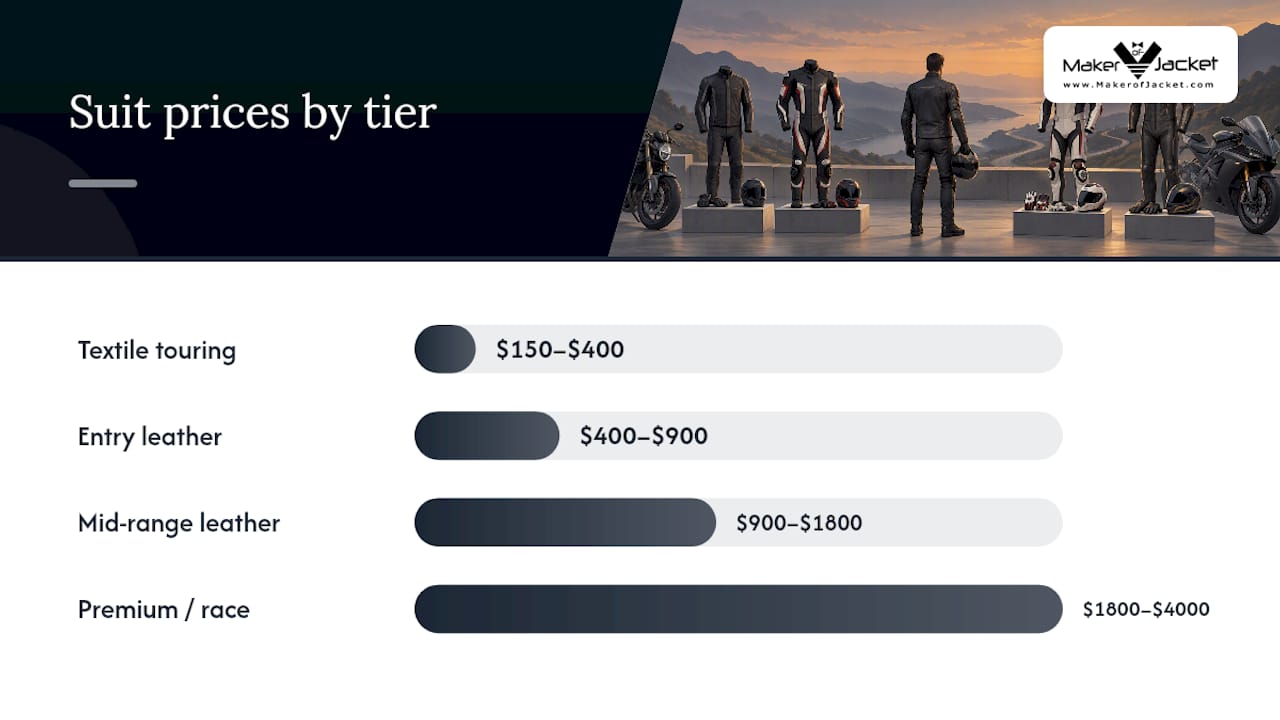
- Textile touring suits ($150 to $400): These use synthetic weaves like Cordura or ballistic nylon, include basic CE armor at the shoulders and elbows, and prioritize weather resistance over abrasion resistance.
- Entry-level leather suits ($400 to $900): Full cowhide construction with foam or basic CE-rated padding, usually a two-piece design with a zip connection at the waist.
- Mid-range leather suits ($900 to $1,800): Thicker hide, reinforced stitching at stress points, better-rated armor, and often a choice between one-piece and two-piece cuts.
- Premium and race-grade one-piece suits ($1,800 to $4,000 and up): Race-cut leather, external sliders, stretch panels at the knees and elbows, and provisions for back protectors and airbag systems.
One-piece suits generally cost more than two-piece suits at the same quality level because they demand more precise pattern work and a full-body zipper system that has to hold under crash loads. A two-piece suit trades some of that protection for everyday convenience. You can wear the jacket alone in town and zip on the pants for longer rides. Riders serious about track days tend to land on one-piece designs, while commuters and weekend riders often prefer the flexibility of two-piece setups.
Feature sets scale with price in predictable ways. A budget textile suit gets you basic abrasion resistance and removable liners for weather. Step into entry leather and you gain real crash-tested hide plus CE-certified armor at the shoulders, elbows, and knees. Mid-range suits add stretch panels, better ventilation, and stronger seams. At the premium end you’re paying for race-grade external sliders, pre-curved sleeves for a riding posture, and stitching dense enough to survive a slide at speed.
Warranty coverage tends to track price too. Budget suits often carry limited coverage on stitching defects only, while mid-range and premium suits from established makers more commonly include coverage on armor components and workmanship for a year or more. Read the fine print before you buy: a suit with no meaningful warranty is a signal to check construction quality closely, not necessarily a dealbreaker if the price reflects that risk. For a broader look at how suit types compare, our guide to the different types of motorcycle suits breaks down which style fits which kind of riding.
What actually drives the price of a motorcycle suit
Two suits can look identical on a rack and cost hundreds of dollars apart. The difference almost always comes down to five things: leather source, fabric grade, construction quality, armor certification, and any electronics built in.
- Leather type: Cowhide is the industry standard, durable and relatively affordable, while kangaroo leather is lighter and stronger per millimeter of thickness, which is why race suits favor it despite the higher cost.
- Textile grade: Cordura, ballistic nylon, and laminated waterproof membranes each add cost as you move up, with laminated multi-layer fabrics commanding the highest prices in the textile category.
- Construction quality: Stitch count, double or triple stitching at stress panels, and reinforced seams all add labor cost but are what actually keeps a suit intact during a slide.
- Armor and certification: CE-rated protectors at the shoulders, elbows, and knees are standard, but chest and back inserts are frequently sold separately and typically add $50 to $150 to the total price.
- Electronics and airbags: Heated liners and airbag-ready modules push a suit’s price well above a standard version of the same model.
Chest and back protector inserts commonly add $50 to $150 to a race suit’s advertised price, since many manufacturers sell the base suit “prep-ready” and treat safety-critical inserts as optional add-ons.
Choosing between cowhide and kangaroo isn’t just about price. Cowhide gives you a thicker, more forgiving hide that’s easier to repair after minor wear, while kangaroo’s tighter fiber structure lets makers cut it thinner without losing strength, which matters when every ounce affects a racer’s mobility. Our breakdown of leather materials for motorcycle jackets covers the trade-offs in more depth if you’re deciding between the two.
Pro Tip: Check whether chest and back inserts are included before comparing two suits by price alone. A suit that looks $150 cheaper may just be missing armor you’ll need to buy separately.
Independent testing has found that price and brand name don’t reliably predict protective quality: some lower-cost suits have outperformed pricier ones on seam strength and construction. That’s a good reason to check specifications rather than assume a higher sticker price always means better protection.
How custom and race suit pricing gets built
Custom and race suits cost more because you’re paying for precision, not just materials. A made-to-measure program has to translate your exact body dimensions into a pattern that keeps armor pockets and stretch panels aligned while you’re leaned over at speed, and that level of fit takes real measurement work.
Programs building race-ready leathers commonly take up to 23 separate body measurements to make sure protective panels and armor pockets land exactly where they need to during a crash. That precision is the main reason a bespoke suit costs more than an off-the-rack piece in the same material and armor class, and it’s also why a well-fitted custom suit tends to protect better: armor that shifts out of place during a slide doesn’t do its job.
A driver of custom-suit pricing is the up to 23 separate body measurements many made-to-measure programs used to ensure protective panels and armor pockets align correctly.
Add-ons stack on top of the base custom price:
- Chest and back protector inserts: typically $50 to $150 depending on protection level.
- External sliders: knee and shoulder sliders add a modest amount per suit but are close to mandatory for track use.
- Race numbering and logos: custom graphics, team colors, or sponsor logos add production time and cost.
- Full custom colorwork: a unique graphic scheme costs more than a stock color option because it requires custom panel cutting rather than a repeatable template.
Lead times matter as much as line items. A standard custom order takes measurable production time to cut, stitch, and fit-check a suit built around your body. Rush orders compress that timeline and typically carry a premium, and every round of alterations after the first fitting adds both time and cost. If you know your event date, order early: a suit rushed through production has less room for the fit corrections that make custom suits worth the extra money in the first place.
How to save money without cutting corners on protection
A budget suit is a reasonable choice if you’re commuting short distances at moderate speeds. It becomes a risky choice if you’re doing highway miles or track days, where higher-speed slides put more demand on armor and seam strength. Buying used is one of the most reliable ways to close that gap.
- Check the seams first. Run your fingers along stress points at the shoulders, elbows, and crotch, looking for loose thread or stretched stitching.
- Inspect the armor. Confirm CE-rated protectors are still present, undamaged, and correctly positioned, since a suit with missing or shifted armor isn’t worth buying at any discount.
- Look at slider wear. Ground-down sliders suggest the suit has already been in a crash, which is a reason to ask for the suit’s history or walk away.
- Flex the leather. Grain that’s cracking or stiff instead of supple has lost some of its abrasion resistance.
- Smell the lining. Persistent odor usually means moisture damage that’s degraded the interior over time.
Used suits in good condition often sell well below their original retail price, with older or heavily worn pieces discounted further. Whatever you save, never compromise on intact CE-rated armor or seam integrity: those are the two things standing between you and the pavement.
Pro Tip: A used suit with fresh armor and clean seams is a better buy than a new budget suit with unrated foam padding.
Maker of Jacket: how our custom suit pricing lines up
Maker of Jacket’s Customize Motorcycle Suit Order is priced at $575, positioning it in the mid-range to premium band described above, built around handcrafted construction and materials chosen for your size and style preferences. Ordering starts with a design preview, moves into measurement and confirmation, and finishes in production, with your material choice, tailoring, and any customization work making up the bulk of that price.
Each piece is built with care and materials chosen for your size and style preferences, and orders include free shipping worldwide and customer support. If you want to see how customization affects fit and safety more broadly, our piece on the advantages of a custom-fit motorcycle suit covers why precise sizing matters beyond comfort.
Financing and payment plans for higher-end suits
High-end suits and full custom orders represent a real cost jump, and many retailers offer some form of installment or buy-now-pay-later option at checkout to spread that cost over a few months. Availability and terms vary by retailer and by the payment provider integrated into their checkout, so check the specific options listed on the product page before you order. If a suit’s price sits at the upper end of your budget, splitting the cost over several payments can make sense, provided you understand the interest terms, if any apply, before you commit. Always confirm terms directly with the seller rather than assuming a plan.
Costs beyond the sticker price
The base price on a suit rarely reflects your final cost. Shipping fees vary depending on the retailer’s policy, and some suits are quoted with free shipping while others add a charge at checkout. Sales tax applies based on your location and is calculated at the time of purchase. Alteration fees come into play if a suit needs adjustment after arrival, and custom orders sometimes include limited alterations in the base price while others charge separately for changes after production. Ongoing maintenance, leather conditioner, zipper lubrication, and occasional professional cleaning, adds a small but recurring cost over the life of the suit. Budgeting an extra amount above the sticker price for these items keeps you from being surprised at checkout or a year into ownership.
What a suit actually costs you over time
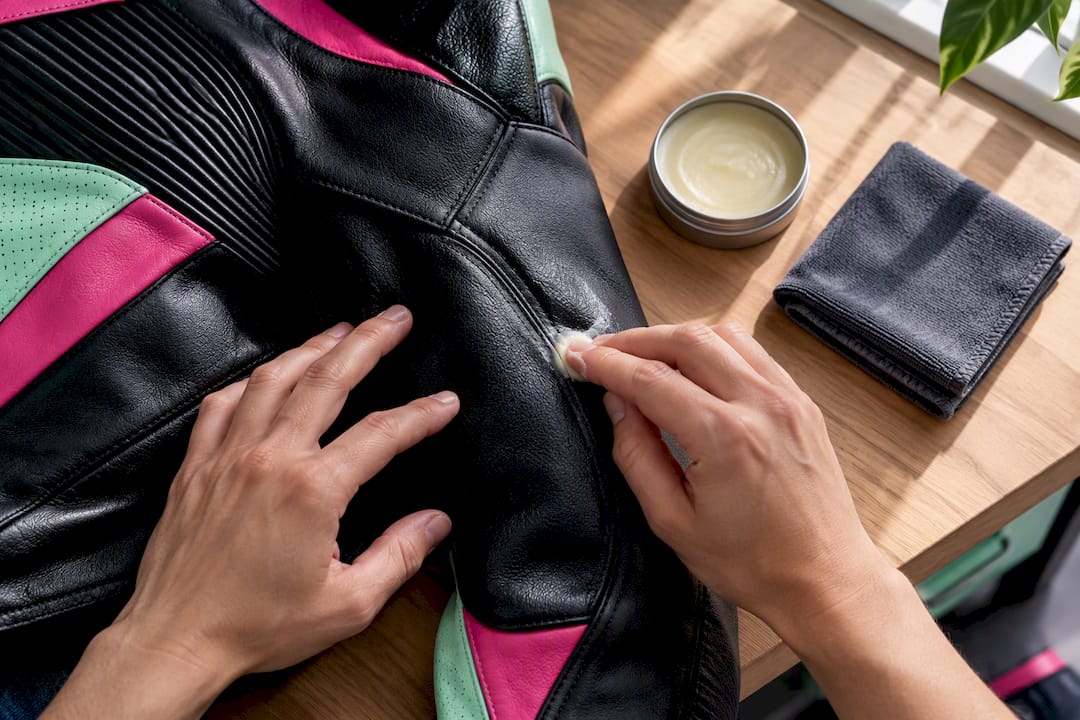
A motorcycle suit isn’t a one-time purchase if you ride regularly. Leather needs conditioning every few months to stay supple and crack-resistant, and textile suits need their waterproof membrane refreshed periodically to keep performing in rain. Armor doesn’t wear out the way fabric does, but it should be replaced after any impact, regardless of how the suit looks afterward. Most riders get several years of regular use out of a well-maintained suit before wear at the seams, cuffs, or armor pockets signals it’s time to replace it. Factoring in conditioner, occasional repairs, and eventual replacement gives you a more honest sense of what a suit costs across its life, not just what it costs on the day you buy it. Proper motorcycle cleaning and care routines apply the same logic to the bike itself: regular upkeep protects the investment you’ve already made.
Warranty coverage and what service costs after you buy
Warranty terms differ widely between retailers, and it’s worth reading them before you buy rather than after something fails. Some suits carry coverage limited to manufacturing defects in stitching, while others extend to armor components for a year or more. After-purchase service, such as replacing worn armor pads or repairing a seam, is sometimes offered by the original seller and sometimes requires a third-party leather repair shop. Custom orders occasionally include a limited alteration window after delivery, but that’s not universal, so confirm what’s covered before you place an order. A suit with a longer warranty and clear service options is generally the safer bet if you’re choosing between two suits at a similar price.
Choosing by rider profile
If you commute short distances at moderate speeds, a textile or entry-level leather suit covers your needs without overspending. Weekend sport riders logging real miles benefit from mid-range leather or a premium two-piece setup, where better armor and seam strength earn their keep. Track riders and racers should budget for a custom or race suit, plus separate money for chest and back inserts, sliders, and periodic armor replacement after any hard crash. Match the suit to how you actually ride, not to what looks impressive hanging in a shop.
— Maker
Ready to start your custom motorcycle suit order
Getting a quote starts with picking your base style, choosing your leather or textile material, and submitting your measurements through the Customize Motorcycle Suit Order page. Most riders should expect a first quote to land near the $575 base price before any add-ons, with the design preview stage giving you a chance to adjust details before production begins.
- Review sizing details on our custom motorcycle suit page before submitting measurements.
- Use the custom jacket ordering guide to understand each production step.
- Reach out through the order page if you need help choosing between leather and textile for your riding style.
Sources
FAQ
Are motorcycle suits worth the cost?
Yes, for anyone riding regularly, since a suit with CE-rated armor and solid construction reduces injury severity in a slide far more than street clothing does. The MSF’s protective gear guidance stresses that proper fit is critical for armor to actually function, which is why buying the right size matters as much as buying the suit itself.
What is the average cost of a motorcycle jacket?
Motorcycle jackets alone, separate from full suits, generally follow the same tiers as suits: budget textile pieces start low, while leather jackets with certified armor cost more depending on material and construction quality. Check the specific product listing for exact pricing, since ranges vary by material, brand, and armor level.
How much does a MotoGP-level race suit cost?
Professional race suits used at the MotoGP level are built to made-to-measure precision, often using up to 23 body measurements to align armor and stretch panels correctly. Retail race suits built to similar standards, like the REV’IT! Apex, start around $1,350 before chest and back inserts, which typically add another $50 to $150.
What is a good budget option for a race suit?
A good budget race suit prioritizes CE-rated armor and solid seam construction over brand name or added electronics, since independent testing has found that price alone doesn’t guarantee protective quality. Look for a suit with intact armor certification and check reviews for seam strength before comparing price tags.


