

Shoulder Fit Matters: Made to Measure vs Off the Rack, MTM

Made to measure beats off the rack whenever you have non-standard proportions, wear suits often, or want a piece built to last years, while off the rack wins when you need something tonight, have a standard build, or are working with a tight budget. The gap comes down to shoulder fit, half-canvas construction, and the 6-inch drop most off-the-rack jackets are built around. A made-to-measure fitting workflow exists exactly for the first group.
TL;DR:
- Shoulder fit is critical and cannot be corrected after construction in off-the-rack suits, making made-to-measure ideal for non-standard proportions.
- Made-to-measure suits typically cost between $399 and $3,000, offering better fit, construction, and customization options than most off-the-rack options.
- Half-canvas construction balances quality and cost, providing superior drape and durability, with alterations limited mainly to hems and tapering.
- Speed favors off-the-rack suits for urgent needs, while made-to-measure usually requires 3 to 6 weeks and at least one fitting for precise fit adjustment.
- For frequent wear or long-term use, investing in a made-to-measure suit ensures longer-lasting garments that can be let out or repaired, reducing waste and environmental impact.
Table of Contents
- Made to Measure vs Off the Rack: Fit and Construction
- What Suits Actually Cost, From Rack to Bespoke
- How Much Say You Get Over Fabric and Details
- Timeline: When Speed Beats Precision
- How to Choose Between Custom and Ready-Made
- What a Real Made-to-Measure Fitting Looks Like
- Returns Get Complicated Once a Garment Is Custom
- Which Option Actually Wastes Less
- Why Makerofjacket Leans Toward Custom First
- Order a Custom Piece Built Around Your Measurements
- Sources
- FAQ
Made to Measure vs Off the Rack: Fit and Construction
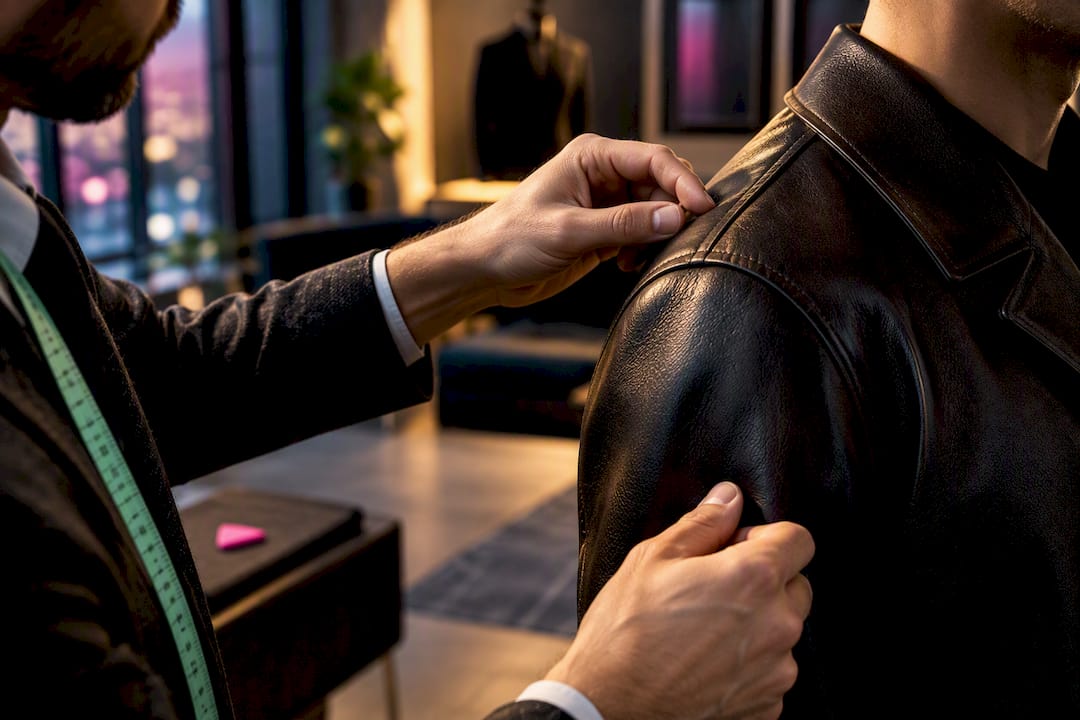
Shoulder fit decides almost everything else about how a jacket looks on you. It’s the one measurement no tailor can meaningfully correct after the fact, because the shoulder seam, sleeve pitch, and collar roll are all built into the pattern before a single stitch goes in. Off-the-rack jackets ship with fixed shoulders sized to a statistical average, and if your shoulders slope more than that average or sit wider than the size that fits your chest, no amount of alteration will fix it cleanly.
That average build is the whole logic behind off-the-rack sizing. Manufacturers cut jackets and trousers around a standard 6-inch drop, the difference between jacket chest size and trouser waist size, because it fits a large slice of male body types reasonably well. It fits nobody perfectly. Made to measure starts from a similar base block, but a fitter adjusts that block using your actual measurements, commonly 10 to 20 data points covering shoulder slope, arm length, chest shape, and posture, before the garment is cut.
Construction matters just as much as the pattern. A fused jacket glues the canvas interlining to the outer fabric, which holds its shape at first but tends to bubble and separate over time, especially with dry cleaning. Half-canvas and full-canvas construction stitch that interlining in by hand instead, letting the fabric drape over your body rather than sit stiffly on top of it.
Half-canvas construction typically hits the best balance of cost and performance, breathing better and aging more gracefully than fused builds while costing less than full canvas. Alterations can shorten sleeves, nip a waist, or hem trousers. They cannot rebuild a shoulder, move a collar seam, or fix a jacket that was simply cut for a different body than yours.
- Shoulder and sleeve pitch: fixed on off the rack, adjusted on made to measure
- Chest-to-waist drop: standardized at 6 inches on most off-the-rack suits
- Canvas construction: fused (off the rack default), half-canvas (common MTM upgrade), full canvas (premium tier)
- Alterations: reliable for hems and taper, unreliable for shoulders and collars
What Suits Actually Cost, From Rack to Bespoke
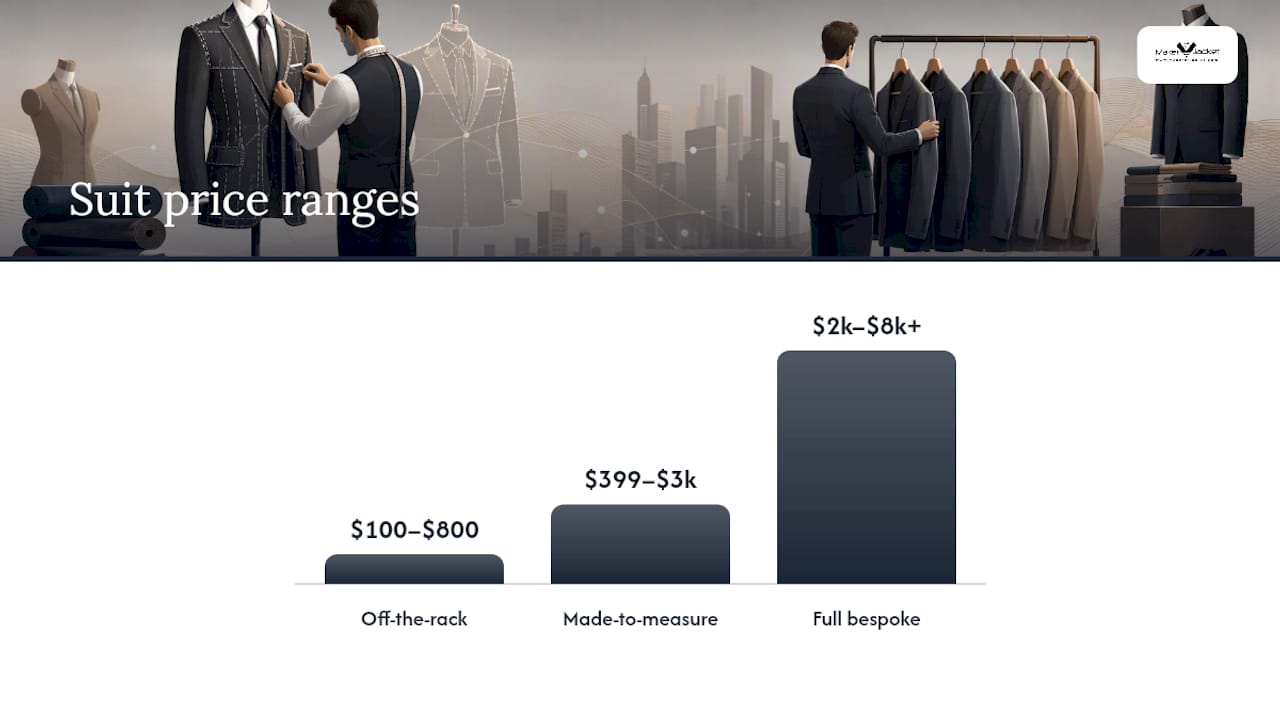
Sticker price tells you almost nothing until you factor in what happens after you buy. Off-the-rack suits run roughly $100 to $800, made-to-measure suits span $399 to $3,000, and full bespoke starts around $2,000 and climbs past $8,000 depending on cloth and the house doing the work.
That off-the-rack number is misleading on its own, though, because almost nobody walks out wearing the suit exactly as it hangs.
- Basic hemming and waist adjustment: often included or under $50
- Sleeve and shoulder adjustments: commonly $75 to $200 depending on the shop and how much reworking the jacket needs
- Full re-tailoring of a poor-fitting jacket: can approach or exceed the price gap between that suit and entry-level made to measure
A $250 off-the-rack suit plus $150 in alterations lands close to $400, right at the floor of the made-to-measure range, and that’s before you account for the fact the MTM version was built for your shoulders from the start rather than adjusted around a shape it was never cut for.
Cost-per-wear is where construction pays for itself. A fused $300 suit that starts bubbling at the lapel after two years of regular wear costs more per year than a $600 half-canvas made-to-measure suit that still holds its shape at year five. If you’re buying one suit to wear fifty times a year for the next decade, the higher upfront number is usually the better deal. If you need something for one event, the math flips.
How Much Say You Get Over Fabric and Details
Made to measure hands you real control over the finished garment, not just the fit. A typical order lets you choose:
- Cloth weight and weave, from lightweight tropical wool for warm climates to heavier flannel for cold ones
- Lining color and pattern, often a place to add a personal touch invisible until the jacket opens
- Lapel style and width, notch, peak, or shawl, sized to suit your frame rather than whatever the factory run included
- Vent style, center, side, or none, which affects how the jacket moves and sits when you walk or sit down
- Pocket styles, flap, jetted, or patch, plus working versus non-working buttonholes
- Trouser rise and break, adjusted to your actual leg length instead of a standard inseam chart
Off-the-rack customization usually means picking from a handful of pre-set combinations a brand already manufactured, not building a jacket around your specs. Some retailers market “customization” that’s really just choosing between two or three lining swatches on a jacket whose shoulder pattern never changes. Full bespoke goes further still than made to measure, drafting a pattern from scratch and involving hand-padded lapels and hand-set sleeves that add both cost and weeks of hand labor. For most buyers, made to measure delivers the customization that actually changes how the suit fits and feels, without bespoke’s price or timeline.
Timeline: When Speed Beats Precision
Off the rack wins on speed, full stop. You can walk into a store, try on three sizes, get basic hemming done, and walk out wearing a suit within an hour or a day depending on how busy the tailor is. That makes it the right call for a wedding you found out about last week or a job interview tomorrow morning.
Made to measure asks for patience. Typical turnaround runs 3 to 6 weeks, versus bespoke’s 6 to 12 weeks or longer, and most providers want at least one fitting to confirm the adjustments before the final garment ships.
- First MTM order: treat it like a prototype, since the first delivery is where fit gets dialed in
- Repeat orders: faster and more accurate once a provider saves your pattern adjustments
- Online MTM: convenient for submitting measurements remotely, but shipping adds time an in-studio fitting skips
- In-studio fitting: slower to schedule but catches fit issues before the final cut
How to Choose Between Custom and Ready-Made
Run through this before you buy anything:
- How often will you wear it? A few times a year points toward off the rack; monthly or more points toward made to measure.
- Does your body match standard sizing? Average proportions make off the rack a reasonable bet; a long torso, sloped shoulders, or an athletic build make MTM worth the wait.
- What’s your budget ceiling? If alterations pushed an off-the-rack suit past $400, compare that total against entry-level MTM pricing before deciding.
- How soon do you need it? Anything under two weeks generally rules out made to measure.
If two or more of those point toward customization, made to measure is the better call.
Before ordering, ask any provider three direct questions: do they save your measurements for future orders, what canvas construction is standard versus an upgrade, and what happens if the finished garment doesn’t fit right. A vague answer on any of those three is a warning sign.
Pro Tip: Ask to see or photograph your saved pattern record after the first fitting. A provider with nothing to show you probably isn’t actually saving your adjustments for next time.
Watch for red flags: no clear alteration or remake policy, marketing that uses the word “canvas” without specifying fused, half, or full, and any “fully customizable” pitch that skips fittings entirely.
What a Real Made-to-Measure Fitting Looks Like
A trustworthy MTM process starts with measurements that specifically address shoulder slope and the chest-to-waist drop, the two areas standard sizing gets wrong most often. Makerofjacket’s fitting workflow captures those figures up front, then keeps them on file so a repeat order skips redundant measuring and starts closer to correct on the first try.
Before committing to any provider, ask to see how they document your measurements, whether that record carries over to future orders, and what their policy is if the first fit needs revision. A provider willing to show you the paper trail is one worth trusting with a $500 garment. Makerofjacket’s approach to custom jacket ordering follows that same logic: measurements saved, adjustments tracked, and a clear path back to the tailor if something needs correcting after delivery.
Returns Get Complicated Once a Garment Is Custom
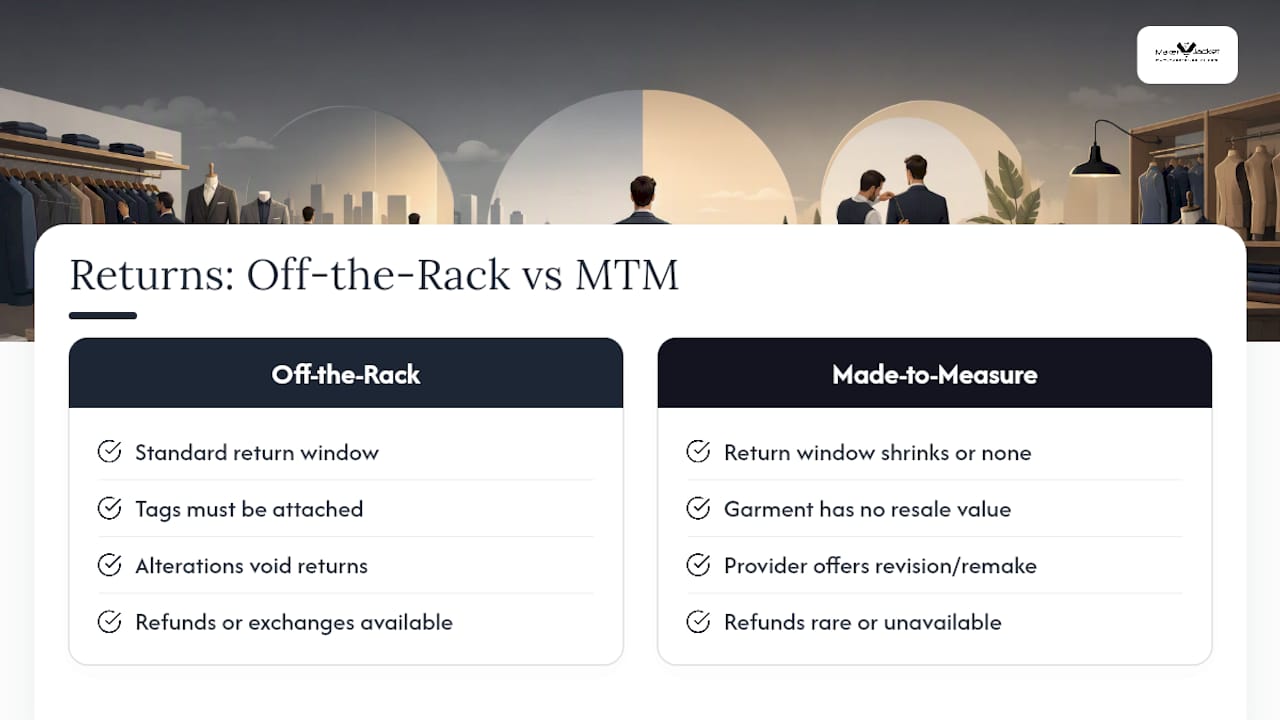
Off-the-rack suits carry standard retail return policies because the garment never changed. Most stores accept a return or exchange within a set window as long as tags are attached and the suit hasn’t been altered, which gives buyers real flexibility if the size is wrong or they change their mind.
Made-to-measure garments break that model. Once a suit is cut to your specific measurements, it has no resale value to the retailer, so return windows shrink or disappear entirely. What most reputable MTM providers offer instead is a revision policy: if the delivered garment doesn’t match the measurements submitted, they’ll adjust or remake the specific problem area rather than issue a refund.
That distinction should shape how you shop. Before ordering anything made to measure, find the provider’s written policy on fit issues rather than assuming a standard retail return applies. Ask specifically what happens if the shoulder doesn’t sit right or the sleeve length is off after the first wear, since those are the areas most likely to need a second look. A provider with no stated remake or revision policy is asking you to take on all the risk of a first-time fit, which is a reasonable deal-breaker if you’re spending several hundred dollars on a single piece.
Off the rack keeps the safety net of a simple return. Made to measure trades that net for a garment built around you, backed by a provider’s willingness to fix it if the first attempt misses.
Which Option Actually Wastes Less
The sustainability case for made to measure is less about the fabric and more about how long the garment stays in rotation. A suit built to fit your actual shoulders and drape correctly gets worn for years; a suit that never quite fit right tends to get pushed to the back of the closet after a season, regardless of how well it was made.
Off-the-rack production runs on volume. Brands manufacture standard sizes in bulk to hit price points, which means overproduction and unsold inventory are baked into the business model. Some of that stock gets discounted, some gets liquidated, and a portion never sells at all. Made-to-measure production is closer to made-to-order: a garment gets cut once a specific customer commits to it, which cuts down on the unsold inventory problem that drives so much textile waste industry-wide.
Longevity matters more than either point, though. Half-canvas and full-canvas construction hold up to repairs and re-tailoring in ways fused construction doesn’t, so a well-built MTM suit can be let out, taken in, or refreshed years down the line instead of replaced outright. A fused suit that starts separating at the lapel is usually headed for the donation bin or the landfill, not the tailor’s bench. If sustainability matters to your buying decision, the math favors fewer garments bought more deliberately over a wardrobe cycled through every year or two.
Why Makerofjacket Leans Toward Custom First
Most people asking whether to go custom already suspect the answer. If you’ve bought three suits in the last five years and none of them sat right at the shoulder, that’s not bad luck. It’s a pattern problem no alteration will solve, and it’s exactly the case Makerofjacket built its fitting process around.
Off the rack still makes sense plenty of the time. If your build is close to standard and you need a suit by Friday, buy the suit and get it hemmed. Save custom for the pieces you’ll actually wear for years.
— Maker
Order a Custom Piece Built Around Your Measurements
Once you’ve decided fit matters more than convenience, ordering shouldn’t feel like a second research project. Makerofjacket’s custom jacket ordering process captures your measurements once, applies them to the style and materials you choose, and keeps that record on file so a second order starts from a fit that’s already dialed in rather than from scratch.
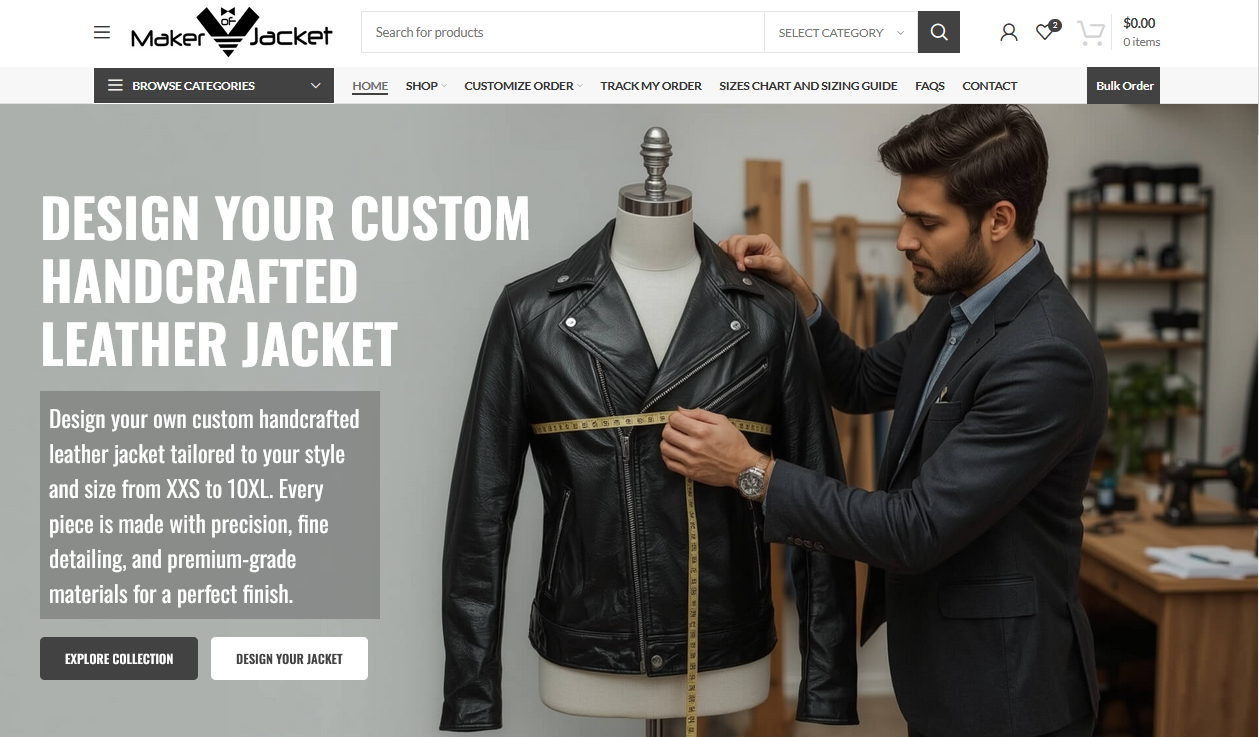
The site’s customize order category covers everything from biker and bomber jackets to trench coats and motorcycle suits, each built to your size and detail preferences with worldwide free shipping included. Every piece is handcrafted using premium-grade materials rather than assembled from a standard factory run, and pricing stays published on the site instead of hidden behind a quote request. If a shoulder has never fit right off the rack, start your custom jacket order today and get a garment built around your actual measurements from the first cut.
Sources
- Made to measure — Wikipedia
- Bespoke vs made-to-measure vs off-the-rack — Nathan Tailors
- Made-to-measure guide — BespokeUnit
- Made to measure vs off-the-rack suits for men — Dunnio Tailor
FAQ
Is a $500 Suit Considered Cheap?
Not for made to measure. A $500 price sits comfortably within the $399 to $3,000 made-to-measure range, often getting you half-canvas construction and a fit adjusted to your actual measurements. For off the rack, $500 lands toward the upper end of that category’s $100 to $800 range, typically buying better fabric but still a fixed, unadjusted pattern.
How Much Should I Pay for a Made-to-Measure Suit?
Expect to pay somewhere in the $399 to $3,000 range depending on fabric quality and construction. Half-canvas builds toward the middle of that range typically offer the strongest balance of durability and price.
Is Made to Measure the Same as Tailored?
Not exactly. Made to measure adjusts an existing base pattern using 10 to 20 of your measurements, while full bespoke tailoring drafts a pattern entirely from scratch for one person. Off-the-rack suits altered by a tailor afterward are neither. They’re a fixed pattern with limited fixes applied on top.
What Is the Difference Between a $500 Suit and a $5,000 Suit?
A $500 suit usually falls in the made-to-measure range, built from an adjusted base pattern with half-canvas or fused construction. A full bespoke suit starts around $2,000 and climbs significantly higher, hand-drafted from scratch with full-canvas construction and significantly more hand labor, which is what drives the price gap between the two.
Should I Buy Custom If I Only Wear a Suit Once a Year?
Probably not. Off the rack makes more sense for infrequent wear, tight budgets, or urgent deadlines, since basic alterations can get you a wearable fit in a day. Save made to measure for suits you’ll wear regularly or keep for years, where the fit and construction investment actually pays off.


