

How to select jacket material for style, comfort, and safety


TL;DR:
- Jacket material impacts comfort, safety, durability, and style suitability for different needs.
- Choice depends on climate, activity, style preferences, and maintenance considerations.
- Custom options allow tailored jackets optimized for individual conditions and aesthetic priorities.
You finally find a jacket that looks incredible online, order it, and then realize it traps heat like a greenhouse every time you wear it. Or worse, you buy a sleek leather piece only to discover it weighs you down on a long ride. Picking the wrong jacket material is one of the most common and costly mistakes riders and fashion lovers make. Material affects how a jacket feels against your skin, how long it lasts, how safe it keeps you, and whether it actually fits your lifestyle. This guide walks you through everything you need to choose the right material with confidence.
Table of Contents
- Understanding jacket materials: Pros and cons
- Assessing your needs: Climate, activity, and style preferences
- Step-by-step: How to select your ideal jacket material
- Care, maintenance, and longevity tips for your chosen material
- Expert perspective: Why material matters more than brand
- Find your perfect jacket: Custom options and expert help
- Frequently asked questions
Key Takeaways
| Point | Details |
|---|---|
| Choose by climate | Select jacket material that suits your usual weather for all-day comfort and protection. |
| Verify material quality | Check stitching, feel, and texture to ensure you get a durable, stylish jacket. |
| Consider activity needs | Pick tougher materials for riding and lighter fabrics for everyday fashion. |
| Maintain for longevity | Proper care keeps jackets looking great and safe to wear for years. |
| Customize for personal style | Personalized jackets let you tailor material, fit, and finish to your exact preferences. |
Understanding jacket materials: Pros and cons
Now that you know how much jacket material can affect comfort and safety, let’s break down your main options.
There are four major categories of jacket materials: leather, textile, synthetics, and hybrids. Each one has a distinct personality, and none of them is universally perfect. The right choice depends on what you’re asking the jacket to do.
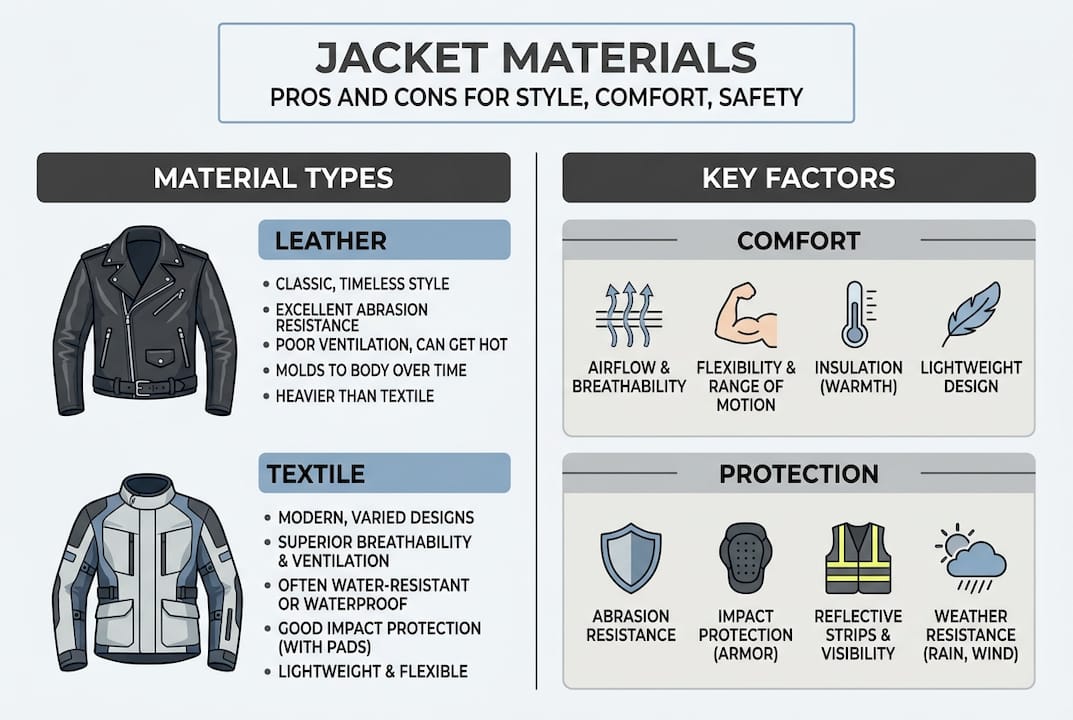
Leather is the classic choice for both fashion and motorcycle riding. It offers a timeless look and serious protection. As noted in our guide on jacket material types, leather offers unmatched durability but can be heavy and less breathable. Full-grain leather is the top tier, while split leather is more affordable but less resilient.
Textile materials like nylon, polyester, and Cordura are lighter and often more breathable than leather. They’re popular in motorcycle gear because modern weaves can rival leather in abrasion resistance while being far easier to clean. They also tend to handle weather better.
Synthetics such as faux leather and PU (polyurethane) are budget-friendly and animal-free. They mimic the look of leather but typically don’t match its long-term durability or feel. Still, for fashion-focused wear, they’re a solid option.
Hybrid materials combine the best of multiple worlds, pairing leather panels in high-impact zones with textile panels for ventilation and flexibility. Many high-end motorcycle jackets use this approach.
Here’s a quick comparison to help you visualize the differences:
| Material | Style appeal | Protection | Breathability | Maintenance |
|---|---|---|---|---|
| Full-grain leather | Very high | Excellent | Low | High |
| Textile (Cordura) | Moderate | Very good | High | Low |
| Synthetic/PU | High | Moderate | Moderate | Low |
| Hybrid | High | Excellent | Moderate | Moderate |
Key takeaways at a glance:
- Leather is best for classic style and maximum abrasion resistance
- Textile suits riders who prioritize ventilation and weather versatility
- Synthetics work well for fashion wear without a heavy price tag
- Hybrids offer a smart middle ground for serious riders who want both comfort and protection
Understanding these trade-offs upfront saves you from buyer’s remorse later.
Assessing your needs: Climate, activity, and style preferences
With the material basics covered, the next step is to match your choice to your real-world needs.
No two riders or fashion lovers live in the same conditions. Someone in Miami has completely different jacket needs than someone in Seattle. Your climate is the first filter you should apply.
Seasonal needs should steer material selection; lighter fabrics for warmer climates, heavier for cold. Our all-seasons jacket guide breaks this down in detail. In humid, hot regions, breathable textiles or perforated leather are your best friends. In cold or wet climates, you want insulation and water resistance built into the material or added as a liner.
Here’s a simple framework to assess your needs:
| Factor | What to look for | Recommended material |
|---|---|---|
| Hot and humid climate | Breathability, ventilation | Perforated leather, textile |
| Cold weather riding | Insulation, wind resistance | Full leather, hybrid |
| Rainy conditions | Waterproofing | Textile with DWR coating |
| Urban fashion wear | Aesthetics, lightweight | Synthetic, slim leather |
| Long-distance riding | Abrasion resistance, comfort | Hybrid, thick textile |
Next, think about your actual activity. Are you commuting daily, hitting weekend rides, or wearing the jacket mostly off the bike? A jacket built for serious road protection will feel stiff and heavy in a coffee shop. A fashion-forward piece won’t keep you safe at highway speeds.
Here’s a step-by-step way to assess your activity needs:
- Write down how many hours per week you’ll wear the jacket on a bike versus off it
- Identify your typical riding speed and road type (city streets vs. highways)
- Consider whether you need CE-rated armor compatibility in the material
- Think about how often you’ll be in rain or extreme temperatures
- Factor in how much you care about the jacket doubling as everyday fashion
Finally, think about your personal aesthetic. Modern riders want gear that looks good on and off the bike. Classic leather gives you that timeless edge. Textile gear has caught up visually, with sleek cuts and colorways. For fit and comfort tips that go beyond material, it’s worth exploring how cut and construction interact with fabric choice.

Pro Tip: Don’t just pick a material based on photos. If possible, wear a jacket made from your shortlisted material for at least 30 minutes before committing. How it feels after half an hour tells you far more than how it looks on a hanger.
Step-by-step: How to select your ideal jacket material
Once your needs are clear, here’s how to put that knowledge into practice and select a material with confidence.
Selecting jacket material isn’t just about knowing the options. It’s about verifying that what you’re buying actually delivers on its promises. The market is full of jackets that look premium but cut corners on material quality.
Follow this process:
- Define your primary use case. Riding, fashion, or both? This narrows your material category immediately.
- Set a realistic budget. Full-grain leather and high-end textile gear cost more upfront but last significantly longer.
- Check the material composition label. Look for specific fabric names (Cordura, full-grain, top-grain) rather than vague terms like “premium leather.”
- Inspect the stitching. As detailed in our guide on jacket quality checks, high-quality jackets can be verified through careful inspection of stitching and feel of the fabric. Tight, even stitching signals quality construction.
- Test flexibility and weight. A jacket that restricts your arm movement or feels uncomfortably heavy will end up in your closet, not on your back.
- Review the lining. Many buyers ignore the lining, but a poor lining ruins comfort regardless of how good the outer material is.
- Confirm safety certifications if riding. Look for CE Level 1 or Level 2 armor compatibility, especially in the shoulder and elbow zones.
Our jacket buying checklist covers every factor you should verify before purchasing.
“The most common mistake buyers make is focusing entirely on the outer shell and ignoring the lining, construction, and hardware. A jacket is only as good as its weakest component.”
Pro Tip: When shopping online, zoom into product photos to inspect stitching lines and seam edges. Brands confident in their quality will show these details clearly. If photos are blurry or only show the front, that’s a warning sign.
Avoiding common mistakes matters as much as following the right steps. Don’t assume a higher price always means better material. Don’t skip safety requirements just because a jacket looks tough. And never ignore the lining.
Care, maintenance, and longevity tips for your chosen material
After you’ve chosen your material and verified quality, knowing how to keep your jacket looking and performing its best is essential.
Even the best jacket material will degrade quickly without proper care. Proper care extends jacket life and preserves its appearance, which means your investment keeps paying off for years. The care routine varies significantly depending on what your jacket is made of.
Leather care essentials:
- Clean with a damp cloth and leather-specific cleaner, never harsh detergents
- Condition every 3 to 6 months using a quality leather conditioner to prevent cracking
- Store on a wide, padded hanger away from direct sunlight and heat
- Apply a waterproofing spray before the rainy season
- Check out our detailed leather jacket maintenance guide for a full routine
Textile and synthetic care essentials:
- Most textile jackets can be machine washed on a gentle cycle, but always check the label
- Reapply DWR (durable water repellent) coating after washing to restore water resistance
- Air dry only. Machine drying can damage coatings and warp the structure
- Inspect seam tape and zippers regularly since these fail before the fabric does
Hybrid jacket care:
- Treat leather panels with conditioner and textile panels with DWR spray separately
- Avoid submerging the jacket in water; spot clean leather sections instead
For riders, maintenance also means safety maintenance. Check armor pockets for wear, make sure zippers still close fully, and inspect abrasion zones after any fall or heavy use. Our jacket longevity tips cover this in more depth.
Pro Tip: Store leather jackets in a breathable garment bag, never in plastic. Plastic traps moisture and accelerates cracking. A cotton bag keeps dust off while letting the leather breathe.
With consistent care, a quality leather jacket can last 10 to 20 years. Textile jackets typically last 5 to 10 years with proper maintenance. The material you choose is only half the equation. How you treat it is the other half.
Expert perspective: Why material matters more than brand
With practical knowledge in hand, consider this expert viewpoint before you let branding override your personal needs.
Here’s something the industry rarely admits: brand name is one of the least reliable indicators of jacket quality. We’ve seen riders spend a fortune on a famous logo only to end up with a jacket that’s too hot in summer, too stiff to move in, and too fashion-forward to offer real protection. The brand didn’t fail them. The material choice did.
When you build a jacket from scratch, as we do with every custom order, the material conversation always comes first. What climate? What riding style? What does your body need to stay comfortable for four hours on the road? Those answers dictate the material, and the material dictates everything else.
Brand loyalty has its place, but it should never override your personal needs. A jacket that fits your lifestyle perfectly, made from the right material for your conditions, will outperform a prestigious label in the wrong fabric every single time. Our style, fit, and safety checklist puts your needs at the center of every decision, which is exactly where they belong.
Customization is the real answer here. When you choose your own material, you stop compromising.
Find your perfect jacket: Custom options and expert help
Ready to find your perfect material and style? Here’s how Maker of Jacket can help.
Knowing what material you need is only the beginning. Finding a jacket that actually delivers on all those requirements, in your size, your style, and your preferred finish, is where most buyers hit a wall. That’s exactly what we built Maker of Jacket to solve.
When you order a custom jacket with us, you choose the material, the cut, the color, and the details from the ground up. No compromises. Our team walks you through every decision, so you get gear that performs exactly the way you need it to. Explore our customization journey to see how the process works, from first concept to finished jacket. Whether you’re a rider who needs CE-rated protection in a breathable textile or a style-first buyer who wants premium leather tailored to your measurements, we have the expertise and options to make it happen.
Frequently asked questions
What is the best jacket material for motorcycle riding?
Leather remains the top choice for riders because of its natural abrasion resistance and proven track record. However, modern textile blends offer lighter, more breathable alternatives with excellent certified protection.
How can I tell if a jacket material is high quality?
Look closely at the stitching, texture consistency, and how the fabric feels under tension. As our quality guide explains, careful inspection of stitching and fabric feel are the most reliable indicators of a well-made jacket.
Does jacket material affect comfort in different climates?
Absolutely. Lighter fabrics for warmer climates and heavier, insulating materials for cold conditions make a significant difference in daily wearability and riding comfort.
How should I care for a leather jacket versus a textile one?
Leather needs regular conditioning and gentle spot cleaning, while textiles benefit from occasional machine washing and reapplication of water-repellent coating. Our care basics for jackets page covers both in full detail.
Can I customize jacket material for style and safety?
Yes. Custom jacket builders allow you to select your exact material, fit, and finishes so you get the precise balance of style and protection your lifestyle demands.
Recommended
- Jacket buying checklist: Expert steps for style, fit, and safety
- Why Jacket Materials Matter for Riders’ Safety – Maker of Jacket
- Custom jacket checklist: style and safety criteria
- Top Types of Jacket Materials for Style and Protection 2025 – Maker of Jacket
- Nachhaltige Damen-Winterjacken: Vergleich und Tipps


