

U.S. Flag Clothing Etiquette: When It’s Respect, Not Law

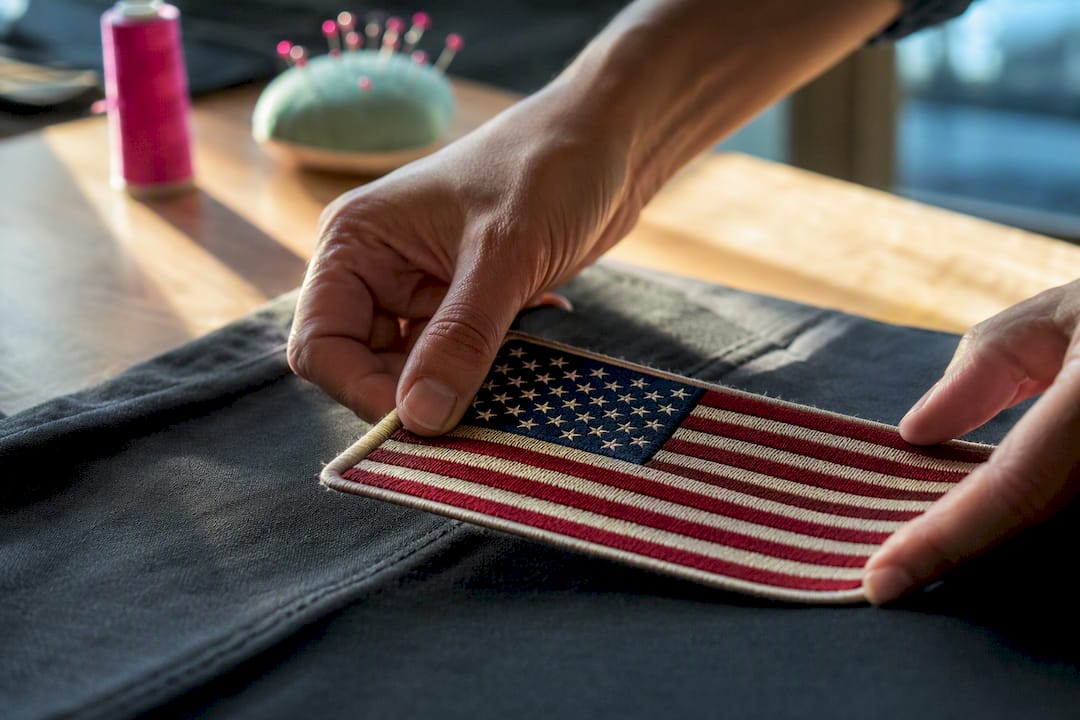
Wearing a printed American flag design on a t-shirt, hat, or jacket is generally acceptable, even though the U.S. Flag Code discourages using an actual flag as clothing. The Flag Code is a set of etiquette guidelines, not enforceable law, a distinction The American Legion has spent decades clarifying for confused shoppers and manufacturers alike. Nobody is getting arrested for a flag hoodie.
TL;DR:
- Wearing clothing printed with the American flag is legal and protected by the First Amendment, despite the Flag Code discouraging its use as apparel.
- The Flag Code’s language, such as “should not” wear the flag as clothing, serves as etiquette guidance, not enforceable law or criminal regulation.
- Using an actual flag for clothing, such as cutting up a flag to make a costume, is considered disrespectful and is distinct from printed flag designs used in apparel.
- Proper flag patch or print orientation, like stars on the right side of patches or chest prints with stars facing forward, is important to respect traditional display conventions.
- It is advisable to buy manufactured flag clothing designed for apparel and avoid disassembling or disposing of real flags in the process.
Table of Contents
- Understanding Flag Clothing Etiquette Under the U.S. Flag Code
- Is Wearing Flag Clothing Illegal? The First Amendment Angle
- Flag-Print Clothing vs. Cutting Up a Real Flag
- Dos and Don’ts for Flag-Themed Clothing
- Patches and Uniforms: Why Orientation Sometimes Flips
- Getting the Orientation Right: Stars Before Bars
- How Maker of Jacket Approaches Respectful Flag Apparel
- Balancing Free Expression and Respect
- Order a Flag-Themed Jacket Built the Right Way
- Primary Sources and Authoritative Guidance
- Sources
- FAQ
Understanding Flag Clothing Etiquette Under the U.S. Flag Code
The actual text of 4 U.S.C. § 8 is shorter and less scary than most people assume. Two subsections get quoted constantly in flag clothing etiquette debates. Subsection (d) says the flag “should not be used as wearing apparel, bedding, or drapery.” Subsection (j) goes further, stating no part of the flag should ever be used as a costume or athletic uniform.
Notice the word choice: “should,” not “shall” or “must.” That’s not an accident. Congress wrote the Flag Code as a guide to respectful behavior, not a criminal statute, and courts have consistently read it that way. The American Legion, one of the organizations most involved in shaping and promoting the Code, describes it plainly as etiquette guidance focused on respect for the flag rather than a rulebook with teeth.
Beyond clothing, the Code lays out several other widely cited expectations for handling a real flag:
- Never let the flag touch the ground or any surface beneath it.
- Don’t display the flag flat or use it as a table covering, backdrop, or bunting substitute.
- Avoid using the flag, or any picture of it, in advertising or for disposable purposes like napkins or packaging.
- Never mark, deface, or attach anything to the flag itself.
These rules were written with an actual, physical flag in mind, like the kind flown on a pole or draped over a casket, not a graphic printed on cotton at a garment factory. That distinction matters for everything that follows.
Is Wearing Flag Clothing Illegal? The First Amendment Angle
No. There’s no federal or state penalty for wearing a flag t-shirt, flag swim trunks, or a jacket with a flag patch, and there never really has been in modern practice. The Flag Code contains no enforcement mechanism, and legal commentary on the subject consistently notes that wearing the flag carries no criminal exposure under current law.
The bigger legal backdrop here is the First Amendment. The Supreme Court’s 1989 ruling in Texas v. Johnson struck down state laws banning flag desecration, holding that the flag is a vehicle for expression the government can’t punish just because some viewers find it disrespectful. If burning a flag in protest is constitutionally protected speech, wearing one printed on a jacket sits on much safer legal ground.
A few practical carve outs are worth knowing:
- Private businesses, schools, and event venues can still set their own dress codes and can ask someone to change clothes or leave, since the First Amendment restrains government action, not private policy.
- Military, government, and some school uniform policies have their own specific rules about flag imagery that can be stricter than general civilian norms.
- Using an actual government-owned or ceremonial flag improperly (cutting one up, for instance) can raise separate property or institutional issues depending on where it came from.
So the honest answer splits in two: legally, you’re in the clear. Socially, some people will still see a flag-print bikini and silently judge you for it. That’s etiquette, not law.
Flag-Print Clothing vs. Cutting Up a Real Flag
Here’s the distinction that resolves most of the confusion around flag clothing etiquette: a shirt printed with a flag design is not legally or functionally “a flag.” The Flag Code’s language, and The American Legion’s own guidance, has long treated commercially manufactured flag-pattern merchandise as separate from the physical, three-by-five flag meant for hoisting on a pole. A garment built from scratch using flag fabric or printed pattern is a different category from a flag that’s been physically repurposed into clothing.
Practical guidance follows from that split:
- Buy printed or woven-pattern garments, not items made by cutting up an actual retired or purchased flag. Manufacturers design flag-print fabric specifically for apparel, which sidesteps the Code’s concern entirely.
- Never disassemble a real flag to make a costume, bag, or accessory, even one you own. That’s the exact use subsection (j) discourages.
- Skip novelty items meant to be disposable, like paper flag hats made for a single parade before getting tossed in the trash. The Code specifically flags this kind of throwaway use as disrespectful.
- Check how the design is applied. A flag pattern woven into a scarf or dyed into a t-shirt reads differently than a flag physically stapled or safety-pinned onto a costume.
T-shirts and ball caps with printed flags are the most common and least controversial category. Swimsuits and athletic wear draw more mixed reactions, partly because subsection (j) specifically calls out athletic uniforms, even though enforcement is nonexistent. Scarves and bandanas with flag motifs are widely accepted. Leather jackets with a stitched flag patch or a printed panel fall into the most protected etiquette category of all: something explicitly designed and manufactured as apparel from day one.
Dos and Don’ts for Flag-Themed Clothing
A short mental checklist saves most people from an etiquette misstep before they ever place an order.
Do:
- Choose printed, woven, or embroidered flag designs made specifically for clothing.
- Place the union (the blue field of stars) toward the front or the wearer’s right, mirroring how a real flag is conventionally displayed.
- Follow proper retirement guidance if you own an actual flag that’s become torn, faded, or otherwise unfit for display.
- Treat flag-print items the way you’d treat any garment carrying national symbolism: with basic care, not casual disregard.
Don’t:
- Cut up, sew, or reshape an actual flag into a piece of clothing.
- Let a flag-print garment drag on the ground repeatedly or get treated as disposable.
- Use flag imagery for one-time promotional gimmicks, like giveaway flag capes meant to be discarded after a game.
- Deliberately deface or write over a flag image as a political statement while still calling it “flag apparel.” That’s a different category (protected protest speech) and worth understanding on its own terms.
Everyday items follow the same logic at smaller scale. Flag-print socks and flag-pattern hats are about as low stakes as it gets, since nobody expects sock etiquette to mirror ceremonial flag protocol. Flag swimsuits generate more raised eyebrows purely because of the athletic-uniform line in subsection (j), even though no actual rule stops you from buying one.
Pro Tip: If you’re shopping for a flag-themed jacket or patch, look for sellers who show a clear product mockup before you buy. A quick preview image saves you from ending up with an upside-down union or a design that looks nothing like the listing photo.
Patches and Uniforms: Why Orientation Sometimes Flips
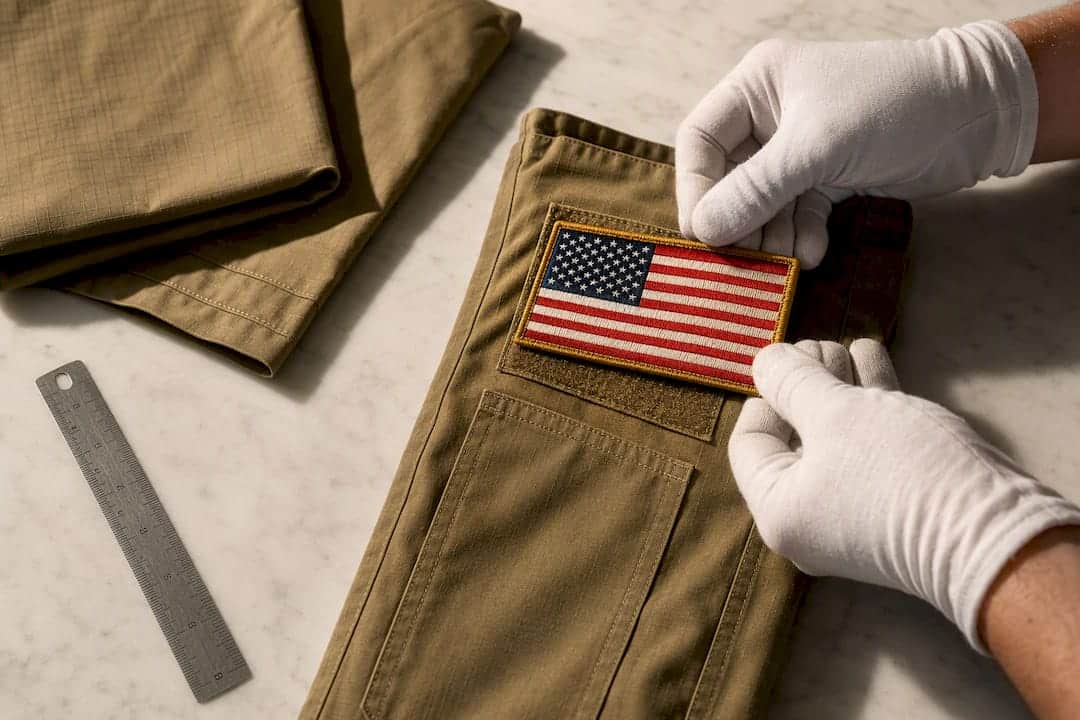
Flag patches follow a slightly different convention than flag prints, and it trips up a lot of buyers. On military, police, and firefighter uniforms, flag patches are often worn on the right shoulder with the union (stars) facing forward instead of the traditional left-side placement. The idea, per longtime guidance from veteran organizations, is that the flag looks like it’s flying backward in the wind as the wearer moves forward, the same effect you’d see on a flag mounted on a moving vehicle.
Civilians aren’t bound by this convention, but mirroring it on a right-sleeve patch is a nice nod to the tradition if you want your jacket to read as intentional rather than accidental. A few placement basics:
- Left chest: the traditional, most common spot for a flag patch or emblem on jackets, coats, and shirts.
- Right sleeve, near the shoulder: the reversed “stars forward” placement borrowed from uniform tradition.
- Pick one convention and stay consistent if you’re ordering multiple pieces, since mixing them on the same garment can look like a manufacturing error rather than a design choice.
Getting the Orientation Right: Stars Before Bars
Flag orientation trips up more buyers than any other part of flag clothing etiquette, mostly because people don’t think about it until the shirt arrives backward. The easiest rule to remember is “stars before bars”: on a standard frontal chest print, the star field sits on the wearer’s right side (the viewer’s left), exactly as it would on a flag held at rest.
A few scenarios worth knowing before you order:
- Chest prints: stars go on the wearer’s right, same as a flag pin worn on a lapel.
- Hats: flag patches typically sit on the left side of a cap, front and center, though right-side placements exist and aren’t wrong, just less traditional.
- Jacket patches: a sewn patch on the left chest usually keeps the standard orientation; a right-sleeve patch is where the reversed “stars forward” convention applies.
- Reversed or negative prints: some designers flip the color scheme (black and white, or inverted red and blue) for a subtler look. Orientation rules still apply even when the colors don’t match a traditional flag.
Pro Tip: If you design or sell flag-print apparel, always generate a front-and-back mockup before production. A five-second glance at a preview image catches a flipped union field that would otherwise take an angry customer email to notice.
How Maker of Jacket Approaches Respectful Flag Apparel
Building flag-themed jackets means taking the Flag Code’s spirit seriously even where it’s not legally binding. That starts with never sourcing garments by cutting up an actual flag: every flag design used in production is printed, embroidered, or dyed specifically for apparel from the outset.
It also means giving customers real visibility before they commit. Detailed product galleries, accurate size guides, and clear mockups let a buyer confirm star placement and color orientation before an order ships, not after. Customization requests get reviewed for placement accuracy, and care instructions for leather and patch-work pieces come standard, so a flag-themed jacket holds up rather than fading or peeling within a season.
Balancing Free Expression and Respect
People feel genuinely different things about the flag, and that’s not a problem to solve, it’s just reality. A veteran at a memorial service and a teenager at a concert aren’t operating under the same expectations, and they shouldn’t be.
My honest read: follow Flag Code guidance closely at formal or ceremonial events, where the social cost of getting it wrong is real and immediate. For everyday clothing, the legal protection for personal expression is strong, and a flag jacket or printed tee falls well within it. Context should drive the choice, not fear of a rule that was never enforceable to begin with.
— Maker
Order a Flag-Themed Jacket Built the Right Way
Makerofjacket is the alternative to guessing whether a flag design will look right once it’s stitched or printed onto real fabric. Flag-themed pieces are designed specifically for clothing from the outset, not repurposed from actual flags, with mockups provided for review before production.

Browse the customization options on our custom jacket page to see star placement, patch versus print choices, and color variations side by side. Pair that with our guide to flag-themed jacket styles if you want a deeper look at how identity and design intersect, and check our leather care guide once your piece arrives so the patch or print holds its color for years. Ready to see your design mocked up? Start a custom order today.
Primary Sources and Authoritative Guidance
Flag clothing etiquette rests on a small set of documents worth bookmarking directly:
- 4 U.S. Code § 8, Respect for Flag, the statutory text itself.
- 4 U.S. Code § 8 via Cornell’s Legal Information Institute, for accessible statutory language.
- The American Legion’s Flag Code guidance, covering display, respect, and proper use.
- VFW’s Flag Etiquette page, for practical do’s and don’ts.
This article is general information, not a substitute for advice from a qualified lawyer. Consult a qualified legal professional about your own circumstances before acting on anything here.
Sources
- 4 U.S. Code § 8 – Respect for flag
- U.S. Flag Code: Display, Respect & Proper Use | The American Legion
- 4 U.S. Code § 8 – Respect for flag | LII / Legal Information Institute
- Flag Etiquette | VFW
FAQ
What are the 7 rules of flag etiquette?
There’s no single official numbered list in the Flag Code itself, but commonly cited guidelines include never letting the flag touch the ground, never displaying it upside down except as a distress signal, never using it as apparel or bedding, never using it in advertising, retiring a worn flag with dignity, and keeping the union facing the correct direction when displayed. The Flag Code covers these points in more detail across its various sections.
What are common flag etiquette mistakes?
The most frequent mistakes include letting a real flag touch the ground, displaying it flat instead of properly mounted, using an actual flag as a costume piece, and treating printed flag giveaways as disposable items to be tossed after one use. VFW’s etiquette guidance lists several of these as the errors people encounter most in everyday settings.
Is it okay to wear a shirt with the American flag on it?
Yes. A flag-print shirt is treated differently from an actual flag under the Flag Code, and The American Legion confirms that commercially produced flag-pattern clothing is generally acceptable. The Code’s discouragement of “wearing apparel” refers to using a real flag as clothing, not to printed designs manufactured specifically for apparel.
Does the Constitution say you can’t wear the flag?
No, the Constitution says the opposite. The First Amendment, as interpreted in Supreme Court rulings like Texas v. Johnson, protects expressive uses of the flag, and legal analysis confirms there’s no criminal penalty tied to wearing flag-themed clothing anywhere in the United States.


