

6–12 Weeks or 2–4 Weeks: Bespoke vs Made to Measure for US Buyers

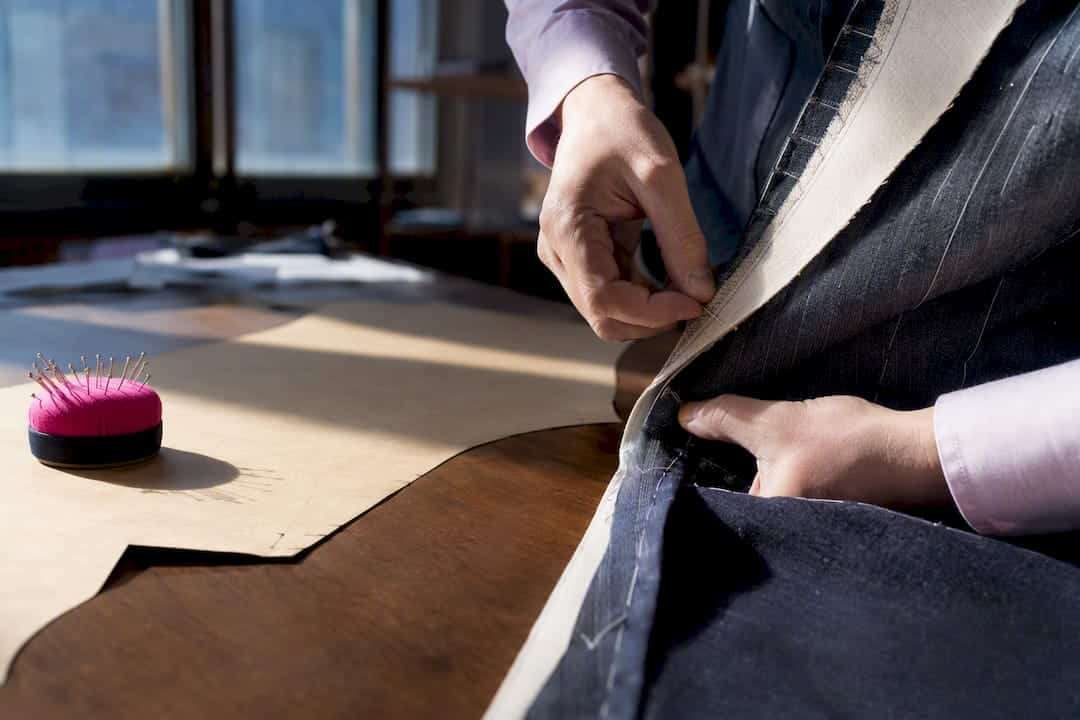
If you have unusual proportions, a strong sense of personal style, or plan to build a wardrobe over years, bespoke earns its cost and its wait. If you want a great fit fast, at a fraction of the price, made-to-measure covers most buyers just as well. The right pick comes down to three things: how complex your body is to fit, how much you’re building toward repeat orders, and whether you value process or just outcome.
TL;DR:
- Made-to-measure can often deliver nearly the same fit quality as bespoke at a lower cost by adjusting existing patterns, especially with multiple fittings.
- Bespoke suits are better suited for atypical body shapes and long-term wardrobe building, thanks to custom pattern drafting and multiple fittings.
- The main difference lies in pattern origin, with bespoke starting from scratch and MTM adjusting a standard block pattern; fittings and timeline also vary significantly.
- Quality of MTM depends heavily on pattern library size, fitter skill, and factory process, which can sometimes narrow the gap with bespoke if properly managed.
- Asking specific questions about pattern creation, fittings included, and garment construction yields more reliable information than relying solely on price or marketing labels.
Table of Contents
- Bespoke vs Made to Measure: Core Differences at a Glance
- What Bespoke Really Involves
- What Made to Measure Actually Delivers
- Which Body Types and Situations Favor Each Option
- Timeline and Cost: What Drives the Numbers
- How to Evaluate a Tailor or Custom Service
- Maker of Jacket’s Bespoke Workflow, in Practice
- Caring for a Custom Garment Long After the Fitting
- Where Bespoke and Made to Measure Came From
- Myths That Confuse Bespoke and Made to Measure Buyers
- Matching the Right Option to the Right Occasion
- What the Data Actually Supports
- Start Your Custom Jacket With Maker of Jacket
- Sources
- FAQ
Bespoke vs Made to Measure: Core Differences at a Glance
The real gap between bespoke and made-to-measure (MTM) isn’t finish quality. It’s how the pattern gets made and how many times a human checks it against your actual body. Trade definitions draw the line clearly: bespoke starts with a pattern drafted from nothing, built around your measurements and posture. MTM starts with an existing block pattern that a fitter adjusts to get closer to you.
That single difference cascades into everything else:
- Pattern origin: Bespoke drafts new; MTM adjusts an existing block.
- Fittings: Bespoke typically runs two to four fittings, including a baste (skeleton) stage; MTM often relies on one fitting, sometimes none if measurements are taken remotely.
- Construction: High-end bespoke can involve dozens of hours of handwork and a fully canvassed chest piece; MTM mixes machine work with selective hand-finishing, and quality swings widely by maker.
- Timeline: Bespoke commonly takes 6 to 12 weeks or longer; MTM often ships in 2 to 4 weeks.
- Cost: Bespoke suits frequently start in the low thousands of dollars; MTM often lands in the several-hundred-dollar range, sometimes lower for jackets.
- Best for: Bespoke suits clients with atypical builds or long-term wardrobe plans; MTM suits most first-time custom buyers.
None of this makes MTM a lesser product. It makes it a different tool for a different job.
What Bespoke Really Involves
Bespoke starts with a conversation, not a tape measure. A cutter assesses your posture, how you stand, how your shoulders sit, and any asymmetry between your left and right side before writing a single number down. That assessment matters because a pattern drafted from scratch can account for a dropped shoulder or a forward head tilt in ways an adjusted template simply can’t absorb.
Here’s the typical sequence:
- Consultation and measurement. The cutter takes dozens of measurements and notes movement, not just static dimensions.
- Pattern drafting. A unique paper pattern gets built for your body alone, with no starting template.
- Baste fitting. The garment is loosely stitched together (basted) so the cutter can mark corrections directly on the fabric.
- Forward fittings. One or more additional fittings refine shoulder, chest, and sleeve balance as the garment moves from skeleton to near-finished.
- Finishing. Canvas construction and hand-finishing get completed once the fit is confirmed.
Pro Tip: Ask your cutter what happens to your paper pattern after the first garment. A retained pattern means your second jacket skips the drafting stage entirely, which is where a lot of bespoke’s long-term value actually lives.
A skilled cutter’s real skill shows at the baste stage: translating what they see on your body back into corrections on paper, not just chalk on cloth. That’s the step that separates a garment that merely covers you from one that moves with you.
What Made to Measure Actually Delivers
MTM takes a proven block pattern and adjusts it using your measurements, typically somewhere between 15 and 30 data points depending on the provider. That’s fewer variables than bespoke’s from-scratch approach, but for most bodies, it closes the gap far more than people expect.
Quality varies enormously between MTM programs, and the differences come down to a few factors:
- Pattern library depth. A provider with dozens of base blocks across body types will fit you closer than one with three generic silhouettes.
- Fitter skill. The person taking your measurements and translating them into pattern adjustments matters as much as the software behind it.
- Fitting count. Some MTM services now include multiple fittings and genuine hand-finishing, closing the experience gap with bespoke.
- Factory process. Where and how the garment is cut and sewn affects whether “custom” translates into a garment that actually fits differently from off-the-rack.
A well-run MTM process can deliver most of bespoke’s fit benefit at a noticeably lower cost, according to Fielding & Nicholson, though the exact gap depends heavily on the maker’s pattern system and the fitter’s skill. Don’t assume “MTM” means limited. Ask what’s included before you assume the cheaper option means a lesser process.
Which Body Types and Situations Favor Each Option
Your body shape and your buying pattern both point toward one answer more than the other.
Bespoke tends to be worth the premium if you have:
- Noticeable asymmetry between shoulders, hips, or arm length.
- A build that consistently frustrates off-the-rack sizing, like a long torso paired with short arms.
- Postural quirks (forward-leaning stance, one hip higher than the other) that a fitter needs to see in motion, not just measure statically.
MTM makes more sense for:
- A wedding suit or one-off event garment where you want a personal fit without the multi-fitting timeline.
- Work uniforms or rotation suits where consistency across several garments matters more than micro-adjustment.
- Anyone testing custom clothing for the first time before committing to bespoke pricing.
Bespoke tailoring earns its cost fastest for clients whose posture or proportions genuinely fight standard patterns. A rider building a wardrobe of jackets over several years, for instance, benefits from a pattern that gets reused and refined rather than redrawn every time. If you’re a one-and-done buyer with a fairly standard build, that compounding value never gets a chance to pay off.
Timeline and Cost: What Drives the Numbers
Bespoke’s longer timeline isn’t inefficiency. It’s the baste fitting, the correction cycle, and the finishing work that MTM skips or compresses. Expect 6 to 12 weeks for a first bespoke garment, sometimes longer during a tailor’s busy season. MTM usually ships in 2 to 4 weeks since it starts from an existing pattern.
On price, industry examples show bespoke suits often starting in the low thousands of dollars, driven by labor hours, cloth quality, and fitting count. MTM programs frequently start several hundred dollars lower for a comparable jacket. A few questions help you spend wisely:
- Is the cost difference buying you a better fitting process, or just better cloth? Ask separately.
- Does the price include multiple fittings, or just one?
- If a “bespoke” quote looks unusually low, ask directly who drafts the pattern and where the garment gets cut. Genuine bespoke labor doesn’t come cheap, and a price that seems too good for the claimed process usually means something got skipped.
How to Evaluate a Tailor or Custom Service
Marketing language around “bespoke” has gotten loose. A 2008 UK Advertising Standards Authority ruling allowed the term to be used even when some machine work was involved, which means the word alone tells you very little. Ask direct questions instead.
- Who drafts the pattern, and from what starting point? A real bespoke process starts blank, not from a template.
- How many fittings are included, and what happens at each one? A single fitting for a complex body is a red flag.
- Where is the garment cut and sewn? Vague answers here usually mean the process is thinner than the pitch.
- Can you see or feel the canvas construction? A full floating canvas moves differently from a fused one, and you can test it by pinching the lapel.
Pro Tip: If a tailor can’t clearly explain what happens between your first measurement and your first fitting, that’s usually a sign the process is more marketing than method.
Negotiate for an extra fitting if your build is complex. It costs the tailor time, but it’s cheaper than a jacket you never wear.
Maker of Jacket’s Bespoke Workflow, in Practice
Maker of Jacket runs a documented master fitting workflow built around exactly the process questions above: who measures, how fittings happen, and how customization gets translated into a finished jacket. The customization journey walks buyers through style, color, and theme choices before production starts.
This approach tends to fit three kinds of buyers best: riders who need both fit and protective gear performance, style-focused shoppers building a themed or personalized collection, and repeat buyers who want each new jacket to build on the last. Before a consultation, take your own measurements using a step-by-step measuring guide, note any posture quirks, and bring a well-fitting jacket as a reference if you have one.
Caring for a Custom Garment Long After the Fitting
A bespoke garment’s care needs actually start at the construction stage. Full canvas construction, common in high-end bespoke, breathes and molds to your body over years of wear, which means it needs occasional airing and proper hanging on a shaped wooden hanger rather than a wire one. Fused MTM garments are more forgiving of casual storage but degrade differently. The fused layer can bubble or separate from heat and humidity exposure over time, something canvas construction resists.
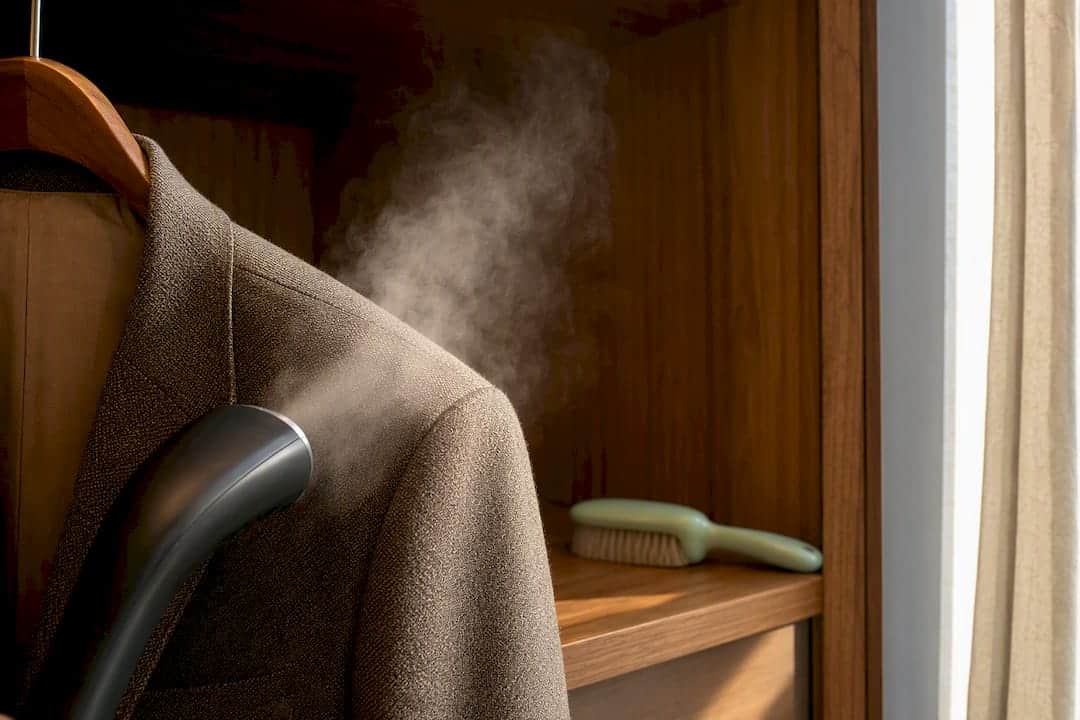
Both categories share the same enemies: moisture, direct heat, and compressed storage. Steam rather than iron whenever possible, since direct heat risks flattening the drape a fitter worked to build in. Dry cleaning should happen sparingly. Solvents strip natural oils from wool fibers and, over years, that dulls the fabric’s hand and shortens its life. Leather garments follow a different rulebook entirely. Conditioning, controlled humidity, and avoiding prolonged sun exposure all matter more than dry cleaning, and a dedicated leather care routine keeps a custom leather jacket supple for years instead of stiffening and cracking.
Bespoke garments, because they’re often kept for a decade or more, tend to justify a periodic professional press and inspection. MTM pieces, often cycled through a wardrobe faster, get less of that long-term investment, but they still benefit from proper hanging and the same steam-over-iron rule.
Where Bespoke and Made to Measure Came From
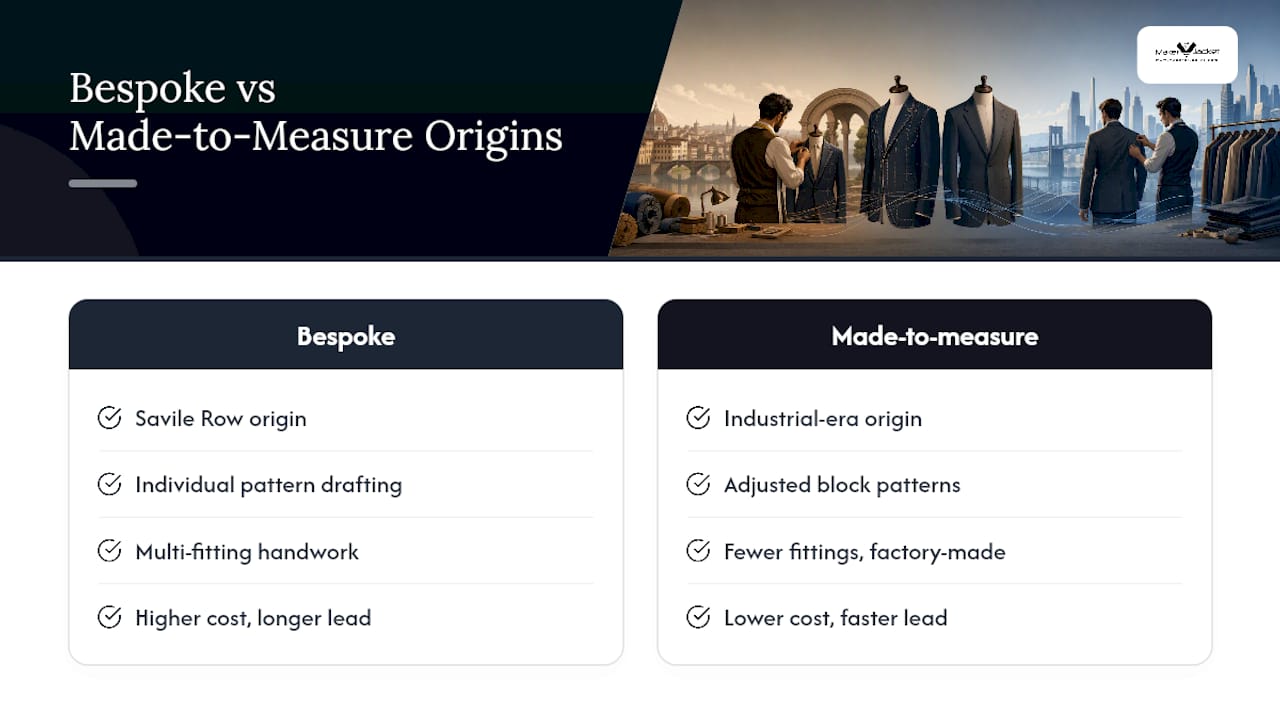
Bespoke tailoring’s roots trace to London’s Savile Row, where the term itself originally referred to cloth “spoken for” by a specific customer rather than sold off a shelf. That’s the literal origin of the word: fabric reserved and cut for one person, as documented in the trade’s own history. The practice formalized over the nineteenth century into the structured, multi-fitting process still used today, with cutters developing individual patterns as their primary craft.
Made-to-measure emerged later, as a response to the industrial-era demand for faster, cheaper customization. Manufacturers realized they could adjust a standardized block pattern instead of drafting from nothing, cutting both labor time and cost while still offering a personalized result. This made custom clothing accessible to a much broader customer base than bespoke ever could reach, since bespoke’s hours of skilled handwork put it out of reach for most buyers.
The two paths have run in parallel ever since, serving genuinely different needs rather than one simply being a discount version of the other. Bespoke stayed rooted in individual craftsmanship and pattern ownership. MTM scaled personalization through better manufacturing systems, pattern libraries, and, more recently, digital measurement tools that speed up the adjustment process without eliminating the human fitter’s judgment.
Myths That Confuse Bespoke and Made to Measure Buyers
The biggest myth is that “bespoke” always means better. It means different, and only better for certain bodies and buying patterns. A well-fitted MTM jacket on a standard build can outperform a rushed or poorly cut bespoke garment on the same person.
A second myth: high price always proves genuine bespoke process. It doesn’t. Since marketing use of the term has blurred over the years, a high price tag alone doesn’t confirm a from-scratch pattern or multiple fittings. Ask the process questions from earlier in this guide regardless of what the price suggests.
Third myth: bespoke and made-to-order are interchangeable terms. They’re related but not identical. Made-to-order commonly describes any garment produced after you order it, which can include MTM, while true bespoke specifically implies the from-scratch pattern and fitting structure described throughout this guide. Not every made-to-order jacket is bespoke, even if some sellers use the words loosely.
Fourth myth: MTM is a “lesser” purchase. Many modern MTM programs now include several fittings and real hand-finishing, closing the gap with entry-level bespoke far more than buyers assume. Treating MTM as a consolation prize rather than a legitimate category leads people to overspend on bespoke they didn’t need.
Matching the Right Option to the Right Occasion
A wedding is the classic MTM occasion for most guests and even many grooms. You want a sharp, personalized fit without committing to a multi-month bespoke timeline for a garment worn once or twice. The same logic applies to work uniforms and rotation suits, where consistency across multiples matters more than the pattern being drafted from nothing each time.
Bespoke earns its place for garments meant to anchor a wardrobe for years. A daily-wear jacket, a signature leather piece, or a motorcycle suit that has to fit precisely under riding gear all benefit from the extra fitting rounds and the retained pattern for future orders. Riders in particular have a functional reason to lean bespoke. Fit affects how motorcycle safety gear performs, since armor and padding only protect correctly when the garment sits exactly where it’s supposed to.
Themed or personalized jackets, the kind built around a specific color, flag, or design concept, tend to split the difference. The customization itself often lives in fabric, color, and detailing rather than the pattern method, which means MTM frequently delivers everything a buyer wants at a lower price point. Save bespoke’s premium for garments where fit precision, not decoration, is the priority.
What the Data Actually Supports
The conventional advice on this topic treats bespoke as the aspirational choice and MTM as the budget compromise. That framing doesn’t hold up once you look at what actually drives fit quality: the pattern method and the fitting structure, not the price tag or the prestige of the label.
Most buyers overestimate how much their body needs a from-scratch pattern. If you have a reasonably standard build, a well-run MTM program with several fittings will get you further than a rushed bespoke job from an overbooked tailor. Where bespoke genuinely wins is narrower than the marketing suggests: significant asymmetry, a wardrobe built around repeat orders, or a garment where safety and fit intersect, like riding gear.
Prioritize the questions, not the label. Ask who drafts the pattern, how many fittings are included, and where the garment gets made. Those three answers tell you more than any price point or the word “bespoke” printed on an invoice. Buyers who lead with those questions end up matching their spend to their actual need instead of paying for a word.
— Maker
Start Your Custom Jacket With Maker of Jacket
If you’ve read this far, you likely fall into one of two camps: a rider or style-focused buyer who wants a jacket built around your exact body and preferences, or someone testing custom clothing for the first time before committing further. Either way, Maker of Jacket’s process is built to meet you where you are.
Unlike a traditional bespoke tailor with a months-long waitlist, Maker of Jacket runs a documented fitting workflow designed to get your customization choices, from style to color to thematic detailing, translated into a finished jacket without the drawn-out consultation cycle full bespoke suiting requires. You pick the style, submit your measurements using the measuring guide, and move straight into production.
Ready to see what a custom fit actually feels like? Order your custom jacket directly through the site, or browse the personalization options first if you want to explore styles before committing to your measurements.
Sources
- Bespoke – Wikipedia
- Bespoke vs Made-to-Measure vs Off-the-Rack: What’s Actually Different (2026) | Nathan Tailors
- Bespoke vs Made to Measure: Which Is Worth It – Fielding & Nicholson
- Made to Measure & Bespoking suiting – London Review of Suit Tailors
FAQ
Is bespoke the same as made to order?
No. Made-to-order is a broader term for any garment produced after you place an order, which can include MTM, while bespoke specifically means a pattern drafted from scratch with multiple fittings.
What is the American equivalent of bespoke?
There isn’t a distinct American term. “Custom tailoring” or “custom-made” is often used in the US the way “bespoke” is used in British English, though usage overlaps heavily with made-to-measure in casual conversation.
Is bespoke always higher quality?
Not automatically. A well-run made-to-measure program with skilled fitters and multiple fittings can outperform a rushed or poorly executed bespoke job, since fit quality depends on the pattern method and fitter skill, not the label alone.
What is the difference between made to order and made-to-measure?
Made-to-order simply means the garment is produced after your order is placed, using a standard or adjusted pattern. Made-to-measure specifically involves taking your individual measurements and adjusting an existing base pattern to fit them.
Does Maker of Jacket offer a bespoke or custom process?
Yes. Maker of Jacket runs a documented customization and fitting workflow for jackets and motorcycle apparel, letting buyers submit measurements and style preferences directly through the site.


