

Measure Once, Skip Exchanges: Motorcycle Glove Sizing on the Handlebar

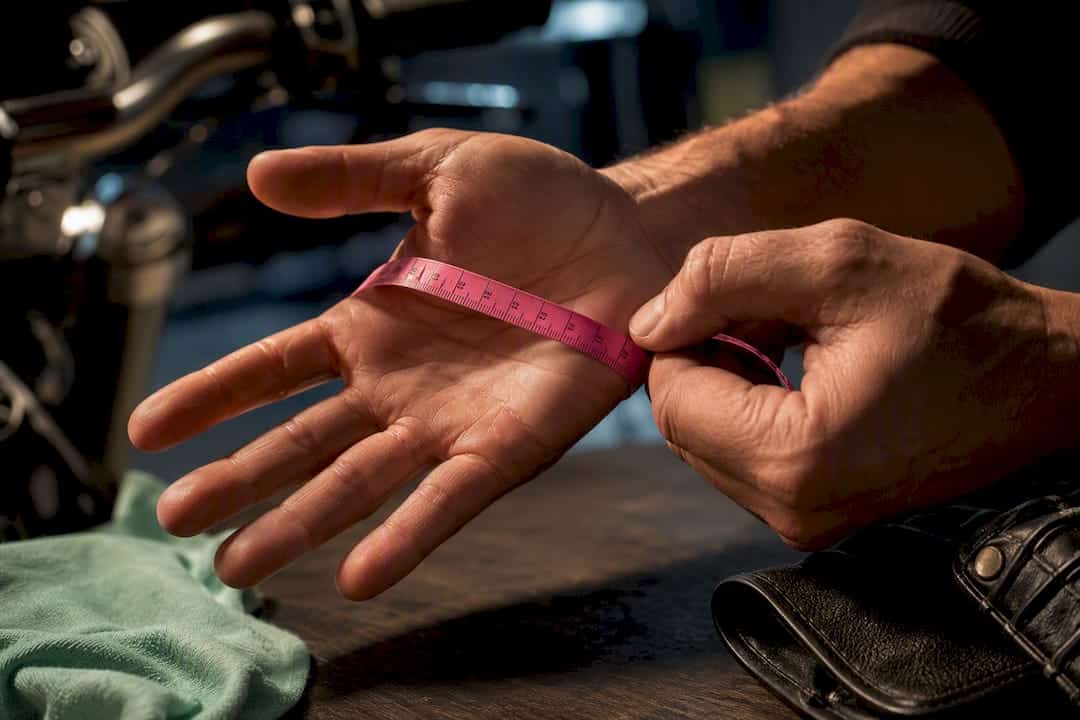
Measure your palm circumference around the widest part just below the knuckles, excluding the thumb, and use the larger of your two hands to pick a size on the model’s chart. Round up if you land between sizes, and size up further if you plan to wear liners. Everything else, letter sizes, European numbers, leather stretch, comes down to getting that one measurement right and then confirming the fit on an actual handlebar.
TL;DR:
- Measure both hands when sizing gloves, and always record the larger circumference to ensure a comfortable fit during riding.
- Leather gloves will loosen with wear and conditioning but should feel snug initially; textile gloves tend to hold their shape and require correct sizing upfront.
- Rely on actual handlebar tests rather than static palm measurement to confirm the glove fits well during real riding motion.
- Size up for winter gloves with insulation and waterproof membranes to accommodate liners and maintain dexterity, especially when choosing based on measured size.
- Fit precision is crucial for overall riding gear compatibility, as improper glove or jacket fit can affect safety and comfort in real-world conditions.
Table of Contents
- How Do You Measure Your Hand for Motorcycle Gloves?
- US Letter Sizes vs. European Numbers: What Do They Actually Mean?
- Will Leather Gloves Stretch, and How Should That Change Your Size?
- What Does a Correct Glove Fit Feel Like on the Handlebar?
- Should You Size Differently for Sport Riding, Touring, or Cold Weather?
- Why Do My Gloves Feel Wrong, and How Do I Fix It?
- How Do You Measure Hand Width for a More Precise Fit?
- Why Fit Precision Matters Beyond Just the Glove
- Get Gloves and Gear That Actually Match Your Measurements
- Sources
- FAQ
How Do You Measure Your Hand for Motorcycle Gloves?
Grab a flexible fabric tape measure or a piece of string and a ruler. That’s the whole toolkit. A stiff metal tape won’t wrap the curve of your palm accurately, and a phone app measurement is a poor substitute for the real thing.
Measure both hands, not just your dominant one. Hands are rarely identical, and manufacturers recommend recording the larger measurement so the glove doesn’t pinch your bigger hand on the road.
Here’s the actual sequence:
- Wrap the tape around your palm just below your knuckles, skipping over the thumb entirely. Keep your fingers relaxed and together, not clenched into a fist.
- Read the circumference in inches. This single number is what most size charts are built around, since glove sizing is based primarily on hand circumference measured at this exact spot.
- Measure hand length from the crease of your wrist to the tip of your middle finger. Some brands ask for this as a secondary check against their chart.
- Note the time and conditions. Hands swell after workouts, in heat, or at the end of a long day, so measure mid-morning at a normal room temperature for a number you can trust.
- Measure again with liners on if you know you’ll be wearing them underneath, since that changes the effective circumference you need room for.
The most common mistake is pulling the tape too tight, which shaves a quarter inch or more off your real number. The second most common mistake is measuring a clenched fist. Unless a specific brand’s chart explicitly asks for a closed-fist measurement, keep your hand relaxed and flat.
Pro Tip: Write both measurements down and keep them in your phone. Every future glove, jacket cuff, or gauntlet purchase gets easier once you have your own numbers instead of guessing from memory.
US Letter Sizes vs. European Numbers: What Do They Actually Mean?
There’s no single industry standard for motorcycle glove sizing. Two brands can list “Large” and mean noticeably different circumferences, because sizing labels and cuts vary from manufacturer to manufacturer. That’s the single biggest source of frustration for riders switching brands.
That said, most charts cluster around similar ranges, and knowing the rough conversion saves you a returns shipment:
- 7 to 7.5 inches typically lands in Small (US) or European size 8
- 8 to 8.5 inches typically lands in Medium (US) or European size 9
- 9 to 9.5 inches typically lands in Large (US) or European size 10
- 10 to 10.5 inches typically lands in XL (US) or European size 11
- European numeric sizes generally run close to your circumference in centimeters divided by roughly 2.5, so a 23cm palm lands near a European size 9
Treat those numbers as a starting point, not gospel. American-cut gloves tend to run roomier through the palm and fingers, while European-cut gloves fit closer and narrower, which matters if you have wide hands or you’re switching from a US brand to an Italian or Spanish one. Sport gloves also run tighter by design across every brand, while touring and winter gloves build in extra volume for liners and airflow.
The rule that actually holds across every brand: check the model-specific chart before you buy, not the brand’s general size guide. A chart built for jackets and suits follows the same logic, letter sizes and numeric sizes both trace back to a body measurement, so once you understand one, you understand the pattern for the rest of your riding gear.
Will Leather Gloves Stretch, and How Should That Change Your Size?
Material changes everything about how a “correct” size feels on day one versus month three.
Leather stretches a small amount during break-in, commonly cited as a few percent of give as the hide molds to your hand’s shape. A leather glove that feels snug but not restrictive in the store is doing exactly what it should. If it feels loose on day one, it will feel sloppy by week three.
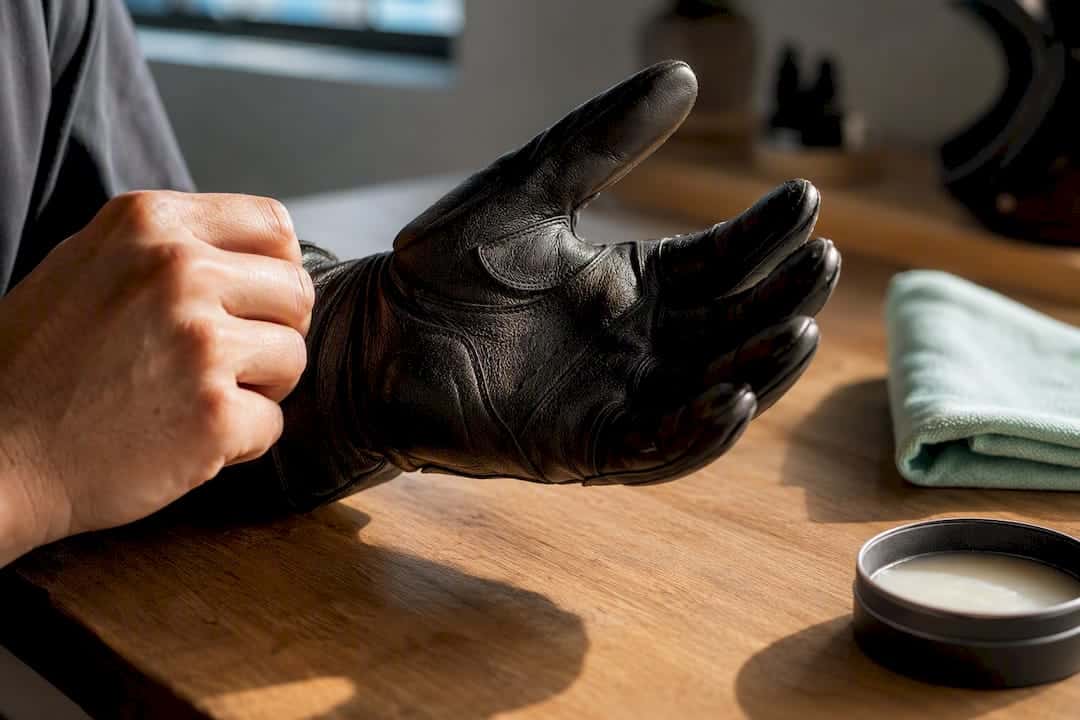
Textile and synthetic gloves hold their shape. They don’t relax the way leather does, so if you’re stuck between two sizes in a textile glove, go with the larger one.
Waterproof membranes like Gore-Tex add a layer that doesn’t stretch at all and often feels stiffer out of the box. Budget extra room in the fingers and palm, especially if the glove is built for a liner underneath.
- Leather: buy snug, expect it to loosen with wear
- Textile: buy true to size or slightly roomy, since it won’t give
- Membrane-lined winter gloves: size up one increment to leave room for insulation and dexterity
Pro Tip: If you’re buying leather gloves for a specific event or trip, break them in for at least a few short rides beforehand. New leather feels different at highway speed than it does standing in your driveway. Regular leather conditioning also keeps the material supple enough to keep flexing correctly instead of stiffening up over a season.
What Does a Correct Glove Fit Feel Like on the Handlebar?
A flat palm test tells you almost nothing useful. The only test that matters is grabbing an actual handlebar, or a thick pipe of similar diameter, in your normal riding posture.
- Grip the bar the way you actually ride, then check for bunching across the back of the hand or in the palm. Bunched material between your palm and the grip is a fit failure, not a break-in issue.
- Check fingertip contact. Your fingers should reach the end of each glove finger without your fingertips being pinched or your knuckles floating in dead space.
- Test your thumb’s full range. It needs to move freely to reach the horn button, kill switch, or turn signal without the seam fighting you.
- Squeeze the brake lever and roll the throttle through a full motion. If the leather or textile binds at the wrist or across the knuckles during this motion, the glove is too small.
- Check the gauntlet-to-jacket overlap at the wrist. A glove that rides up when you extend your arm exposes skin exactly where a slide would put the most abrasion.
This handlebar test beats a clenched-fist check every time, because gripping a real bar reveals actual riding ergonomics that a static fist never will. A correct fit follows your hand’s movement without binding, and you’ll feel that difference within thirty seconds on a real grip.
Should You Size Differently for Sport Riding, Touring, or Cold Weather?
Riding style changes what “correct” fit means, even at the identical circumference measurement.
Sport and track riders generally want a snugger fit because feel and feedback through the controls matter more than all-day comfort. If you’re between sizes and you ride aggressively, sizing down slightly, within reason, often improves lever feel and control.
Touring and cruising riders benefit from a touch more room, since comfort over hours on the bar outweighs razor-sharp feedback. A slightly roomier fit also breathes better on long summer stretches.
Cold-weather gloves are their own case entirely. Measure with your liner on, then size up if the resulting glove feels tight anywhere. Insulation eats into usable space fast, and a too-tight winter glove restricts blood flow, which makes your hands colder, not warmer. Gloves with removable liners or adjustable cuffs give you one pair that flexes across seasons instead of forcing a new purchase every time the weather turns.
Why Do My Gloves Feel Wrong, and How Do I Fix It?
- Too tight: give leather a few short rides to break in; if seams still strain or fingers go numb, exchange for the next size up.
- Too loose or bunching: tighten the wrist closure first; if bunching continues, try a different cut (women’s gloves are often narrower through the palm) or drop half a size.
- Pressure points at the thumb base or knuckles: look for a pre-curved model, since a flat-cut glove fights your hand’s natural resting shape.
- Beyond fixing: if adjustments don’t solve it, exchange rather than force a bad fit. A loose glove that bunches at the grip reduces control and can compromise safety in a way tight sizing rarely does.
How Do You Measure Hand Width for a More Precise Fit?
Circumference and length get you most of the way to a correct size, but width across the palm catches the fit problems those two measurements miss. Two riders can share the same circumference and still need different gloves if one has a broad, flat palm and the other has a narrower, higher-arched one.
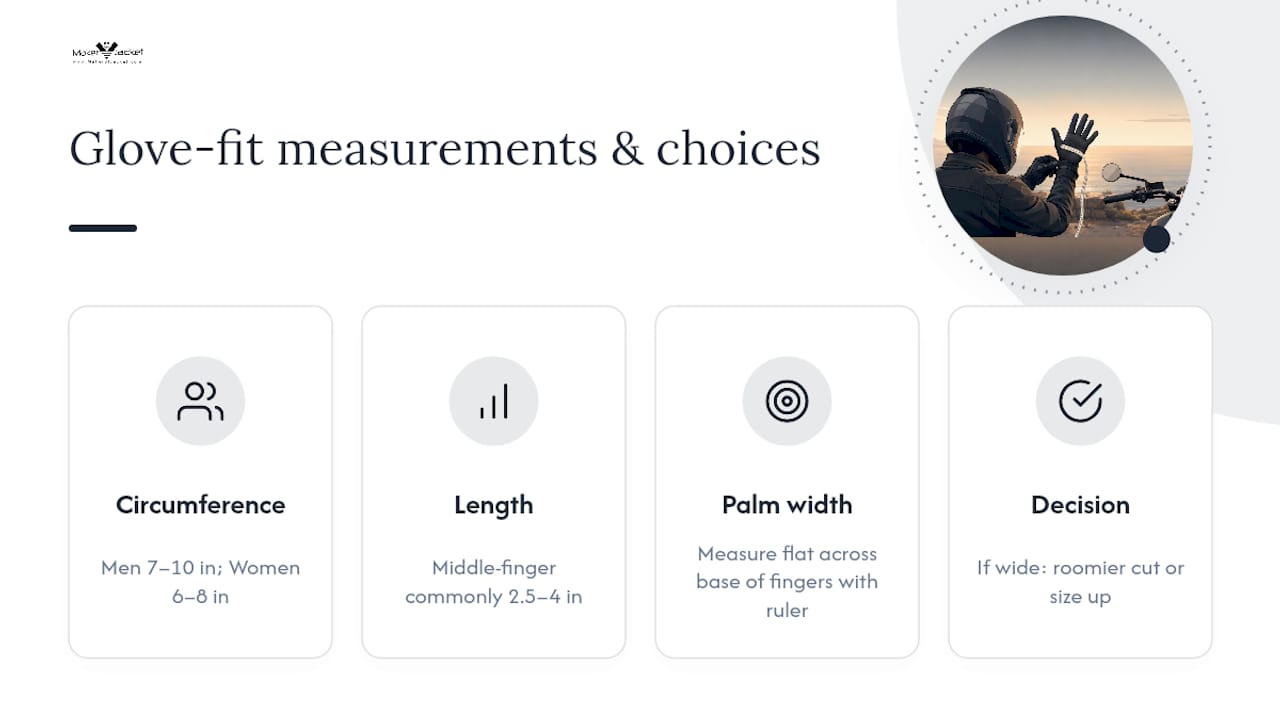
To measure width, lay your hand flat on a table, fingers together and relaxed, and measure straight across the widest point of your palm, typically right at the base of your fingers where they meet the palm. Use a ruler laid flat rather than a flexible tape here, since you want a straight-line measurement, not one that follows the curve of your hand.
Width matters most when you’re choosing between two brands with similar circumference charts but different cuts. A wide-palmed rider who buys a narrow European-cut glove based on circumference alone often ends up with a fit that’s technically correct on paper and uncomfortable in practice, tight across the palm even though the finger length is fine.
If your width measurement feels notably wider than average for your circumference, lean toward brands known for a roomier American cut, or size up one increment and rely on the wrist closure to take up any slack in length. Adult hand circumferences run roughly 7 to 10 inches for men and 6 to 8 inches for women, with middle-finger length commonly between 2.5 and 4 inches, so use your own width number as a tiebreaker whenever your circumference sits near the edge of a size bracket rather than comfortably inside one.
Why Fit Precision Matters Beyond Just the Glove
Getting glove sizing right is the same discipline that goes into fitting a motorcycle jacket. A glove that’s a half size off is annoying. A jacket cuff that doesn’t overlap your gauntlet properly leaves a gap of exposed wrist in exactly the spot that hits pavement first in a low-side fall. That overlap is not a styling detail, it’s a coverage detail.
Anyone measuring hands for gloves should apply the same care to jacket sizing, since sleeve length and cuff design determine whether your gear works together as a system instead of as separate pieces that happen to be worn at the same time.
— Maker
Get Gloves and Gear That Actually Match Your Measurements
Most off-the-shelf gloves force you to compromise somewhere between circumference, length, and width, because a mass-produced size chart can only average out so many hand shapes. Some companies offering jackets and motorcycle apparel take the approach that you submit your own measurements, and the piece gets built to match them instead of the other way around.

That matters most at the wrist and cuff, where a jacket needs to overlap your gloves without gaps or bunching. Once you’ve got your hand and forearm measurements from the process above, put them to use on a custom motorcycle jacket built around your actual dimensions rather than a generic size bracket. Measure once, order once, and skip the exchange cycle entirely.
Sources
- How to Measure for the Perfect Motorcycle Glove Fit | Olympia Gloves
- Getting a Perfect Fit: Ultimate Guide to Motorcycle Glove Sizing | Olympia Gloves
- How to Measure for Motorcycle Gloves: A Step-by-Step Guide for Proper Sizing | Motoworks Chicago
FAQ
What size glove is equivalent to a size 7?
A size 7 circumference in inches typically corresponds to a Small in US letter sizing and roughly European size 8, though the exact match depends on the brand’s chart.
Are motorcycle gloves supposed to fit tight?
They should fit snug and close to the hand without pinching or restricting movement. A leather glove that feels a bit tight in the store usually loosens slightly with break-in, but numbness or seam strain means it’s too small.
Is it better to size up or down in gloves?
It depends on the material and riding style: size up for textile, membrane-lined, and cold-weather gloves, and consider sizing down slightly only for snug-fitting leather sport gloves you plan to break in.
Is size 10 a large glove?
A 10-inch circumference generally falls into XL or European size 11 on most charts, making it larger than a standard Large, so check the specific model’s chart before assuming.
How often should I remeasure my hands for gloves?
Once a year is enough for most riders, since hand size doesn’t change often. Remeasure sooner if you notice consistent fit problems across multiple brands.


