

Protect Your Leather Jacket: Demand a Test Before Laser Engraving

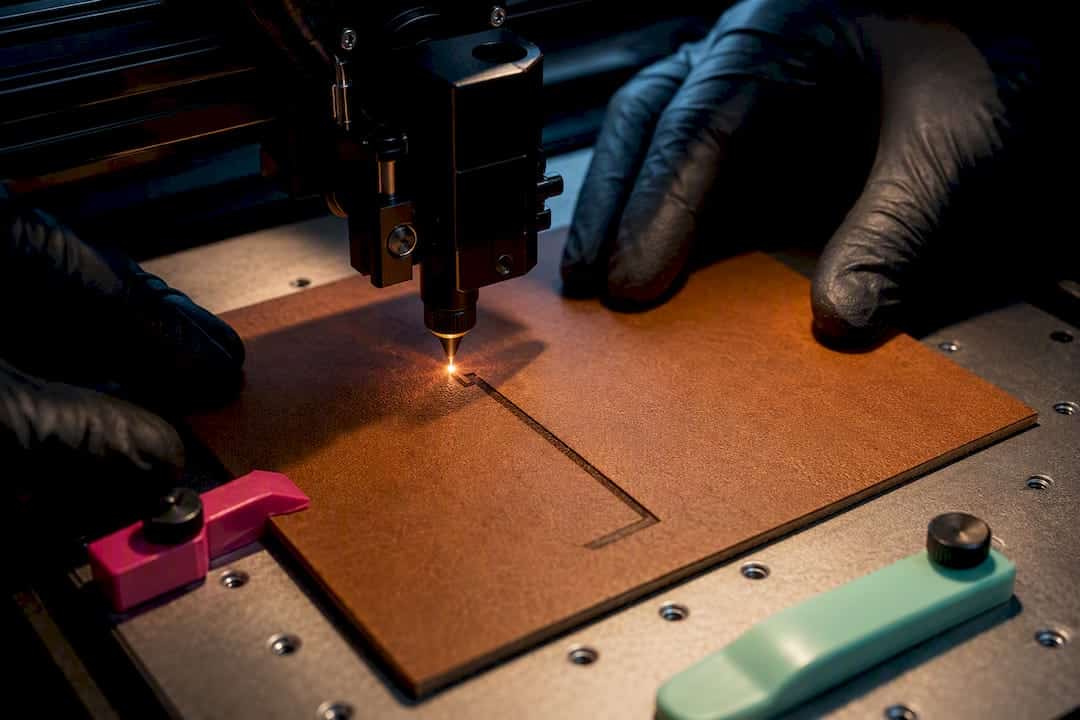
Yes, most genuine leather jackets can take a CO2 laser engraving, and vegetable‑tanned or lighter hides give the sharpest, most consistent contrast. Never let anyone put a laser to PVC faux leather. Before you commit a jacket to the machine, get a test engraving and a placement mockup from your supplier. That single step separates a crisp, permanent mark from a ruined panel.
TL;DR:
- Vegetable-tanned leather offers the most predictable and high-contrast engraving results than chrome-tanned or faux leathers, requiring testing to confirm outcomes.
- PVC faux leather should never be laser engraved due to toxic gas release, and chrome-tanned leather demands sample testing for safe, effective marking.
- Vector files like SVG or EPS are ideal for logos and line art, with minimum line weight of half an inch for readability, and placement depends on jacket panel size.
- Engraving costs vary based on setup fees, design complexity, and quantity, with time typically including testing, approval, and production stages, plus optional rush services.
- Proper care involves gentle cleaning immediately after engraving, avoiding abrasion, and waiting days before conditioning to prevent uneven darkening or damage.
Table of Contents
- Which Leathers Are Safe for Laser Engraving on Leather?
- What Should You Ask the Supplier Before Ordering?
- What Artwork Files Work Best for Engraving on Leather?
- How Much Does Laser Engraving on Leather Cost, and How Long Does It Take?
- How Do You Care for a Freshly Engraved Leather Jacket?
- How Does Maker of Jacket Handle Laser Engraving Orders?
- When Engraving Beats Embroidery, and When It Doesn’t
- Sources
Which Leathers Are Safe for Laser Engraving on Leather?
Not every jacket panel reacts the same way under a laser, and the material makes or breaks the result. Vegetable‑tanned leather is the benchmark. Its natural fibers caramelize evenly, producing the deep, dark line work you see on premium branded jackets, and CO2 lasers tuned to the 10,600 nm wavelength are the industry standard for this reason.
Chrome‑tanned leather, the kind used in a lot of biker and fashion jackets, is a different story. It can engrave well, but chemical tanning agents make the reaction less predictable, so a test sample on chrome‑tanned or oil‑tanned hides is not optional. It’s the only way to know how that specific hide will respond.
Here’s how the main categories stack up:
- Vegetable‑tanned leather: best contrast, most predictable results, ideal for logos and fine detail.
- Chrome‑tanned leather: workable but variable; always test first.
- PU faux leather: sometimes engraves acceptably, but check with the supplier before assuming it will.
- PVC faux leather: unsafe to laser. It can release toxic gas when burned, so this material gets refused outright by any responsible shop.
- Suede, nubuck, and oiled leathers: engrave with a softer, less defined look and can singe unevenly, so expect a more rustic aesthetic rather than crisp lines.
Pro Tip: Ask your seller for the tanning method in writing before you order. “Genuine leather” on a tag tells you nothing about how it was tanned, and that’s the detail that actually determines engraving quality.
What Should You Ask the Supplier Before Ordering?
A good supplier will welcome these questions. A shop that gets defensive about testing or safety is a shop to avoid. Run through this list before you send money or artwork:
- Request a test engraving on the same leather batch as your jacket, not a generic sample hide, and get photos before anything moves to production.
- Ask about their test protocol. Reputable operators run a power and speed matrix against documented settings for each material rather than guessing on the fly.
- Confirm they refuse PVC jobs. If a shop says PVC faux leather is fine to laser, that’s a red flag worth walking away from.
- Ask what test samples cost and whether that fee credits toward your final order. Some suppliers absorb it; others charge a flat testing fee.
- Get a placement mockup and a final approval photo before they run the actual jacket through the machine.
A supplier’s skill in adapting laser settings to each individual hide is really what separates a crisp, premium mark from a scorched mess on an expensive jacket.
Pro Tip: Ask specifically whether they turn off air assist for engraving passes. It’s a small operational detail, but shops that know to mention it unprompted usually know what they’re doing.
What Artwork Files Work Best for Engraving on Leather?
Your file format matters more than most buyers expect. Logos and line art should arrive as vector files, meaning SVG, PDF, or EPS, since vectors scale cleanly to any size without losing edge definition. Photographs need to be raster images at 300 DPI or higher, rendered in grayscale so the laser can translate tonal value into burn depth.
Fine detail is where most designs fail. Thin strokes, small serif fonts, and delicate line work tend to vanish once the leather chars around them. As a rule of thumb, keep line weights and text no smaller than what would still be legible printed at half an inch tall, and avoid font styles with hairline strokes entirely.
Placement matters as much as the file itself. A few common panel areas and what tends to work on each:
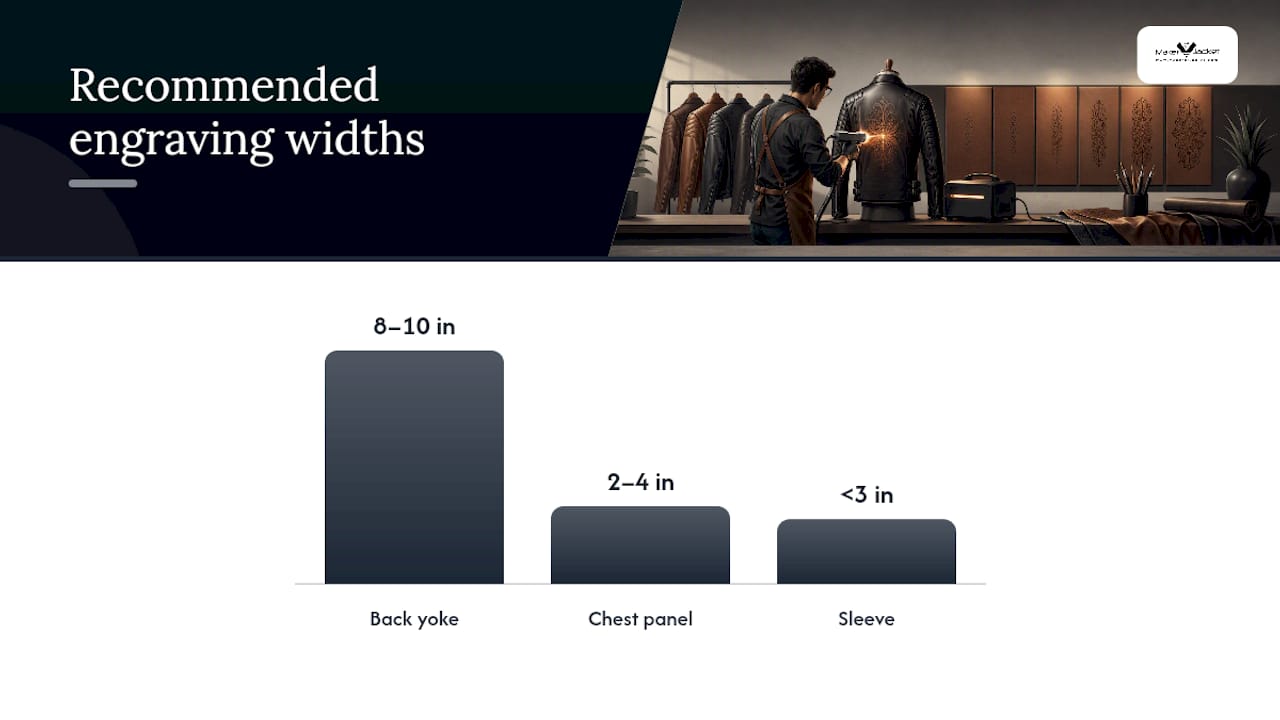
- Back yoke: the largest flat surface, good for bold logos or full artwork up to roughly 8 to 10 inches wide.
- Chest panel: better suited to smaller marks, initials, or a brand emblem in the 2 to 4 inch range.
- Sleeve: works well for serial numbers, small icons, or a signature line, generally under 3 inches.
Lighter hides show carbonization more dramatically than dark ones, so if your jacket is a deep brown or black, plan for a subtler visual effect and consider a larger design to compensate. Always request a proof photo on the actual leather before final approval. It’s the only way to see true contrast rather than guess at it from a screen.
How Much Does Laser Engraving on Leather Cost, and How Long Does It Take?
Pricing depends on a handful of variables, not a flat rate. Expect the total to reflect:
- A setup or test fee, since dialing in settings for your specific hide takes machine time.
- Engraving time itself, which scales with the size and density of your design.
- Design complexity, where fine detail and large coverage areas cost more than a simple logo.
- Shipping, especially if you’re sending a jacket in for engraving rather than ordering new.
Single jacket orders typically run higher per piece than small batch runs, since a supplier can dial in one setting and repeat it across multiple identical jackets. Any quote you see online should be treated as a starting point. Your actual supplier’s quote is the number that matters, because it accounts for your leather, your design, and their equipment.
Turnaround generally follows this sequence: test sample and approval, then production, then shipping, with rush options often available for an added fee. Building in time for the test and approval stage upfront saves you from a rushed, disappointing result later.
How Do You Care for a Freshly Engraved Leather Jacket?
The laser doesn’t just mark the surface. It carbonizes leather fibers, which can leave fine residue and slightly alters the texture right where the design sits. That’s why gentle cleaning right after engraving matters more than people assume, since wiping down the area removes loose char without disturbing the fresh mark.
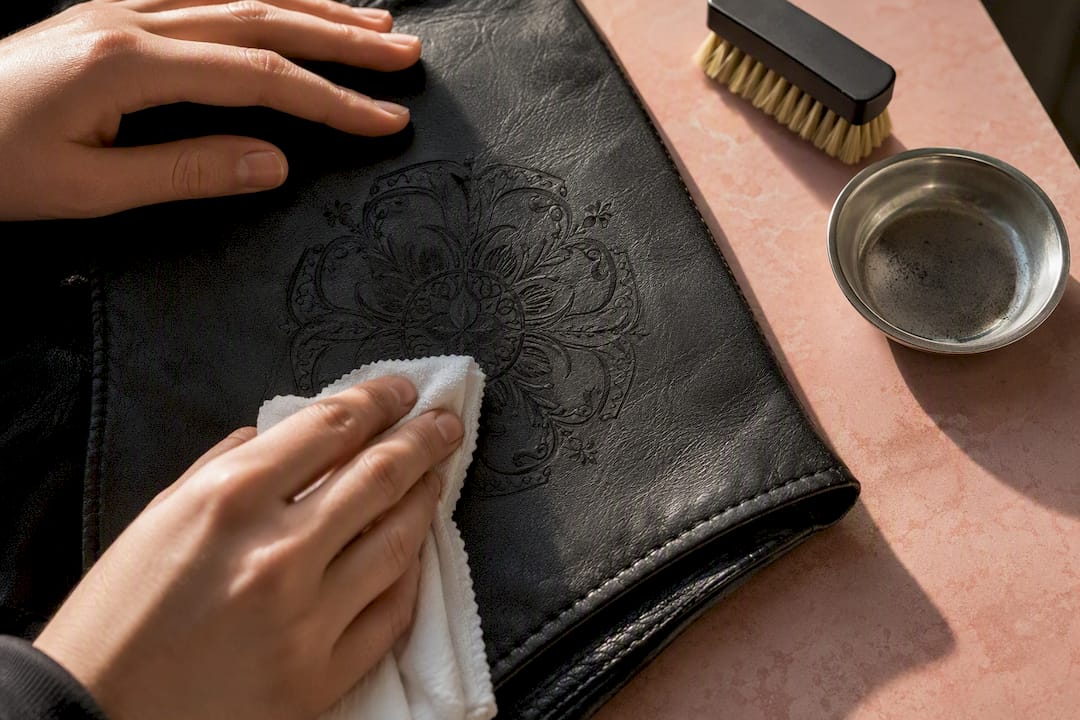
Hold off on conditioning for a few days, then test any product on an inconspicuous spot before treating the whole jacket. Some conditioners darken engraved areas differently than untouched leather.
A few habits worth building in:
- Skip abrasive rubbing near the design for at least a week or two after engraving.
- Store the jacket away from direct heat or sunlight while the area settles.
- Follow a full leather cleaning routine periodically rather than spot treating only the engraved section.
- Keep up with general leather maintenance so the surrounding leather ages evenly with the engraved area.
How Does Maker of Jacket Handle Laser Engraving Orders?
Some suppliers offer laser engraving on eligible jackets and build testing into the process rather than treating it as an upsell. You get a sample and a placement mockup before we touch your actual garment.
Ordering runs in a straightforward sequence: pick your jacket style, request the engraving option, upload your artwork, and review a test sample before we move to production. That approval step is where you confirm placement, size, and contrast look right on your specific leather, a process we walk through in detail on our customization journey. Once you sign off, we complete the order and ship.
If you’re outfitting a team or planning a themed batch of jackets, engraving scales better per piece than a single custom order, so it’s worth asking about run pricing when you reach out. And if you’re a retailer or business looking to build out a personalized jacket line at volume, financing options for scaling a retail operation exist for exactly that kind of growth.
Ready to see what your design looks like on real leather? Start your custom jacket order and request the engraving option during configuration. We’ll send a test sample before anything goes to full production, so you know exactly what you’re getting.
When Engraving Beats Embroidery, and When It Doesn’t
Engraving earns its keep on natural leather with a minimalist logo, a serial number, or a signature mark meant to last the life of the jacket. It’s permanent, subtle, and ages into the hide rather than sitting on top of it.
Where engraving falls short is multicolor branding or heavily textured artwork. A laser burns in one tone. If your design needs color separation or dense texture, embroidery or a patch will read better and hold up just as long. If you’re unsure which fits your design, a customization team can look at your artwork and advise on which method will work best.
— Maker
Sources
- How to laser engrave leather: settings, types, and what actually works | Bonny Creations
- How Do CO₂ Laser Marking Machines Enable Custom Logo Production in Leather Goods?


