

Choose a Jacket by Activity and These 4 Fit Measurements


The right way to choose a jacket is to start with what you’ll actually do in it and the weather you’ll face, then narrow by fit and materials. Decide first between insulation types (down for dry cold, synthetic for wet or high-output activity) and shell types (waterproof for storms, breathable water-resistant for everyday). Everything else, including brand and price, comes after those two calls. Customization options let you fine-tune fit and style once you’ve settled the function.
TL;DR:
- Down jackets offer superior warmth-to-weight ratio and packability but lose most insulation once soaked in water.
- Synthetic insulated jackets are more resilient in wet conditions and typically cost less, making them suitable for unpredictable weather.
- Proper fit depends on shoulder seam, sleeve length, chest ease, and overall length; measuring a favorite jacket helps ensure online accuracy.
- Waterproof jackets with taped seams are essential for rain-heavy activities like commuting and hiking, while breathability suits high-output sports.
- Jackets priced under $200 tend to be less durable and feature fewer technical details, while higher-priced options focus on quality, longevity, and repairability.
Table of Contents
- Major Jacket Types and Who They Suit
- Down vs Synthetic vs Hybrid: Which Insulation Wins?
- Getting the Fit Right: Measurements That Actually Matter
- What to Inspect in Materials and Construction
- Which Features Actually Matter for Your Activity?
- What Does Your Budget Actually Buy You?
- Your Step-by-Step Jacket Buying Checklist
- Why We Build Customization Around Fit First
- Build the Jacket That Actually Fits Your Life
- Sources
Major Jacket Types and Who They Suit
Every jacket style was built to solve a specific problem before it became a fashion statement, and knowing the original problem tells you a lot about who should actually wear it.
Puffer and down jackets exist for one reason: maximum warmth without maximum weight. They’re the go-to for cold, dry climates and for anyone who needs a coat that packs down small for travel or a gym bag. The tradeoff is that a soaked puffer loses much of its insulating power until it dries out.
Synthetic insulated jackets look similar to puffers but use polyester fill instead of down clusters. They cost less, shrug off drizzle, and keep working when damp. If you commute on foot or bike through unpredictable weather, this is often the smarter buy over down.
Shell and rain jackets carry no insulation at all. They’re a weather barrier, meant to be layered over a fleece or insulated mid layer. Anyone who hikes, runs, or spends real time outdoors in variable conditions needs one in the closet, insulated or not.
Parkas split the difference: long, heavily insulated, often with a fur or faux-fur trimmed hood, built for standing around in genuinely cold, wet conditions rather than moving through them. City dwellers who wait for buses in January love parkas for exactly that reason.
Bomber jackets are short, snug at the waist and cuffs, and built more for style than serious weather. They layer well over a hoodie or sweater and read as casual in almost any setting, from streetwear to a night out.
Denim and trucker jackets offer minimal insulation and even less waterproofing, but they’re the most versatile casual layer in most closets. Wear one alone in mild weather or as a mid layer under a shell when temperatures drop.
Field and utility jackets borrow from military and workwear design: multiple cargo pockets, a straight or slightly boxy cut, and a canvas or waxed-cotton shell. They handle light rain reasonably well and look right in both an office-casual setting and a weekend errand run.
Leather and moto jackets trade warmth for abrasion resistance and attitude. A quality leather biker jacket protects skin better than almost any textile in a slide, and it ages into a look no synthetic fabric replicates. It’s a poor choice for genuine cold or rain, though, unless it’s lined and treated.
Trench coats and blazer-style coats are the smart-casual and dressy end of the spectrum. Both work over suits or with jeans, and a good trench handles light rain thanks to its tightly woven cotton or poly-cotton shell.
A few jacket types can legitimately cover more than one job. A packable synthetic puffer works as travel outerwear and as a mid layer under a shell on a ski trip. A well-built technical shell paired with a swappable insulated liner does the work of two or three single-purpose jackets. If you only want to own one or two coats, build around that kind of modular pairing rather than a single jacket that tries to do everything at once.
- Puffer/down: best for dry, cold climates and packable travel
- Synthetic insulated: best for wet, cold, or budget-conscious buyers
- Shell/rain jacket: best for hiking, running, and layered systems
- Parka: best for standing in cold, wet weather (commuting, city winters)
- Bomber: best for casual style over other layers
- Denim/trucker: best for mild weather and mid-layer versatility
- Field/utility: best for smart-casual everyday wear with storage needs
- Leather/moto: best for style, abrasion resistance, and motorcycling
- Trench/blazer coat: best for dressier occasions and light rain
Down vs Synthetic vs Hybrid: Which Insulation Wins?
Down wins on warmth-to-weight and packability. Synthetic wins the moment things get wet. That single trade-off should drive most of your insulation decision.
Down offers the highest warmth-to-weight ratio and compresses smaller than synthetic fill of comparable warmth, which is why backpackers who count every ounce still default to down for dry, cold trips. But down clusters collapse when saturated, and a wet down jacket can feel like wearing a soggy pillow with almost none of its former insulating power.
Synthetic insulation, made of polyester fibers, keeps some loft even when damp and dries faster than down. It’s heavier and bulkier for the same warmth, but it’s the more forgiving choice for anyone who can’t guarantee dry conditions. High-output activities favor synthetic insulation and breathability, while dry, cold, pack-focused trips favor down.
Hybrid jackets put synthetic fill in moisture-prone zones (shoulders, cuffs, hood) and down in the core, chasing the best of both. They’re a reasonable middle ground if you refuse to choose but rarely outperform a jacket built purely for your specific conditions.
Pro Tip: Fill power measures warmth per ounce, not total warmth — a jacket with 800-fill down and thin baffles can be less warm overall than a 600-fill jacket stuffed with more total down. Check both fill power and fill weight before assuming a higher number means a warmer coat.
Hydrophobic down treatments try to close the gap by coating down clusters to resist moisture. They genuinely improve wet-weather performance, but that coating degrades with repeated washing, and restoring it means treating the jacket with a product like Nikwax Down Proof. Treat hydrophobic down as a helpful compromise, not a permanent fix.
Waterproofing terminology causes almost as much confusion as insulation type:
- Waterproof means a jacket has a membrane (think Gore-Tex or a proprietary equivalent) and taped seams that block water under sustained pressure, like driving rain.
- Water-resistant means the fabric weave and finish slow water absorption but won’t hold up in a downpour.
- Water-repellent usually refers to a DWR (durable water repellent) coating on the fabric surface, which causes water to bead and roll off until the coating wears down.
Here’s how that plays out in real decisions. Commuting on foot through rain calls for a waterproof shell with taped seams, full stop. Backpacking in mixed weather usually calls for a waterproof or highly water-resistant shell layered over synthetic insulation, since you can’t guarantee dry days. Skiing favors a waterproof, breathable shell (deep snow means constant contact with moisture) paired with a warm mid layer you can vent. Travel jackets can lean toward water-resistant and packable, since most trips involve more sidewalk drizzle than sustained storms.
Getting the Fit Right: Measurements That Actually Matter
A jacket that fits in the mirror can still fail in real life if the shoulders bind or the sleeves ride up the moment you reach for something.
Four measurements decide whether a jacket works:
- Shoulder seam: it should sit right at the edge of your shoulder bone, not out past it (too big) and not pulling toward your neck (too small). This is the hardest spot to alter after purchase, so get it right at the point of sale.
- Sleeve length: sleeves should end at your wrist bone, not covering your hand and not exposing several inches of shirt cuff.
- Chest ease: you need enough room to comfortably layer a sweater or fleece underneath without the jacket pulling across your back or restricting your arms.
- Overall length: this varies by type. A bomber or trucker should hit around the hip; a parka or trench typically falls mid-thigh to knee.
Once the measurements check out, test the jacket in motion. Raise both arms overhead. Sit down. Bend forward as if tying a shoe. If the jacket rides up uncomfortably at the waist, pulls tight across the shoulders, or restricts your neck when you look up, that’s a fit problem no tailor fixes easily, since shoulders are the single hardest part of a jacket to alter after the fact.
Buying online removes the fitting-room step, so replace it with a simpler one: measure a jacket you already own and love, then compare those numbers directly against the brand’s size chart rather than guessing from your usual shirt size. Account for what you’ll wear underneath, too. A shell meant to sit over a thick fleece needs more chest ease than a standalone leather jacket worn over a t-shirt. Maker of Jacket’s sizing guide for fashion and motorcycle fit walks through this comparison method in more detail, and the fit and comfort guide covers how sizing changes based on jacket type.
What to Inspect in Materials and Construction
Price alone doesn’t tell you whether a jacket is well built. Specific details do.
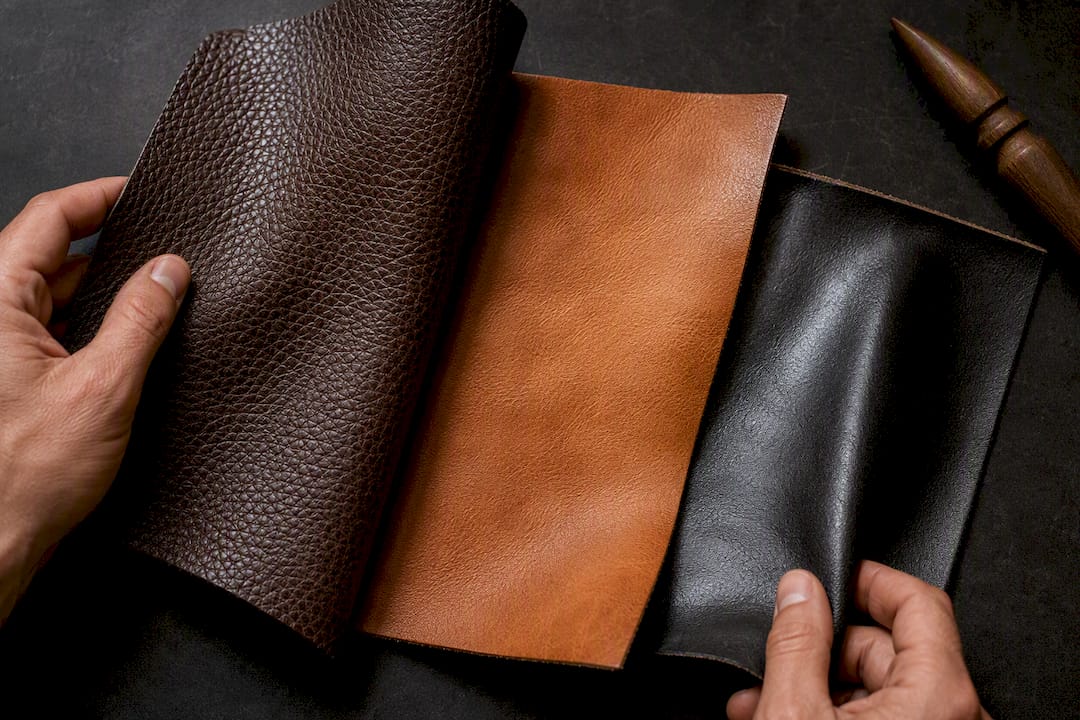
Leather grades matter more than most shoppers realize. Full-grain leather uses the entire hide, including natural texture and imperfections, and it’s the most durable option available. Top-grain leather has the surface sanded and refined, trading some durability for a more uniform look. Corrected-grain and bonded leather are lower tiers, often coated to hide the leather’s poor natural quality. Vegetable-tanned leather develops a rich patina over years of wear, while chrome-tanned leather stays softer and more uniform from day one, which is really a style preference more than a quality hierarchy.
Shell fabrics for technical jackets get rated by denier, a measure of fabric thread thickness that roughly tracks with abrasion resistance. Laminated membranes bonded to the fabric’s interior are what make a shell genuinely waterproof rather than just water-resistant, and a DWR coating on the outer face determines how well water beads and rolls off before it ever reaches that membrane.
Construction details separate a jacket that lasts a decade from one that falls apart in a season:
- Branded zippers like YKK or RiRi run smoother and survive years of daily use better than unbranded hardware.
- Double-stitching at stress points (underarms, pocket edges, cuffs) resists the seam failures that show up first on cheap jackets.
- Lining quality affects both comfort and durability; a rough or thin lining will wear through faster than a properly finished one.
- Panel count on a leather jacket affects both fit and cost. More panels generally mean better shaping but more labor and higher price.
Pro Tip: When shopping online, zoom into product photos of the zipper pull and stitching lines. Cheap zippers often show visible casting seams or dull, uneven plating, and rushed stitching shows irregular spacing you can spot even in a still image.
For a deeper walkthrough, Maker of Jacket’s guide on how to verify jacket quality covers stitching and hardware checks step by step, and the material selection guide breaks down fabric options beyond leather.
Which Features Actually Matter for Your Activity?
Not every jacket feature deserves your attention, and paying for ones you’ll never use is how budgets get wasted.
- Commuting: prioritize a waterproof or highly water-resistant shell, decent breathability if you’re walking or biking, and a hood that fits over a hat.
- Hiking and backpacking: pit zips for dumping heat on climbs, a helmet-compatible or oversized hood, and enough room underneath for a base and mid layer.
- Skiing: a powder skirt to block snow at the waist, a helmet-compatible hood, and venting you can open on the lift and close on the run.
- Motorcycling: abrasion resistance above almost everything else, whether that’s leather or an abrasion-rated textile, plus armor pockets at the shoulders and elbows.
- Everyday style: fit and silhouette matter more than technical features. A well-cut bomber or trench needs no pit zips.
The jacket’s role in your layering system also decides which features matter. As an outer shell over insulation, waterproofing and breathability come first. As a standalone mid layer or single jacket, warmth and fit take priority over weather sealing. And every feature involves a trade-off: more waterproofing usually means less breathability, and more insulation usually means more bulk and weight. Choose the two features that matter most for your primary use, and treat everything else as a bonus.
What Does Your Budget Actually Buy You?
Jacket pricing splits into rough tiers, and knowing what each one buys keeps you from overpaying or underbuying.
- Under $200: expect synthetic shells, lower-grade or corrected leather, and simpler construction with fewer stitching reinforcements. Fine for occasional wear or a first jacket in a style you’re still testing.
- $200 to $600: this is where full-grain or top-grain leather, name-brand zippers, and genuinely waterproof technical shells start showing up consistently. Mr.Wayne’s leather buying guide places durable full and top-grain leather squarely in this range, calling it the realistic value zone for a jacket meant to last years.
- $600 and up: premium vegetable-tanned leather, artisan construction, and technical fabrics from established outdoor brands live here. You’re paying for longevity and repairability as much as materials.
A jacket that can be repaired (a leather jacket with a resolable seam, a shell with replaceable zippers) holds its value longer than one built to be replaced. Spend up on leather and high-fill down if you’ll wear the jacket for years; save money on trend pieces you expect to retire in a season or two.
Your Step-by-Step Jacket Buying Checklist
Run through these steps in order, whether you’re shopping in a store or scrolling online.
- Define your primary use and climate. Commuting, hiking, motorcycling, or everyday style, plus the coldest and wettest conditions you’ll actually face.
- Choose the jacket type and insulation. Match down, synthetic, or a shell to what step one told you.
- Test fit and movement. Check shoulder seam, sleeve length, chest ease, and range of motion before anything else.
- Inspect materials and hardware. Leather grade, shell fabric, zipper brand, and stitching quality.
- Confirm features and pockets. Only the ones relevant to your activity, not every extra the jacket offers.
- Check the return policy and care requirements. Especially important for online orders and leather, which needs specific maintenance.
- Buy.
Pro Tip: Before buying online, pull up multiple product photos, not just the hero shot, and look specifically at how the jacket drapes on a model in motion rather than standing stiffly. A generous return window matters more than any marketing copy, since a jacket photograph can’t tell you how the shoulders will actually sit on your frame.
Measuring a jacket you already own and comparing it to the retailer’s size chart, as covered in the fit section above, remains the single most reliable trick for buying outerwear sight unseen. Maker of Jacket’s buying checklist and types of jacket fit guide both walk through this in more detail if you want a second reference before you order.
Why We Build Customization Around Fit First
Most jacket-buying advice treats style and function as competing priorities. They’re not. Starting every custom order with activity and climate is important, because a beautiful jacket that fights your body or your weather never gets worn twice. Customization exists specifically to resolve the fit and style trade-offs that off-the-rack sizing can’t. If a standard chest measurement runs too tight for your layering needs or a sleeve length sits wrong for your frame, that’s exactly the gap our size guides and made-to-order options are built to close.
— Maker
Build the Jacket That Actually Fits Your Life
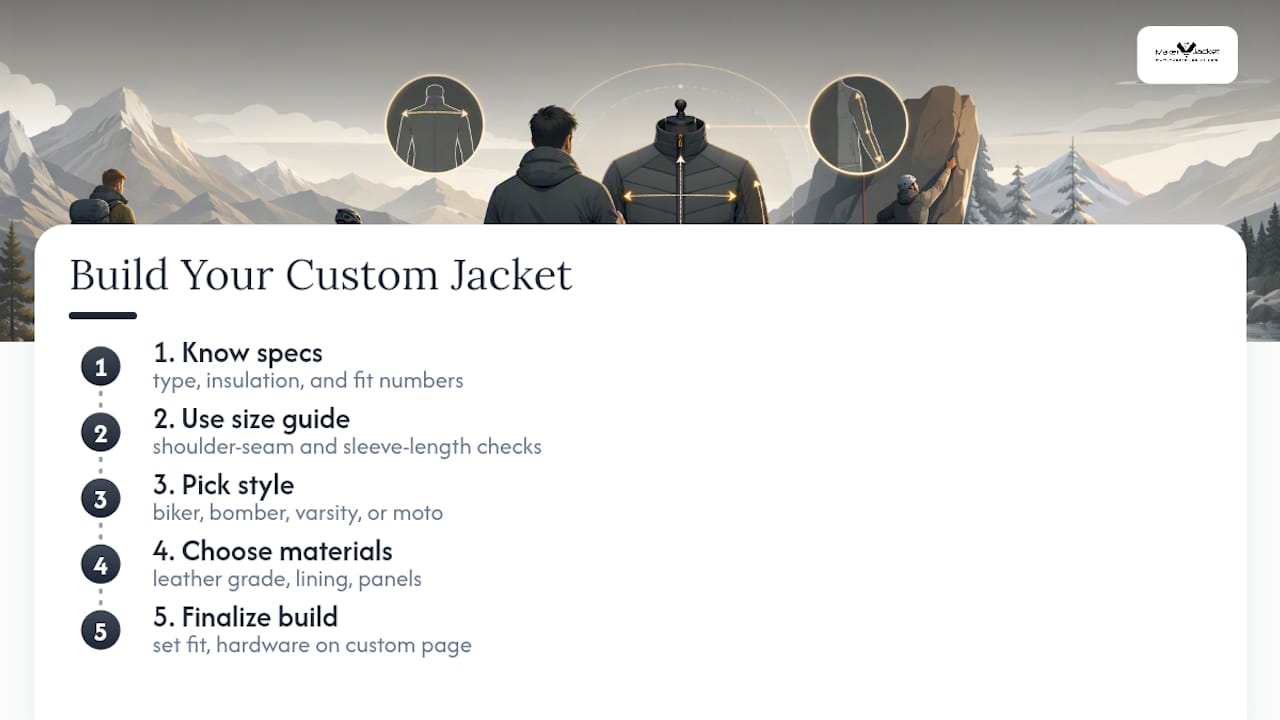
Once you know your jacket type, insulation, and fit numbers, You can build to exact specs instead of hoping a size medium works out. Customizable biker, bomber, varsity, and moto jackets in real leather grades are offered, with size guides built for the same shoulder-seam and sleeve-length checks covered above.
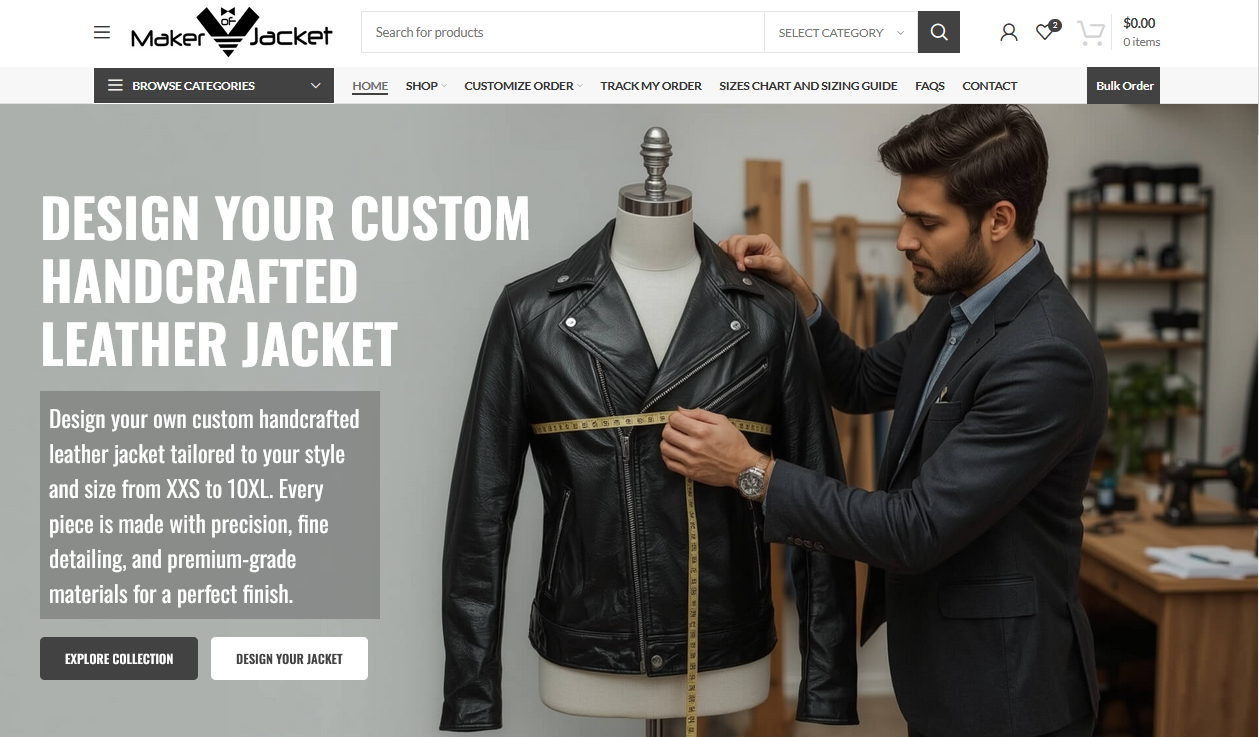
Browsing our range of jacket styles shows how much room there is to adjust cut, panel count, and lining once you’ve locked in the function you need. If leather is your focus, the leather grading breakdown and leather care guide cover the maintenance side so your investment holds up for years, not seasons. Riders should look at our motorcycle gear essentials for abrasion-rated options built specifically for the saddle.
Start your build on the custom jacket page, where you can set fit, leather grade, lining, and hardware before placing an order.
Sources
For more technical depth beyond this guide, REI’s breakdowns on down insulation and insulated jacket selection cover fill types in detail. Orvis’s leather jacket guide, Mr.Wayne’s leather buying checklist, and Kit Authority’s insulation comparison each dig deeper into the specifics touched on here.
- A Buyer’s Guide to Down Insulation – REI
- How to Buy a Leather Jacket That Will Outlive You – Mr.Wayne®
- Down vs synthetic insulation: which jacket wins? | Kit Authority


