

Why jackets have ventilation: comfort, safety, style


Jacket ventilation is one of those features most riders and fashion enthusiasts take for granted until they’re stuck in traffic on a hot afternoon, drenched in sweat, wondering why they didn’t pay more attention to airflow when they bought their gear. But ventilation isn’t just a summer convenience. It’s a carefully engineered system that affects how you perform, how safe you stay, and yes, how good you look. Whether you ride daily or wear jackets as a style statement, understanding how ventilation works will change how you shop and what you expect from your outerwear.
Table of Contents
- Understanding jacket ventilation: What it is and how it works
- Types of ventilation systems: Materials, designs, and innovations
- Performance and comfort: The real impact of ventilation
- Balancing ventilation with protection and style
- Choosing the right ventilated jacket for you: Key considerations
- The truth about jacket ventilation: What most don’t realize
- Ready for comfort, protection, and style? Discover your perfect jacket
- Frequently asked questions
Key Takeaways
| Point | Details |
|---|---|
| Ventilation boosts comfort | Airflow features prevent overheating and sweat, especially during active use or warm weather rides. |
| Multiple ventilation types | Designs include mesh panels, zippered vents, and perforated leather, each offering different benefits and trade-offs. |
| Balance style and safety | Choosing the right ventilation means considering both protection needs and personal fashion preferences. |
| Match to your lifestyle | Your ideal ventilated jacket depends on climate, activity, and whether you ride, commute, or prioritize aesthetics. |
Understanding jacket ventilation: What it is and how it works
At its core, jacket ventilation is any design feature that allows air to move through or around the jacket to regulate your body temperature. This includes zippered vents, mesh panels, perforated leather, and open-weave fabrics. Each method works differently, but the goal is the same: keep you cool, dry, and comfortable.
The most effective ventilation systems use what’s called the chimney effect. Cool air enters through chest or front vents and hot, moist air exits through back vents positioned higher on the jacket. Heat naturally rises, so this placement isn’t accidental. It’s physics working in your favor. The result is a continuous flow of air that pulls sweat away from your skin and keeps your core temperature stable.
Jackets incorporate ventilation primarily to regulate body temperature by promoting airflow, preventing overheating, and reducing sweat buildup during activity or in warm conditions. This matters whether you’re doing 70 mph on the highway or walking through a crowded city block.
Here’s a quick breakdown of where ventilation typically appears:
- Chest vents: Allow cool air to enter at speed
- Back vents: Exhaust hot air using the chimney effect
- Underarm vents: Reduce heat in high-sweat zones
- Sleeve vents: Improve circulation along the arms
- Mesh panels: Provide constant passive airflow without needing to be opened
Ventilation isn’t limited to motorcycle gear. Fashion jackets, activewear, and even bomber styles now incorporate subtle mesh linings or perforated panels. Understanding jacket insulation and warmth alongside ventilation helps you build a complete picture of how modern jackets manage your comfort across seasons.
Pro Tip: If you’re shopping for a ventilated jacket, check whether the vents are zippered or fixed. Zippered vents give you control. Fixed mesh panels offer constant airflow but no option to close up when temperatures drop.
Types of ventilation systems: Materials, designs, and innovations
Not all ventilation is created equal. The method a brand uses to move air through a jacket has a direct impact on how much airflow you get, how durable the jacket is, and how it performs in different weather conditions.
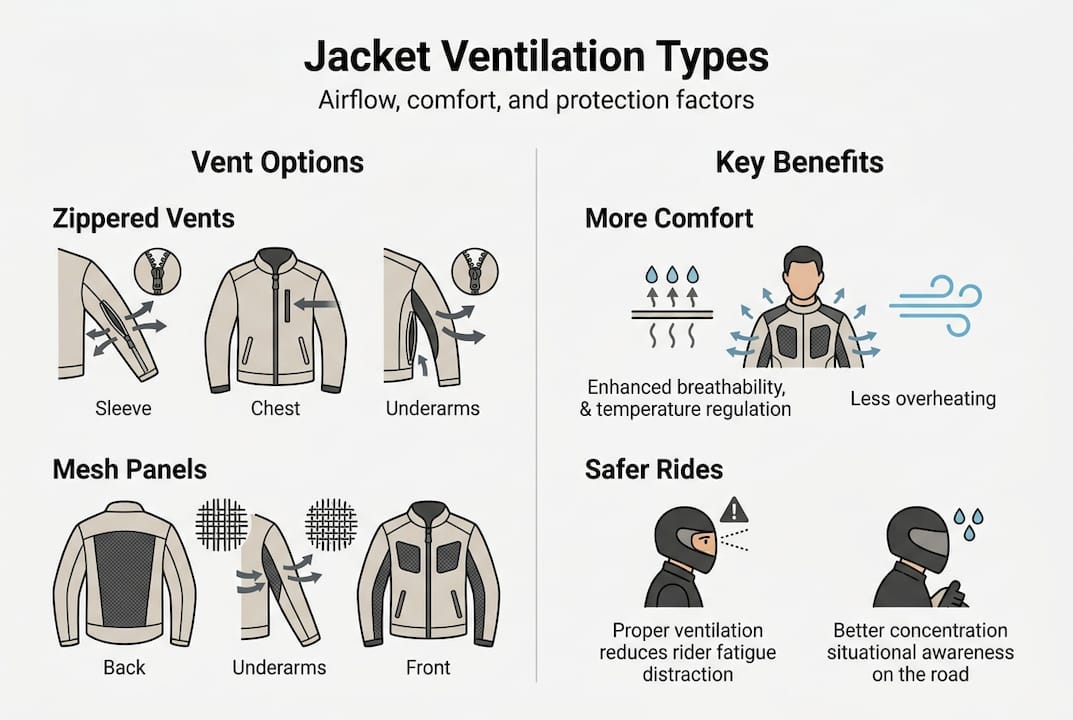
Motorcycle jackets use perforated panels, zippered vents, and mesh inserts in the chest, back, and sleeves to manage airflow while maintaining abrasion resistance. Each approach has real trade-offs worth understanding before you buy.
Brands like Vanson and REV’IT use patented systems such as AirCurtain and 3D mesh to optimize airflow without sacrificing structural integrity. These proprietary technologies represent years of engineering investment, and they genuinely outperform basic designs in controlled tests.
Here’s how the main ventilation types compare:
| Ventilation type | Airflow level | Durability | Best use case |
|---|---|---|---|
| Zippered vents | High (when open) | High | All-season riding |
| Mesh panels | Constant, moderate | Moderate | Warm weather, city riding |
| Perforated leather | Moderate | High | Style-focused riders |
| 3D mesh lining | High | Moderate | Long-distance touring |
| Solid leather | None | Very high | Cold weather, track days |
For a deeper look at how perforated leather vs mesh stack up in real-world conditions, the differences go beyond just airflow. Perforated leather keeps its shape and abrasion resistance better than mesh but delivers less raw breathability. Mesh wins on airflow but can feel less substantial and offers lower protection in a slide.
If you’re exploring your options, mesh motorcycle jacket benefits are worth reading before committing to a style. And if you’re still figuring out which jacket category fits your riding style, reviewing the types of motorcycle jackets available gives you a strong foundation.
Pro Tip: Avoid judging ventilation by the number of vents alone. A single well-placed back exhaust vent can outperform five poorly positioned ones. Placement matters more than quantity.
Performance and comfort: The real impact of ventilation
You might wonder whether ventilation actually makes a measurable difference or whether it’s mostly marketing. The data is clear.
Ventilation reduces thermal insulation significantly with wind and movement, with studies showing a 27 to 47% reduction in insulation at wind speeds above 0.4 m/s. That’s not a minor effect. At highway speeds, the difference between a vented and non-vented jacket can feel like the difference between comfortable and dangerously overheated.

For long rides, heat exhaustion is a real risk. Your body’s ability to cool itself depends on sweat evaporating from your skin. A jacket that traps heat and moisture blocks that process entirely. Ventilation keeps that cooling mechanism working even when you’re fully geared up.
Here’s how ventilation impacts your ride in practical terms:
- Temperature regulation: Prevents core temperature from spiking during sustained effort or high ambient heat
- Sweat management: Moves moisture away from your skin, reducing chafing and discomfort
- Focus and alertness: Overheating reduces mental clarity. Staying cool keeps you sharper on the road
- Endurance: Riders in ventilated gear report less fatigue on rides over two hours
Reviews note insane breathability in top-tier ventilated jackets, though thermal manikin tests confirm that the actual insulation impact varies based on fit and riding position. A jacket that fits loosely may channel air differently than one that fits close to the body.
It’s also worth noting that maximizing airflow sometimes means sacrificing waterproofing. Some jackets are built to breathe at the expense of keeping rain out. Understanding windbreaker ventilation trade-offs and reviewing motorcycle jacket safety features together helps you make a fully informed decision.
For detailed ventilation research data, the academic literature backs up what riders already know from experience: airflow is not optional for comfort on warm days.
Balancing ventilation with protection and style
More airflow sounds like a straightforward win, but there are real trade-offs to think through. Ventilation, protection, and style don’t always point in the same direction.
Vents adjustable via zip or closure allow for all-season use, but ventilation is less effective at low speeds and perforations reduce abrasion resistance slightly compared to solid leather. That last point matters a lot if you’re a rider who values both safety and breathability.
Here’s how to think through the balance:
- Solid leather: Maximum abrasion resistance, zero passive airflow. Best for track days or cold climates.
- Perforated leather: Good protection with moderate breathability. Strong choice for style-focused riders in warm climates.
- Mesh panels: High airflow, lower abrasion resistance. Best for city riding or touring in hot weather.
- Adjustable vents: Versatile across seasons. Ideal if you ride year-round in a variable climate.
Style plays a role too. Perforated leather looks sleek and intentional. Mesh panels can look technical or sporty depending on placement. Adjustable zippered vents add visual texture without compromising the jacket’s silhouette.
The key is matching your jacket to your actual conditions. A rider in Phoenix needs a different solution than someone commuting through Seattle in October. Getting jacket fit and comfort right is just as important as choosing the right ventilation system, because a poorly fitting jacket disrupts airflow regardless of how many vents it has.
For riders who layer in colder months, understanding layering for comfort and safety adds another dimension to how you use your ventilated jacket across the year.
Pro Tip: If you ride in a climate with big temperature swings, prioritize jackets with closable vents over fixed mesh. You’ll get the best of both worlds without needing two separate jackets.
Choosing the right ventilated jacket for you: Key considerations
Before you buy, slow down and ask yourself a few honest questions. The best ventilated jacket isn’t the one with the most features. It’s the one that fits your life.
Modern designs with high air permeability, such as cycling jackets rated at 0.7 CFM, prioritize breathability over full waterproofing. That trade-off is intentional and works well in dry, warm conditions. But it’s not the right call for every rider.
Here’s a practical checklist before you commit:
- What’s your primary climate? Hot and dry, hot and humid, or variable?
- How long are your typical rides or wear sessions? Short city commutes vs. all-day touring demand different solutions.
- Do you prioritize style, safety, or both equally? Be honest. It shapes everything.
- Do you layer in colder months? If yes, adjustable vents are non-negotiable.
- What’s your budget? Proprietary ventilation systems cost more but often deliver measurably better results.
- Do you need CE-rated armor compatibility? Some mesh jackets sacrifice armor pockets to reduce weight.
For riders moving between city streets and highways, a jacket with zippered chest vents and a mesh back panel gives you the most flexibility. Close the vents in traffic and open them up when you hit the open road.
For fashion-forward wearers who aren’t riding, perforated leather or subtle mesh lining gives you breathability without the technical aesthetic of a full motorcycle jacket. The result looks intentional and polished.
For a full breakdown of what to look for, the guide to choosing the perfect motorcycle jacket covers fit, materials, and features in detail.
The truth about jacket ventilation: What most don’t realize
Here’s something the industry rarely admits openly: more vents don’t automatically mean more comfort. Real airflow depends on fit, riding position, and the materials surrounding those vents. A jacket with eight vents that fits loosely may move less air efficiently than one with two well-placed vents in a close fit.
Designers face a constant tension between safety certifications and trend-forward silhouettes. A jacket built to pass CE Level 2 abrasion tests may need thicker panels that limit where vents can go. The result is a compromise that not every brand communicates honestly to buyers.
Brands invest heavily in proprietary ventilation systems, and those systems are genuinely impressive. But your actual experience on the road depends just as much on how you layer, what climate you’re riding in, and whether the jacket fits the way it was designed to fit. The gear is only part of the equation.
Experienced riders often say the same thing looking back: they wish they’d understood that leather jacket style tips and technical performance aren’t separate conversations. The best jacket is the one that works for your body, your climate, and your riding style at the same time. Chasing maximum airflow without considering those factors is how you end up with a jacket that looks great on a hanger and feels wrong on the road.
Ready for comfort, protection, and style? Discover your perfect jacket
Now that you know what to look for, finding the right ventilated jacket becomes a much more focused search. At Maker of Jacket, we offer a range of options built for riders and style-focused wearers who refuse to compromise on either comfort or quality.

If you want something built specifically for your body and climate, you can order a custom jacket tailored to your exact specifications. Prefer something ready to ship? Browse the vented leather motorcycle jacket collection for proven performance. And if breathability is your top priority, the full range of mesh motorcycle jacket options gives you high-airflow designs without sacrificing style. Worldwide free shipping means your next favorite jacket is closer than you think.
Frequently asked questions
Why do some jackets have vents while others don’t?
Jackets incorporate ventilation to regulate body temperature for active use or warm climates, while solid jackets are designed to prioritize insulation and wind resistance for colder conditions.
Does ventilation affect a jacket’s protective qualities?
Properly designed ventilation maintains most protective qualities, but perforations reduce abrasion resistance slightly compared to solid leather, so the trade-off is real but manageable with the right design.
Are ventilated jackets suitable for winter riding or cold weather?
Many ventilated jackets are built with adjustable zip vents that close completely, making them adaptable for colder conditions when paired with appropriate base layers.
What is the chimney effect in jacket ventilation?
The chimney effect describes how cool air enters through chest or front vents and hot air exits through back vents positioned higher on the jacket, continuously moving heat and moisture away from your body.


