

Unlock the perfect fit: understanding jacket size guides


TL;DR:
- Proper fit is essential for safety, comfort, and cost savings in premium and motorcycle jackets.
- Accurate measurement of chest, waist, sleeve, and back length is crucial for selecting the right size.
- Custom and tailored options ensure optimal fit, especially for unique body shapes and layering needs.
Buying a premium leather jacket or a motorcycle jacket is a serious investment, and nothing stings more than unboxing something you waited weeks for only to find the sleeves are too short or the chest pulls at the seams. Even experienced shoppers who know their usual size get burned by this. The truth is, jacket sizing is genuinely different from regular apparel sizing, and most size guides only tell half the story. This guide will walk you through everything you need to know about reading jacket size guides accurately, understanding fit nuances specific to leather and motorcycle gear, and making confident sizing decisions whether you’re buying off-the-rack or going fully custom.
Table of Contents
- Why jacket size guides matter for premium and motorcycle jackets
- Decoding jacket size guides: Charts, measurements, and what they really mean
- The nuances of fit: Accounting for style, layering, and leather characteristics
- Solving sizing dilemmas: Custom options, alterations, and troubleshooting fit
- The overlooked truth: Why sizing is more personal than ‘by the numbers’
- Get your custom-fit adventure started
- Frequently asked questions
Key Takeaways
| Point | Details |
|---|---|
| Key measurements matter | Focus on chest, waist, sleeve, and back length for the best results. |
| Size guides aren’t universal | Every brand uses different charts—always double-check before you buy. |
| Layering changes sizing | Choose your size based on intended use, especially if layering or adding armor. |
| Custom options solve fit gaps | When standard sizing fails, explore custom orders or alterations for your ideal fit. |
Why jacket size guides matter for premium and motorcycle jackets
When you’re buying a basic cotton hoodie, a slightly off fit is annoying but manageable. When you’re buying a premium leather jacket or a motorcycle suit, an inaccurate size can cost you real money and, in the case of riding gear, real safety. Proper fit is crucial for both comfort and safety in motorcycle apparel, and that’s not just marketing language. It’s a functional reality.
Here’s why sizing goes wrong so often in this category:
- Armor positioning depends on fit. In motorcycle jackets, CE-rated armor sits at specific points on your shoulders, elbows, and back. If the jacket is too large, that armor shifts away from the impact zones it’s designed to protect.
- Leather doesn’t forgive like fabric does. A cotton jacket that’s slightly snug will stretch and soften. A leather jacket that’s too tight across the shoulders will remain uncomfortable and may even crack at stress points over time.
- Sleeve length affects control. On a bike, sleeves that are too short ride up and expose your wrists. Too long and they bunch inside gloves, reducing grip feel.
- Custom jackets still require accurate input. Even when you’re ordering a bespoke piece, giving wrong measurements produces wrong results.
Decoding jacket size guides: Charts, measurements, and what they really mean
Size guides come in several formats and knowing which type you’re looking at changes how you use it. The main systems you’ll encounter are US letter sizing (S, M, L, XL), US numeric sizing (38, 40, 42, chest in inches), European numeric sizing (48, 50, 52), and brand-specific fit charts that list exact measurements in inches or centimeters.
As noted by jacket fitting experts, different brands use different sizing systems or measurement points, which means your size in one brand’s catalog is not automatically your size in another’s. A size Large in one brand may correspond to a size XL in another.
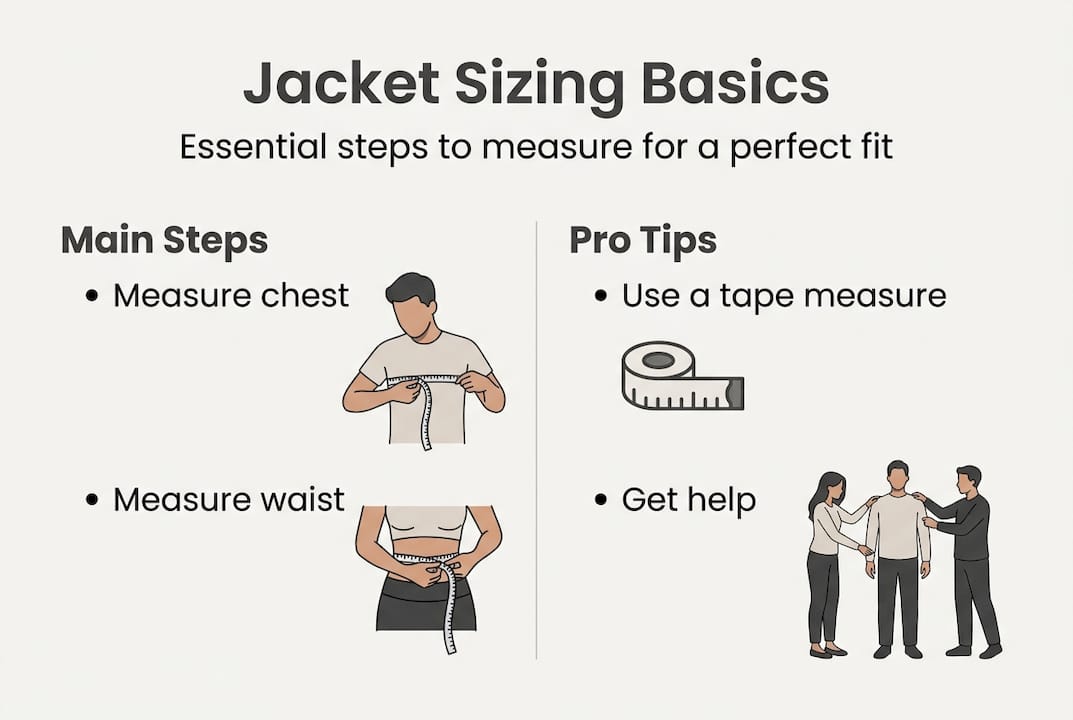
The four measurements you absolutely need before consulting any chart:
- Chest circumference. Measure around the fullest part of your chest, keeping the tape parallel to the floor and snug but not tight.
- Waist circumference. Measure around your natural waist, roughly one inch above your navel.
- Sleeve length. Measure from the center back of your neck, across your shoulder, and down to your wrist with your arm slightly bent.
- Back length. Measure from the top of your collar bone at the back down to where you want the jacket to end.
Here’s a general size comparison to give you a starting point:
| Size | Chest (inches) | Waist (inches) | Sleeve (inches) |
|---|---|---|---|
| S | 36-38 | 30-32 | 32-33 |
| M | 38-40 | 32-34 | 33-34 |
| L | 40-42 | 34-36 | 34-35 |
| XL | 42-44 | 36-38 | 35-36 |
| XXL | 44-46 | 38-40 | 36-37 |
For precise measuring jacket size results, always use a soft fabric tape measure and have someone help you. Self-measuring tends to produce slightly inaccurate numbers because it’s hard to keep the tape level on your own back.
Pro Tip: Always compare your actual body measurements to the brand’s chart, not your usual size label. The label on your current jacket reflects that brand’s sizing, not your body. Your body measurements are the only universal reference point.
If your numbers fall between two sizes on the jacket size chart guide, the general rule is to size up, then consider minor alterations if needed. Sizing down when you’re between sizes almost always leads to a jacket that’s too restrictive across the chest and shoulders.
The nuances of fit: Accounting for style, layering, and leather characteristics
Now that you can read a chart, here’s where most buyers still get tripped up. Size guides tell you what fits your body. They don’t always tell you what fits your body in a specific jacket style, wearing your usual layers, doing the activities you actually do.

Jacket style has a massive effect on how a given size feels. Jacket style and leather type significantly impact fit and size choice. A slim-cut moto jacket and a relaxed bomber jacket in the same labeled size will feel completely different on the same body. Moto jackets are typically cut closer to the body with angled seams designed for a forward-leaning riding posture. Bombers are cut with more room through the body and shorter at the waist.
Key fit variables that size charts often skip:
- Leather stiffness. Full-grain leather is stiffer than lambskin and will not soften quickly. A jacket that feels barely snug at purchase may take months to break in to a comfortable fit.
- Lining thickness. A quilted or insulated lining adds bulk inside the jacket and reduces effective interior space by roughly half a size.
- Cut type. Slim, regular, and relaxed cuts can vary by two or more inches in chest room even within the same labeled size.
- Shoulder seam placement. This is the hardest thing to alter later. The shoulder seam should sit exactly at the edge of your shoulder, not drooping down your arm or riding up toward your neck.
“A snug fit is safer on a bike, but too tight restricts movement and defeats the purpose of the armor inside.”
For layering, a useful rule of thumb is to add one inch of chest measurement for every significant layer you plan to wear underneath. A thin base layer adds almost nothing. A midweight fleece adds roughly one inch. A thick thermal or a hoodie can add two inches or more. Use the fitting workflow to map your layering needs before committing to a size.
Pro Tip: Before ordering, try on a similar jacket at a local store while wearing the same layers you plan to ride or wear in. Note how the fit feels and compare those measurements to the brand’s chart. This real-world calibration is worth more than any online calculator.
Solving sizing dilemmas: Custom options, alterations, and troubleshooting fit
Even after careful measuring and chart-reading, sometimes the jacket still doesn’t fit right. Here’s a structured approach to fixing it.
Troubleshooting checklist when the fit is off:
- Re-measure yourself. Measurement errors are more common than you’d think, especially for sleeve length and back length.
- Compare your measurements to the brand’s chart again, not to the size label on the jacket you received.
- Lay the jacket flat and measure it directly. Sometimes the issue is a manufacturing variance, not a sizing error.
- Contact the vendor’s support team with your measurements and the jacket’s actual dimensions. A good vendor will help you identify whether it’s a sizing issue or a style preference issue.
- Decide whether the problem is fixable with alterations or requires an exchange.
Here’s a practical overview of common alteration options:
| Alteration | Difficulty | Approximate cost | Time |
|---|---|---|---|
| Sleeve hem shortening | Low | $20-40 | 1-3 days |
| Waist taking in | Medium | $40-70 | 3-5 days |
| Side seam adjustment | Medium | $50-80 | 3-5 days |
| Shoulder recut | High | $100-150+ | 1-2 weeks |
Minor alterations like sleeve hems and waist adjustments are straightforward and affordable. Shoulder recutting is expensive and not always possible without compromising the jacket’s structure. This is why getting shoulder fit right at purchase is so critical.
When standard sizing consistently fails you, custom orders are the real solution. Custom orders and thorough measurement reviews reduce fit issues on high-end jackets significantly. The custom ordering process involves submitting your exact measurements, specifying your preferred fit style, and working with the maker to produce a jacket built around your body rather than a generic template.
When communicating your sizing needs to a vendor, be specific. Don’t say “I have broad shoulders.” Say “My shoulder width is 18.5 inches and I need the seam to sit at the edge, not drop toward my arm.” Numbers communicate; descriptions leave too much room for interpretation.
The overlooked truth: Why sizing is more personal than ‘by the numbers’
After fitting thousands of customers, one pattern stands out clearly: two people with identical chest and sleeve measurements often need completely different jackets. The numbers are the same. The fit experience is not.
Posture plays a huge role. Someone who carries their shoulders forward will find a jacket that fits perfectly in a standing position feels tight across the upper back when they’re seated on a bike. Shoulder shape matters too. Sloped shoulders versus square shoulders change how the collar sits and how the jacket hangs, even when all the measurements match.
Personal preference is the other factor that charts can’t capture. Some riders want a jacket that feels like a second skin. Others want room to move freely. Neither preference is wrong, but they point to different sizes on the same chart.
Our advice: treat your measurements as the starting point, not the final answer. Tailoring the fit to your specific posture, shoulder shape, and comfort preference is what separates a jacket you wear every day from one that stays in the closet. Trust your body’s feedback as much as the tape measure.
Get your custom-fit adventure started
Now that you understand how to read size guides, account for layering, and troubleshoot fit, the next step is finding a jacket that’s actually built for you.
At Maker of Jacket, we specialize in exactly this. Whether you need help interpreting measurements, want to customize jackets for unique fit, or are ready to order your perfect custom jacket from scratch, our team and tools are set up to make the process straightforward. Explore the full customizing jacket process to see how we turn your measurements and style preferences into a jacket that fits the way premium leather should.
Frequently asked questions
What are the most important measurements for jacket sizing?
Chest, waist, and sleeve length are the most critical, along with back length, to ensure the jacket sits correctly from shoulder to hem.
How do I know if I should size up for layering?
If you plan to wear thick layers or protective gear under your jacket, layering needs often require sizing up by at least one full size based on the brand’s chart.
What should I do if my measurements fall between two sizes?
It’s best to size up if between sizes and then make minor alterations for a precise, comfortable result.
Are jacket size guides the same for all brands?
No. Sizing systems can differ between brands, so always consult each brand’s specific chart rather than relying on your usual size label.
Can I order a truly custom size if nothing off-the-rack fits?
Yes. Custom orders address unique fit issues by building the jacket around your exact measurements rather than a standard template.


